
Paired T-Distribution, Paired T-Test, Paired Comparison Test, Paired Sample Test

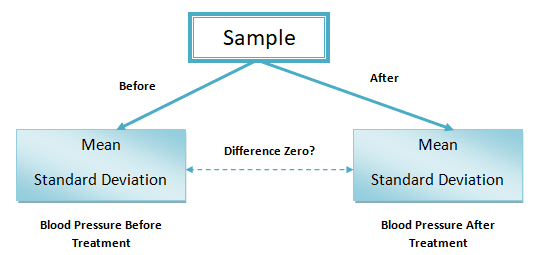
A Paired T-Distribution and Paired T-Test (Paired T-Distribution, Paired T-Test, Paired Comparison Test, Paired Sample Test) are statistical methods that compare the mean and standard deviation of two matched groups to determine if there is a significant difference between the two groups. In other words, they test whether or not the average difference between the two measurements is statistically significant from zero.

Student’s T-Distribution is used to find confidence intervals for the population mean when the sample size is less than 30 and the population standard deviation is unknown.  Further, the Student’s T-Test is divided into paired and unpaired T-Tests.

Also, See Student’s T-Test: for when samples are <30 in size.

When the sample groups are not independent, the appropriate method to test for differences between the groups is known as a paired comparison test (or paired T-test or paired sample test).

Furthermore, use the Paired T-Distribution and Paired T-Test to identify if a change has significantly impacted a process. The Paired T-test is similar to a 1-sample T-test. A 1-sample T-Test compares one sample mean. At the same time, a paired T-Test calculates the difference between paired values and then performs a 1-sample T-Test on the differences.

When to use Paired T-tests and Paired T-distributions

The Paired T-distributions, Paired T-tests, Paired Comparison Tests, and Paired Sample Tests are parametric procedures. Paired Samples T-tests are used when the same group is tested twice. It is often used in “before and after” designs where the same individuals are measured before and after a treatment or improvement to see if changes occurred over time.
Paired T Distribution, Paired T Test, Paired Comparison test, Paired

Paired T-Distribution and Paired T-Test Assumptions

  • Two repeated or matched samples, in other words, must have a before and after design or matched pairs.
  • Paired samples T-tests can have only two groups. Use ANOVA for more than two measures.
  • The non-negotiable assumption for the paired samples is dependent variable must be quantitative.
  • The paired T-Test assumes no extreme outliers.
  • The dependent variable’s sampling distribution should be normally distributed. If the data is non-normal, use the Wilcoxon test.
  • A dependent variable is a continuous variable measured at an interval or ratio.
  • Unlike the independent samples T-Test, there is no assumption for homogeneity of variance with a paired sample T-Test.

What is the Hypothesis of the Paired T-test?

  • The Null Hypothesis for a paired T-test is that the average difference between the two population means is zero (0). In other words, there is no significant difference between the two population means.
  • The Alternative Hypothesis for a paired T-Test: there is a significant difference between the two population means.

How to conduct a Paired T-test

  • Establish the Null Hypothesis and Alternative Hypothesis
  • Determine the significance level
  • Calculate the difference between each observation in the two groups
  • Then, compute the mean difference (x̅ – µ)
  • Calculate the standard deviation of differences (s) and then calculate the standard error, i.e., s/√n (where n is the sample size)
  • Compute the T-Statistic, t= (x̅ – µ)/ s/√n
  • Determine t critical value with n-1 degrees of freedom
  • Finally, interpret the result. If the test statistic falls in the critical region, reject the null hypothesis.

Hypothesis Testing

A Tailed Hypothesis is an assumption about a population parameter. The assumption may or may not be accurate. One-tailed Hypothesis is a test of a hypothesis where the area of rejection is only in one direction. Two-tailed tests measure against the alternative that there is a significant difference between the two population means. The selection of one or Two-tailed tests depends upon the problem.

Example of Two-tailed Paired T-test

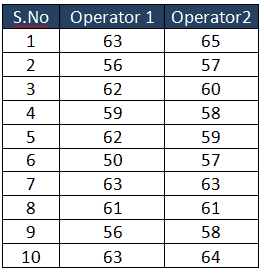
Example: Two operators check the same dimension on the same sample of 10 parts. Below are the results. Is there a significant operator measurement error? Test at the 5% significance level.
Solution Details:
We need to calculate the T-Statistic value using t= (x̅ – µ)/ s/√n and then compare it to a table value t critical.

  • H0 =There is no significant measurement error between the two operators.
  • H1 =There is a significant measurement error between the two operators.
  • n=10
  • DF (degrees of freedom) = n-1 ; 10-1 =9
  • Significance level =5%
Calculate the difference between each observation in the two groups
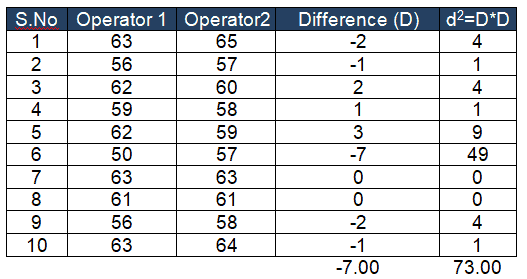
Compute the mean difference (x̅ – µ)
  • µ (mean of first test) = 59.5 ; take the average of the 10 data points in Op1
  • x̅ (mean of new test) = 60.2 ; take the average of the 10 data points in Op2
  • x̅-µ = 60.2 – 59.5 =0.7
Calculate the Standard Deviation of differences (s)
  • D = -7 ; d2 = 73. The Difference column in the table is Operator 1 minus Operator 2, the reverse of x̅ – µ above, so its sum is -7 while x̅ – µ = +0.7. Either order gives the same s, because the formula squares D; just keep one order when you take the sign of t.
  • Use sd = sqrt [ (Σ(di – d)2 / (n – 1) ] where di is the difference for pair i, d is the sample mean of the differences, or s=( √ ((n*d2)-D2)/df) / √(n)
  • s = (√ ((10*73) -(-7*-7)/9) / √(10) = 2.7508
Calculate the standard error

Standard error = s/√n = 2.7508 / √10 = 0.869

Compute the T-Statistic

t= (x̅ – µ)/ s/√n = (0.7) / 0.869 = 0.805

Determine t critical value with n-1 degrees of freedom

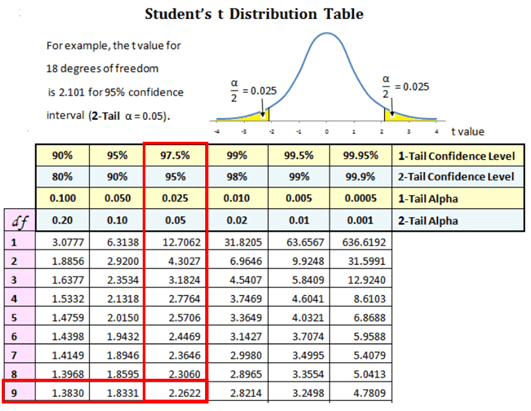
Since this is a Two-tailed test at an alpha of 5% t critical = 2.262
Paired T Distribution, Paired T Test, Paired Comparison test, Paired
Interpret the results

Compare t statistic to t critical 0.805 < 2.262.  In Hypothesis Testing, a critical value is a point on the test distribution compared to the test statistic to determine whether to reject the Null Hypothesis. The t calculated is not in the rejection region. Hence, we fail to reject the Null Hypothesis and say there is no difference between the two mean values.

Paired T 2 Tailed Template

Unlock Additional Members-only Content!

To unlock additional content, please upgrade now to a full membership.
Upgrade to a Full Membership
If you are a member, you can log in here.

Example of One-tailed (Right) Paired t-test

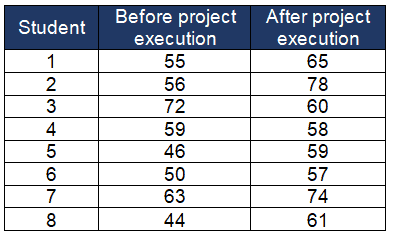
Example: An artificial Intelligence (AI) training institute evaluates the effectiveness of training by comparing the knowledge of the students before and after the execution of live projects. At a 95% confidence level, does this information provide sufficient evidence to indicate that the live projects will improve the students’ AI knowledge?
Paired T Distribution, Paired T Test, Paired Comparison test, Paired

Solution Details:
We need to calculate the T-Statistic value using t = (x̅ – µ)/ s/√n and then compare it to a table value t critical.

  • H0 = There is no significant change in AI knowledge before and after the execution of live projects.
  • H1 = There is a significant improvement in AI knowledge before and after the execution of live projects.
  • n=8
  • DF (degrees of freedom) = n-1 ; 8-1 =7
  • Significance level =5%
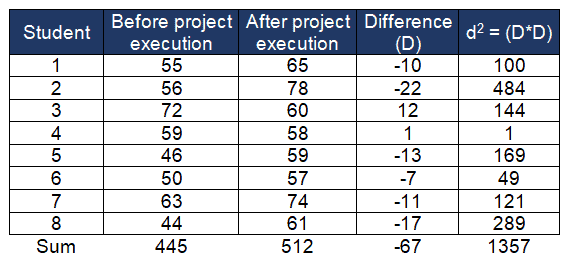
Calculate the difference between each observation in the two groups
Paired T Distribution, Paired T Test, Paired Comparison test, Paired

Compute the mean difference (x̅ – µ)

  • µ (mean of the first test) = 55.625; take the average of the 8 data points before the project execution
  • x̅ (mean of the new test) = 64; take the average of the 8 data points after the project execution
  • x̅-µ = 64 – 55.625 =8.375
Calculate the standard deviation of differences (s)
  • D = -67 ; d2 = 1357. The Difference column in the table is Before minus After, the reverse of x̅ – µ above, so its sum is -67 while x̅ – µ = +8.375. Either order gives the same s, because the formula squares D; just keep one order when you take the sign of t.
  • Use sd = sqrt [ (Σ(di – d)2 / (n – 1) ] where di is the difference for pair i, d is the sample mean of the differences, or s=( √ ((n*d2)-D2)/df) / √(n)
  • s=(√ ((8 * 1357) -(-67 * -67) / 7) / √(8) = 10.66

Calculate the standard error

Standard error = s/√n =10.66 / √8 = 3.769

Compute the T-Statistic

t = (x̅ – µ)/ s/√n = (8.375) / 3.769 = 2.221

Determine t critical value with n-1 degrees of freedom

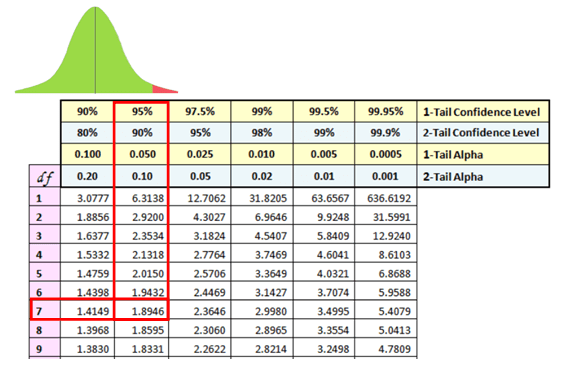
Since this is a One-tailed (right-tailed) test at an alpha of 5% t critical = 1.8946
Paired T Distribution, Paired T Test, Paired Comparison test, Paired

Interpret the results

Compare t statistic to t critical 2.221 > 1.8946.  In Hypothesis Testing, a critical value is a point on the test distribution compared to the test statistic to determine whether to reject the null hypothesis. The t calculated is greater than the critical value and is in the rejection region. Hence, we can reject the Null Hypothesis and say that there is a significant improvement in knowledge before and after the execution of live projects.

Paired T Right-Tailed Excel Template

Unlock Additional Members-only Content!

To unlock additional content, please upgrade now to a full membership.
Upgrade to a Full Membership
If you are a member, you can log in here.

Example of One-tailed (Left) Paired t-test

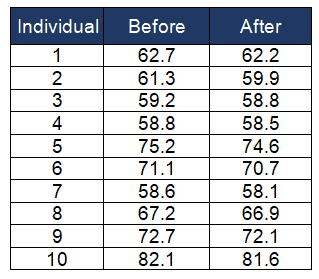
Example: A dietician evaluates the individual’s weight before and after following the diet plan. At a 95% confidence level, is there any significant evidence of the individuals’ weight reduction?
Solution Details:
We need to calculate the T-Statistic value using t= (x̅ – µ)/ s/√n and then compare it to a table value t critical.

  • H0 = There is no significant change in weight before and after following the diet plan
  • H1 = There is a significant reduction in weight before and after following the diet plan
  • n=10
  • DF (degrees of freedom) = n-1 ; 10-1 =9
  • Significance level =5%
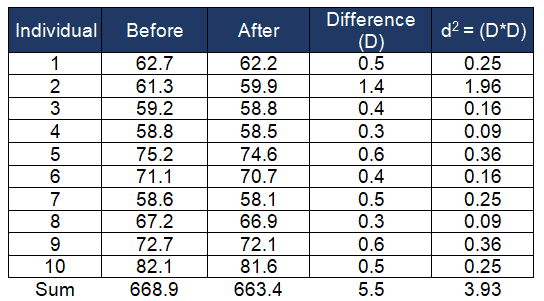
Calculate the difference between each observation in the two groups
Compute the mean difference (x̅ – µ)

  • µ (mean of the first test) = 66.89; take the average of the 10 data points before the diet plan
  • x̅ (mean of the new test) = 66.34; take the average of the 10 data points after the diet plan
  • x̅-µ = 66.34 – 66.89= -0.55

Calculate the standard deviation of differences (s)

  • D = 5.5 ; d2 = 3.93. The Difference column in the table is Before minus After, the reverse of x̅ – µ above, so its sum is +5.5 while x̅ – µ = -0.55. Either order gives the same s, because the formula squares D; just keep one order when you take the sign of t.
  • Use sd = sqrt [ (Σ(di – d)2 / (n – 1) ] where di is the difference for pair i, d is the sample mean of the differences, or s=( √ ((n*d2)-D2)/df) / √(n)
  • s=(√ ((10*3.93) -(5.5 * 5.5) / 9) / √(10) = 0.3171

Calculate the standard error

Standard error = s/√n = 0.3171 / √10 = 0.1003

Compute the T-Statistic

t= (x̅ – µ)/ s/√n = (-0.55) / 0.1003 = -5.48

Determine t critical value with n-1 degrees of freedom

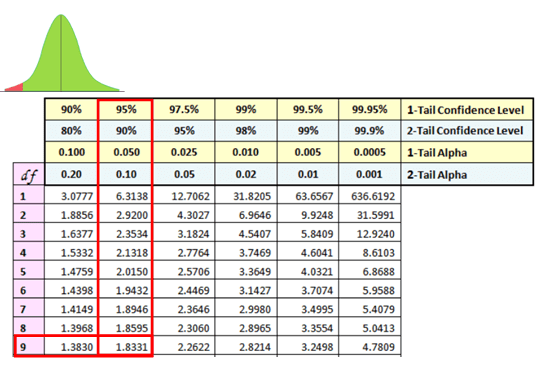
Since this is a One-tailed (left-tailed) test at an alpha of 5% t critical = -1.833
Interpret the results

Compare t statistic to t critical  -5.48 < -1.833. In Hypothesis Testing, a critical value is a point on the test distribution compared to the test statistic to determine whether to reject the Null Hypothesis. The t calculated is less than the critical value and is in the rejection region. Hence, we can reject the Null Hypothesis and say there is a significant reduction in individual weights before and after the diet plan.

Paired T Left Tailed Excel Template

Unlock Additional Members-only Content!

To unlock additional content, please upgrade now to a full membership.
Upgrade to a Full Membership
If you are a member, you can log in here.

Important Paired T-Distribution and Paired T-Test Videos

Also, See

ASQ Six Sigma Black Belt Exam Paired Distribution and Paired T-Test Questions

A black belt plans to test the performance of workers before and after training. Which of the following hypothesis tests should be used to determine whether the training actually improved the workers’ performance?

(A) 2-sample z test
(B) 2-sample t-test
(C) Paired t-test
(D) F test

Unlock Additional Members-only Content!

To unlock additional content, please upgrade now to a full membership.
Upgrade to a Full Membership
If you are a member, you can log in here.

When you’re ready, there are a few ways I can help:

First, join 12,000+ other Six Sigma professionals by subscribing to my email newsletter. A short read every Monday to start your work week off correctly. Always free.

* * *

If you’re looking to pass your Six Sigma Green Belt or Black Belt exams, I’d recommend starting with my affordable study guide:

1)→ 🟢Pass Your Six Sigma Green Belt: a study guide organized by the exam Body of Knowledge, 1,000+ practice questions with detailed answer explanations, and 8 full-length mock exams

2)→ ⚫Pass Your Six Sigma Black Belt: the full Black Belt Body of Knowledge, 2,000+ practice questions with detailed answer explanations, and 8 full-length mock exams

You’ve spent so much effort learning Lean Six Sigma. Why leave passing your certification exam up to chance? This comprehensive study guide offers 1,000+ exam-like questions for Green Belts (2,000+ for Black Belts) with full answer walkthroughs, access to instructors, detailed study material, and more.

​ Thousands have used this system to prepare. Join them here. 
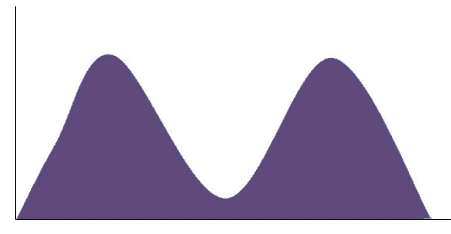
Bimodal Distribution

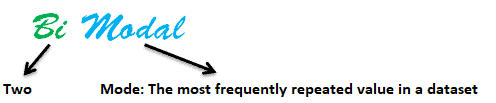
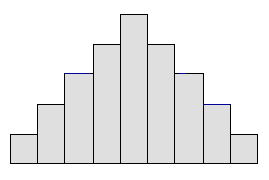
A bimodal distribution has two modes. In other words, the outcome of two processes with different distributions are shown together in one set of data. It is also known as double-peaked distribution. For example, data distribution of two production shift data in a manufacturing plant.

Bimodal Distribution

The Normal Distribution is an extremely important continuous probability distribution. It is symmetric about the mean, and the histogram fits a bell curve that has only one peak. In contrast, the bimodal distribution will have two peaks. Values in bimodal distributions cluster at each peak, which will increase first and then decrease. In other words, the two peaks in this distribution represent the two local maximums.

Types of modes

Data distribution is a function that prints all possible values for a variable and counts the relative frequency (probability of how often they occur).

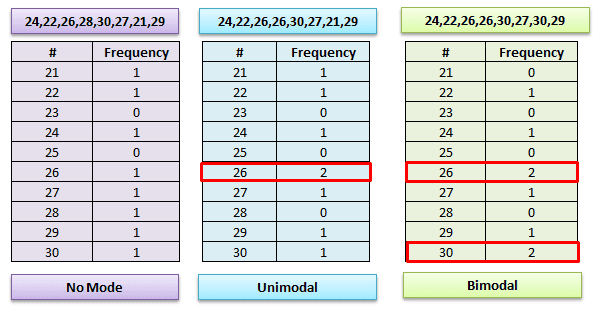
The term mode refers to the value that occurs most often in the data set. Sometimes the data may not have any repeated or multiple numbers; then, it is a zero mode. Similarly, if the data has only one number in the frequency table, it is a unimodal distribution.

Bi-modal means “two modes” in the data distribution. For example, the data distribution of cook times for fajita recipes might have two modes: chicken and steak. A bi-modal distribution means that there are “two things” impacting the process. If the data set has more than two modes, it is an example of multimodal data distribution.

Bimodal Distribution

What is the Significance of a Bimodal distribution?

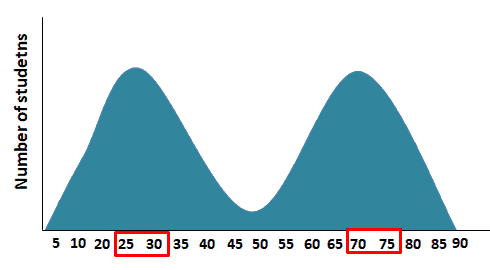
The bimodal distribution indicates there are two separate and independent peaks in the population data. For example, students test scores may follow a normal distribution. However, sometimes scores fall into bimodal distribution with one group of students getting scores between 70 to 75 marks out of 100 and another group of students getting scores between 25 to 30 marks. Reviewing the two different data groups will help the teacher to determine the reason for variations in the test scores of the two groups.

Important Bimodal Distribution Videos

Six Sigma Green Questions

Question: When analyzing sample data a Belt may experience a Bimodal Distribution with each mode displaying Normal Distribution. This could be caused by _________________________ .

(a) Two different machines being read.
(b) Two operators on different shifts.
(c) Two suppliers’ parts being used.
(d) All these are correct answers.

Answer:

Unlock Additional Members-only Content!

To unlock additional content, please upgrade now to a full membership.
Upgrade to a Full Membership
If you are a member, you can log in here.

Normal Probability Plot

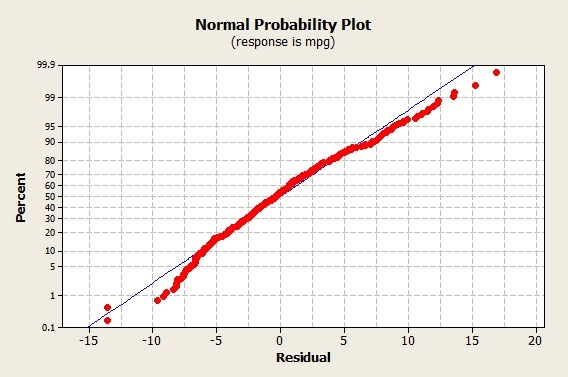
The normal probability plot is a graphical technique for normality testing: assessing whether or not a data set is approximately normally distributed. In other words, a normal probability plot is a graphical technique to identify substantive departures from normality.  The normal probability plot is one type of quantile-quantile (Q-Q) plot.

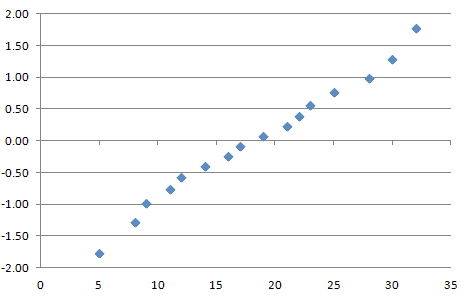
A Normal Probability Plot compares the values in a data set (on the vertical axis) with their associated quantile values derived from a standardized normal distribution (on the horizontal axis). In other words, it plot graph Z-scores against the data.

Normal probability plot
Photo by chansr

Why Do You Use a Normal Probability Plot?

The normal probability plot is formed by plotting the sorted data with an approximation to the means or medians of the corresponding order statistics, and we do this because it helps us visualize the data. We use a normal probability plot in order to determine if a small set of data comes from a normal distribution. In other words, if we get a straight line from the plot, we can say the process is normally distributed. Thus, it is an excellent option to determine the Process capability.

When Do You Use a Normal Probability Plot

The data are drawn against a theoretical normal distribution in a manner that the points should form almost a straight line. Departures from this straight line indicate departures from normality. This includes identifying outliers, skewness, kurtosis, a need for transformations, and mixtures.

How to Construct a Normal Probability Plot

1. Firstly, arrange the values in ascending order. In other words, arrange the n number of values from minimum to maximum.

2. Secondly, arrange a rank order number(i) from 1 to n. Here n is the total number of samples

3. Thirdly, calculate the cumulative probability for each rank order from1 to n values

For example: f(i) = (i-0.375)/(n+0.25)

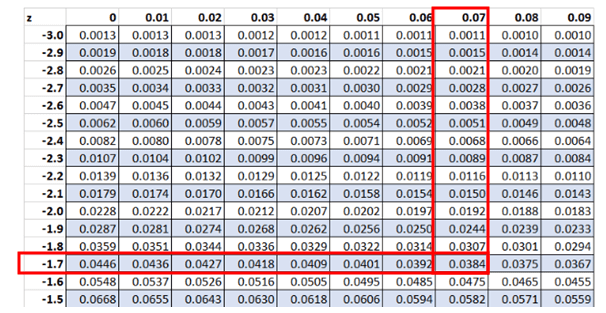
4. Then, for each cumulative probability value, determine the z-value from the standard normal distribution.

5. Next, create a scatter plot with the sorted data versus corresponding z-values

6. Finally, analyze the graph. If all the points are roughly on a straight line, then determine if it follows the normal distribution.

Example of Using the Normal Probability Plot in a Six Sigma Project

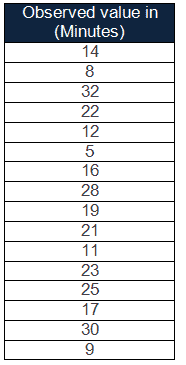
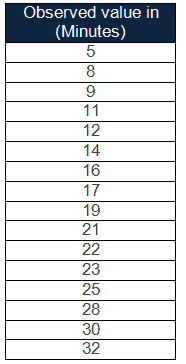
Example: The data in the table below is a random sample of 16 individuals’ wait times in the coffee shop. Is there evidence to support the belief that the variable of waiting time follows a normal distribution?

Step 1: Arrange data in ascending order

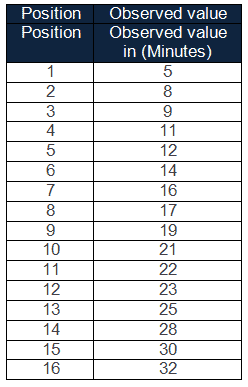
Normal Probability Plot

Step 2: Then, assign a rank order number(i) from 1 to n. For instance, the total number of samples n equals 16.

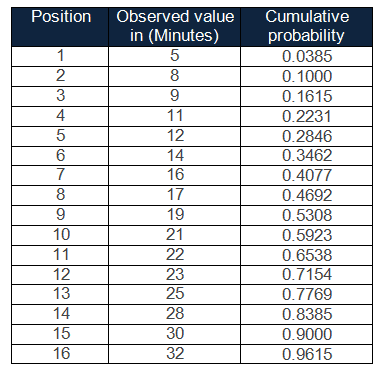
Step 3: Calculate the cumulative probability

f(i) = (i-0.375)/(n+0.25)

for i=1, f(1) =(1-0.375)/(16+0.25) = 0.0385

for i=2, f(2) = (2-0.375)/(16+0.25) = 0.1000, similarly calculate for other values.

Normal Probability Plot

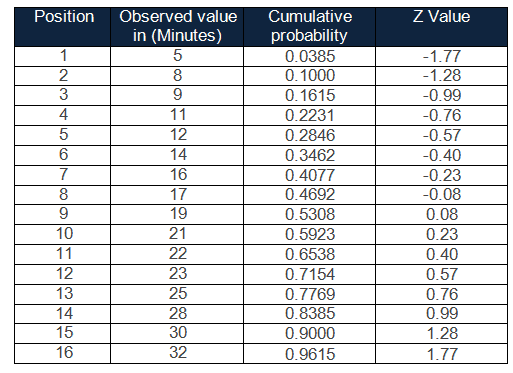
Step 4: Further, determine the z value for each cumulative probability

Step5: Then, create a scatter plot with the sorted data versus corresponding z-values

Step 6: Analyze the graph: To explain, from the above graph, it is almost clear that the Normal probability plot is close enough to linear. Hence we conclude that wait time follows a normal distribution.

Important Videos

Chi Square Distribution & Hypothesis Test

The Chi-Square (χ²) distribution is a continuous probability distribution that plays a vital role in Six Sigma statistical analysis and hypothesis testing. It describes the distribution of a sum of squared random variables (usually z-scores). This distribution is always non-negative (since squares are always positive) and is typically right-skewed, especially for lower degrees of freedom.

The Chi-Square (χ2) distribution is the best method to test a population variance against a known or assumed value of the population. A Chi-Square distribution is a continuous distribution with degrees of freedom. As the degrees of freedom increase, the chi-square curve becomes more symmetric and approaches a normal distribution. Six Sigma practitioners (Green Belts and Black Belts) encounter the chi-square distribution when they need to analyze variability or test hypotheses about categorical data during a DMAIC project.

The best part of a Chi-Square distribution is that it describes the distribution of a sum of squared random variables. It is also used to test the goodness of fit of data distribution, whether a data series is independent, and for judging the confidences surrounding variance and standard deviation for a random variable from a normal distribution.

This guide will explain what the chi-square distribution is, why it’s important in Six Sigma, how to conduct various chi-square hypothesis tests, and when to use each test in the DMAIC process.

What Is the Chi-Square Distribution?

The chi-square distribution is a family of distributions defined by a parameter called degrees of freedom (df). Intuitively, you can think of degrees of freedom as related to sample size – for example, if you sum the squares of k independent standard normal variables, the result follows a χ² distribution with k degrees of freedom. Key properties of the chi-square distribution include:

  • Non-negativity: χ² values range from 0 to ∞ (no negative values, since it’s a sum of squares).
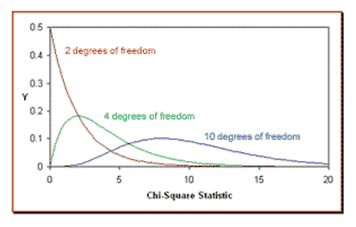
  • Shape depends on degrees of freedom: With low df, the distribution is highly skewed right (a long tail to the right). As df increases, the distribution becomes more bell-shaped and approaches symmetry.
  • Mean and variance: The mean of a χ² distribution is equal to its degrees of freedom, and the variance is twice the degrees of freedom. For example, a χ² with df = 6 has mean 6 and variance 12.
  • Relation to normal distribution: A chi-square distribution with a large df (say df ≥ 30) is approximately normal. In fact, when df increases, the χ² probability density function begins to look symmetric like the normal curvesixsigmastudyguide.com.

These properties mean that small χ² values cluster near zero, and large values are rarer (in the right tail). This characteristic is exactly what makes the chi-square distribution useful for hypothesis testing – we use it to quantify how far our observed data deviate from expectation.

In practice, chi-square statistics often measure the discrepancy between observed data and what we expect under some hypothesis. If the chi-square statistic is small, it suggests the observed data are close to what was expected. If it’s large, it means there’s a big gap between observation and expectation – so large χ² values often indicate that the observed pattern is unlikely to be due to random chance under the null hypothesis.

Why Is Chi-Square Important in Six Sigma?

Six Sigma projects focus on reducing defects and variability. While many Six Sigma analyses involve means and the normal distribution, practitioners also need to understand variability and categorical data relationships. The chi-square distribution is central to several hypothesis tests that Six Sigma teams use to analyze variation and categorical factors in the Analyze phase (and sometimes in Measure/Improve phases). Usually, the goal of the Six Sigma team is to find the level of variation of the output, not just the mean. Chi-square tests help in this pursuit by enabling you to:

  • Evaluate process variance: The chi-square is the distribution used to test a population variance or standard deviation against a target or baseline. For example, you might verify in the Measure phase that a process’s variance is within an acceptable range, or in the Improve phase that an improvement initiative significantly reduced variability. (This is done via the chi-square test for a single variance, described later.)
  • Assess distribution fit: Six Sigma often assumes normality for process metrics, but what if the data are not normal? A chi-square goodness-of-fit test can check if your data follow a particular distribution (e.g., normal, Poisson, etc.). This could occur in Measure/Analyze when you need to validate distribution assumptions for capability analysis or determine if a count of defects fits a Poisson model.
  • Test for independence (association): In Analyze, you may need to determine whether two categorical factors are related. For example, are defect types independent of the machine or shift? A chi-square test of independence can reveal whether there is a statistically significant association between two categorical variables (e.g., factor and defect occurrence), which helps pinpoint root causes. If the test shows dependence, you’ve found a clue on where to focus improvements.
  • Analyze frequency counts and proportions: Chi-square tests handle data in frequency form (counts in categories). This is common in survey data or whenever outcomes are classified into categories. For instance, a Six Sigma team might survey customers about preferences (categorical responses) or classify defect reasons into categories – chi-square analysis can determine if those frequencies differ from expectations or differ across groups.

In summary, the chi-square distribution underpins tools for variation analysis and categorical data analysis in Six Sigma. It is especially relevant during Analyze (hypothesis testing for root cause analysis) but also appears in Measure (for baseline distribution checks or variance tests) and Improve (to confirm changes in variation). Knowing when and how to use chi-square tests during DMAIC ensures you select the right tool for questions about variability or categorical factors.

History of Chi-Square

Karl Pearson (1857 – 1936), the father of modern statistics (founded the first statistics department in the world at University College London), came up with the Chi-Square distribution. Pearson’s work in statistics began when he developed a mathematical method for studying the process of heredity and evolution. Later, the Chi-Square distribution came about as Pearson tried to find a measure of the goodness of fit of other distributions to random variables in his heredity model.

Chi-Square Statistic

A Chi-Square distribution may skew to the right or with a long tail toward the significant values of the distribution. The overall shape of the distribution will depend on the number of degrees of freedom in a given problem. The degree of freedom is one less than the sample size.

Chi-Square Properties

  • The mean of the distribution is equal to the number of degrees of freedom: μ=ϑ.
  • The variance equals two times the number of degrees of freedom: σ2 = 2*ϑ.
  • When the degrees of freedom are greater than or equal to 2, the maximum value for Y occurs when χ2=ϑ-2.
  • As the degrees of freedom increase, the Chi-Square curve nears a normal distribution.
  • As the degrees of freedom increase, the symmetry of the graph also increases.
  • Finally, It may be skewed to the right, and since the random variable it is based on is squared, it has no negative values. As the degrees of freedom increase, the probability density function begins to appear symmetrical.

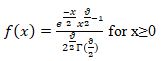
The formula for the probability density function of the Chi-Square distribution is

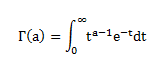
Where ϑ is the shape parameter, and Γ is the gamma function.

The formula for the gamma function is

Chi-Square (χ2) Hypothesis Test

Usually, the goal of the Six Sigma team is to find the level of variation of the output, not just the mean of the population. Above all, the team would like to know how much variation the production process shows about the target to see what changes are needed to reach a process free of defects.

For a comparison between several sample variances or a comparison between frequency proportions, the standard test statistic called the Chi-Square χ2 test will be used. So, the distribution of the Chi-Square statistic is called the Chi-Square distribution.

Types of Chi-Square Hypothesis Tests

The Chi-Square test is best suited for:

Case I: Testing whether a sample’s variance matches a known population variance (Chi-Square test for a single variance).

Case II: Testing whether observed frequencies differ significantly from expected frequencies, as in tests of independence or goodness-of-fit with categorical data.

I’ll give an overview of each below and link to pages where you can find more information on exactly how to perform both.

A hypothesis test is used to assess claims about a population parameter. Whether the test is one-tailed or two-tailed depends on the direction of the alternative hypothesis.

  • A one-tailed test checks whether a parameter is significantly greater than or less than a certain value (rejection area in one tail).
  • A two-tailed test checks whether a parameter is simply different from the hypothesized value (rejection areas in both tails).

The Chi-square test is commonly used for:

  • Goodness-of-fit tests
  • Tests of independence
  • Tests for a single population variance

Key characteristics of the Chi-square distribution:

  • It is non-negative (values ≥ 0)
  • It is not symmetric, it is right-skewed
  • The shape depends on the degrees of freedom (df)
  • For a variance test: df=n−1df = n – 1df=n−1

⚠️ Important distinction:

When testing frequency data (e.g., for independence or goodness-of-fit), you do not need the population variance.

When testing a single variance, you must know the population variance to form your null hypothesis.

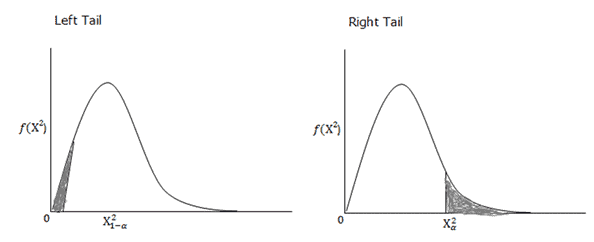
Left tail and Right tailed χ2 distribution:

Chi Square Distribution & Hypothesis Test

Right-Tailed vs. Left-Tailed vs. Two-Tailed Chi-Square Tests

Most chi-square hypothesis tests are naturally one-tailed, but it’s important to understand which tail (right or left) is being used. The chi-square distribution is not symmetric, and it’s typically right-skewed, so the “tail” refers to the upper end (right tail) or lower end (left tail) of the distribution curve.

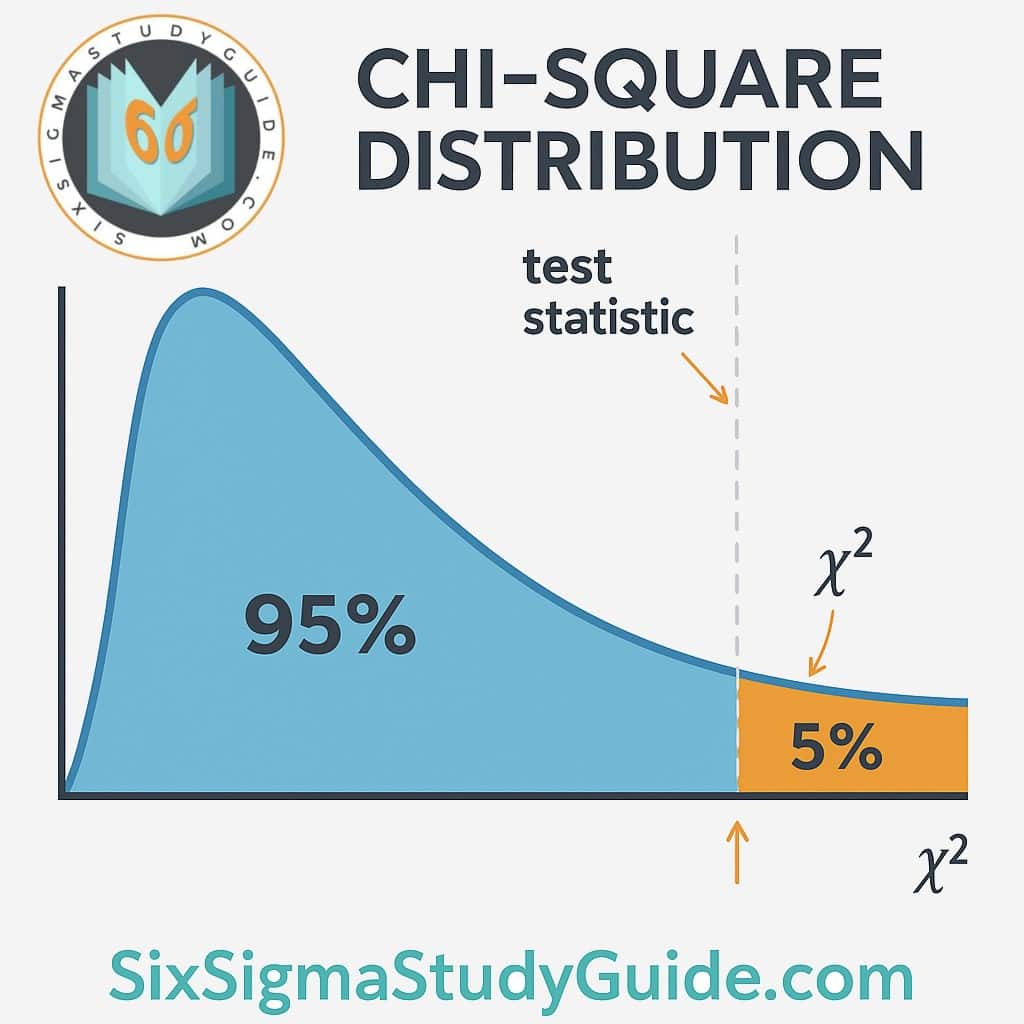
Left-tailed vs. right-tailed regions in a χ² distribution (SixSigmaStudyGuide.com). In a right-tailed test, large χ² values (far right) indicate significance. In a left-tailed test, very small χ² values (far left) indicate significance.

  • Right-Tailed Tests: By far the most common case. Goodness-of-fit and independence tests are almost always right-tailed. Why? Because the test statistic in these cases is χ² = Σ (O−E)²/E, which is always positive. The greater the discrepancy between Observed (O) and Expected (E) frequencies, the larger χ² becomes, pushing it into the right tail of the distribution. If the χ² value is extremely large (beyond a critical value in the right tail), it indicates the observed frequencies deviate significantly from expectations, and we reject the null hypothesissixsigmastudyguide.comsixsigmastudyguide.com. In other words, these tests only have one rejection region on the high side of the χ² curve.
  • Left-Tailed Tests: These are rare for chi-square, but they occur in specific scenarios – particularly the chi-square test for a single variance when you want to see if a variance is significantly smaller than a target value. In a left-tailed χ² test, the rejection region is in the left tail (low values) of the distribution. A small χ² statistic would indicate observed variance is much lower than expected. For example, if you hypothesize that a new process’s variance is less than the old variance, you’d use a left-tailed test (lower variance yields a smaller χ² value). If the test statistic falls below a critical value near the left tail, you reject the null and conclude the variance is significantly lower. (We’ll see an example with queue wait times shortly.)
  • Two-Tailed Tests: There is no built-in two-tailed version of the chi-square in the way we have for Z or t (because χ² ≥ 0 only). However, you can conduct a two-tailed test on variance by splitting α into both tails of the χ² distribution. This is used if you want to detect any significant difference (either increase or decrease) in variance. In practice, a two-tailed chi-square test for variance means you have two critical values: one in the right tail and one in the left tail. You would reject the null hypothesis if the χ² statistic is either too high (above the upper critical value) or too low (below the lower critical value). Two-tailed chi-square tests are less common in Six Sigma because usually one is checking either for an increase or a decrease in variation, not just any change. But it’s conceptually similar to two-tailed tests elsewhere – you’re defining an extreme region on both ends of the distribution.

Selecting the Correct Tail: A common mistake is confusing which tail to use. Remember that for goodness-of-fit and independence tests, you always use the right tailsixsigmastudyguide.com – a large χ² is the signal that the observed data don’t match the null hypothesis expectation. For variance tests, it depends on your alternative hypothesis:

  • H₁: σ² > σ₀² (looking for greater variability) – use a right-tailed test.
  • H₁: σ² < σ₀² (looking for reduced variability) – use a left-tailed test.
  • H₁: σ² ≠ σ₀² (any difference) – use a two-tailed approach (both tails).

In the sections below, we’ll highlight the tail for each type of test. We’ll also discuss how to find the correct critical values from a chi-square table for each case in a later section.

Chi-Square Goodness-of-Fit Test

A chi-square goodness-of-fit (GOF) test checks how well an observed categorical data distribution fits an expected distribution. In other words, it tests whether the frequencies observed in different categories match some hypothesized frequencies. This is useful when you have one categorical variable and a theory or historical data about what the distribution of that variable should be. For example, you might want to verify if defect occurrences follow a Poisson distribution, or if customer preferences are evenly distributed among choices. The chi-square GOF test is a non-parametric test (no assumption of normality; it deals directly with category counts)sixsigmastudyguide.com.

When to use: Use a GOF test in Six Sigma during Measure or Analyze when you need to validate distributional assumptions. For instance, if you assume defects per hour follow a Poisson distribution, a GOF test can confirm or refute that. Or if historical data suggest a certain proportional breakdown of defect causes, you can test if current data still fits that pattern. This helps ensure you’re using the correct statistical models and can reveal changes in process behavior.

Hypotheses: Typically, for a goodness-of-fit test:

  • H₀ (null hypothesis): The observed distribution fits the expected distribution. (No significant difference between observed and expected frequencies.)
  • H₁ (alternative hypothesis): The observed distribution does not fit the expected distribution (at least one category’s frequency is significantly different from expected).

In plain terms, H₀ assumes any differences between observed and expected counts are just due to random chance, while H₁ asserts that the differences are too large to be random – indicating the distribution has changed or the assumption was wrong.

Assumptions: Each observation falls into one of the categories, and you have a sufficiently large sample such that expected counts in each category aren’t too low. A common rule of thumb is that expected counts should be at least 5 in each category (or if that’s not possible, no more than 20% of categories have expected < 5)sixsigmastudyguide.com. If expected frequencies are very small, the chi-square approximation may not be accurate (you might need to combine categories or use an exact test).

Learn more about Chi-Square Goodness of Fit Test including how to create one, a step by step walkthrough, and specifi DMAIC application here.

Chi-Square Test of Independence

The Chi-Square Test of Independence is a statistical tool used to determine whether two categorical variables are related or independent. In Six Sigma, it’s especially valuable during the Analyze phase when working with contingency tables to uncover relationships between process factors, such as defect type and production shift, or customer satisfaction and service location. The test compares observed frequencies in each category combination to what would be expected if the variables were unrelated. A significant difference suggests that one factor may be influencing the other.

This article explains the step-by-step process to run the test: setting up hypotheses, calculating expected frequencies, computing the chi-square statistic, and interpreting the results using degrees of freedom and critical values. It also includes a detailed example involving defect types across shifts, illustrating how to use the test to draw actionable insights. Ideal for Green and Black Belt candidates, the guide emphasizes proper use conditions (like sufficient sample size) and offers practical tips to validate patterns that might otherwise be dismissed as random variation.

Chi-Square Test, Step by Step: A Worked Example

Here’s a complete chi-square test of independence worked from raw data to conclusion, the same 7-step process you’ll use on any Green Belt or Black Belt project involving categorical data.

Scenario: A plant switched a machine to a new setting hoping to cut the defect rate. Did it actually change anything, or is the difference just noise?

Step 1: State the hypotheses

  • H₀: Defect rate is independent of the machine setting (no real association).
  • H₁: Defect rate depends on the machine setting (there is an association).

Step 2: Collect the observed frequencies

200 units were run under each setting:

DefectiveGoodRow total
Old setting30170200
New setting10190200
Column total40360400

Step 3: Calculate the expected frequencies

Expected = (Row total × Column total) / Grand total, for each cell:

  • Old, Defective: (200 × 40) / 400 = 20
  • Old, Good: (200 × 360) / 400 = 180
  • New, Defective: (200 × 40) / 400 = 20
  • New, Good: (200 × 360) / 400 = 180

Step 4: Compute the chi-square statistic

χ² = Σ (O − E)² / E, summed across all four cells:

  • (30 − 20)² / 20 = 5.00
  • (170 − 180)² / 180 = 0.56
  • (10 − 20)² / 20 = 5.00
  • (190 − 180)² / 180 = 0.56

χ² = 5.00 + 0.56 + 5.00 + 0.56 = 11.11

Step 5: Find the degrees of freedom

df = (rows − 1)(columns − 1) = (2 − 1)(2 − 1) = 1

Step 6: Compare to the critical value

At α = 0.05 and df = 1, the critical value is 3.841. Our χ² of 11.11 is well above it.

Step 7: Interpret the result

Since 11.11 > 3.841, we reject H₀. The defect rate really is associated with the machine setting, the new setting’s drop from 15% to 5% defective isn’t just random noise. That’s a real, statistically defensible win to report in your project’s Analyze phase.

Chi-Square test – Comparing Variances

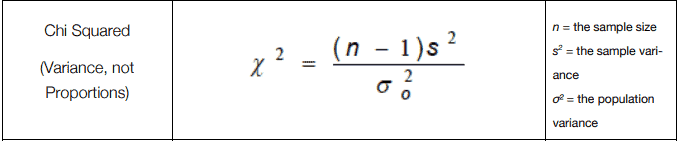
When the population follows a normal distribution, the hypothesis test is used to compare a population variance σ2. The test is given by:

Where the number of samples is n, and the sample variance is s2. The Chi-square distribution is right-skewed, especially with fewer degrees of freedom. As the degrees of freedom increase, the distribution becomes more symmetric and approaches a normal shape.

Chi-Square Variance Test

If you’re working with a single population and want to test whether its variance has changed, the Chi-Square test for variance is the right tool. It’s commonly used in Six Sigma to check whether process variation is still within acceptable limits, or if something’s gone off track.

This test compares a sample variance to a known or historical population variance using the chi-square distribution. Depending on your hypothesis, you’ll use a right-tailed, left-tailed, or two-tailed version of the test to detect increases, decreases, or any change in variation.

See the full guide: Chi-Square Test for Variance here.

Chi-Square Sample Size

Chi-square tests are susceptible to changes in the sample size. If the sample size is larger, the absolute differences become a smaller and smaller proportion of the expected value. In other words, a strong association may not come up if the sample size is small and the findings are not significant, even though they are statistically significant.

Chi Square Distribution & Hypothesis Test

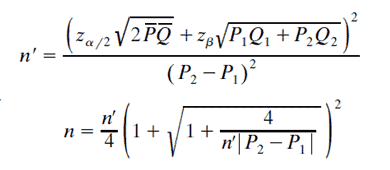
Where…

  • n is sample size with correction
  • n’ is sample size without continuity correction
  • P1 and P2 are the proportions in each group
  • Q1 =1-P1
  • P̅ = P1+P2/2

Chi-Square Videos

https://youtu.be/EA4P1eRdEhA

https://www.youtube.com/watch?v=53kYOOr5Yhk

Chi-Square Tables

Chi-Square Sample Size Calculation

Other Uses of Chi-Square

Six Sigma Black Belt Certification Chi-Square Questions:

chi square question

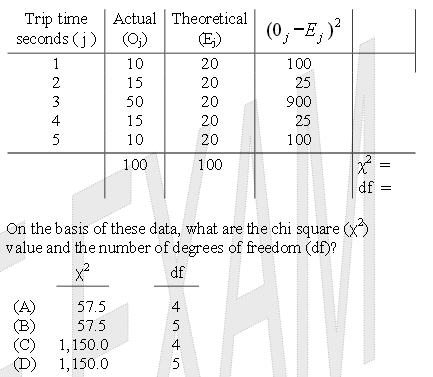
Question: The time for a fail-safe device to trip is thought to be a discrete uniform distribution from 1 to 5 seconds. To test this hypothesis, 100 tests are conducted, with results as shown below.

Based on this data, what are the Chi-Square (c2) value and the number of degrees of freedom (df)?

(A) (c2) value = 57.5, degrees of freedom = 4
(B) (c2) value = 57.5, degrees of freedom = 5
(C) (c2) value = 1,150.0, degrees of freedom = 4
(D) (c2) value = 1,150.0, degrees of freedom = 5

Answer: 

Unlock Additional Members-only Content!

To unlock additional content, please upgrade now to a full membership.
Upgrade to a Full Membership
If you are a member, you can log in here.

When you’re ready, there are a few ways I can help:

First, join 12,000+ other Six Sigma professionals by subscribing to my email newsletter. A short read every Monday to start your work week off correctly. Always free.

* * *

If you’re looking to pass your Six Sigma Green Belt or Black Belt exams, I’d recommend starting with my affordable study guide:

1)→ 🟢Pass Your Six Sigma Green Belt: a study guide organized by the exam Body of Knowledge, 1,000+ practice questions with detailed answer explanations, and 8 full-length mock exams

2)→ ⚫Pass Your Six Sigma Black Belt: the full Black Belt Body of Knowledge, 2,000+ practice questions with detailed answer explanations, and 8 full-length mock exams

You’ve spent so much effort learning Lean Six Sigma. Why leave passing your certification exam up to chance? This comprehensive study guide offers 1,000+ exam-like questions for Green Belts (2,000+ for Black Belts) with full answer walkthroughs, access to instructors, detailed study material, and more.

​ Thousands have used this system to prepare. Join them here. 
Data Distributions

Data distribution is a function that specifies all possible values for a variable and also quantifies the relative frequency (probability of how often they occur). Distributions are considered to be any population that has a scattering of data. It’s important to determine the population’s distribution so we can apply the correct statistical methods when analyzing it.

Data distributions are widely used in statistics. Suppose an engineer collects 500 data points on a shop floor. It does not give any value to the management unless they categorize or organize the data in a useful way. Data distribution methods organize the raw data into graphical methods (like histograms, box plots, run charts, etc.) and provide helpful information.

Data Distributions
Histogram

The basic advantage of data distribution is to estimate the probability of any specific observation in a sample space. A probability distribution is a mathematical model that calculates the probability of occurrence of different possible outcomes in a test or experiment. We use them to define different types of random variables (typically discreet or continuous) to make decisions, depending on the models. One can use mean, mode, range, probability, or other statistical methods based on the random variable category.

Types of Distribution

Distributions are basically classified based on the type of data (Typically discreet or continuous)

Discrete Distributions

A discrete distribution results from countable data with a finite number of possible values. Furthermore, we can report discrete distributions in tables, and the respective values of the random variable are countable. Ex: rolling dice, choosing several heads, etc.

Probability mass function (pmf): A probability mass function is a frequency function that gives the probability for discrete random variables, also known as the discrete density function.

Discrete= counted

Different types of discreet distributions are

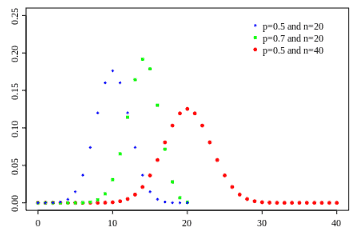
Binomial distribution

  • The binomial distribution measures the probability of the number of successes or failure outcomes in an experiment on each try.
  • Characteristics are classified into two mutually exclusive and exhaustive classes, such as the number of successes/failures and the number accepted/rejected that follow a binomial distribution.
  • Ex: Tossing a coin: The probability of the coin landing Head is ½, and the probability of the coin landing tail is ½
Data Distributions

Picture source

Poisson distribution

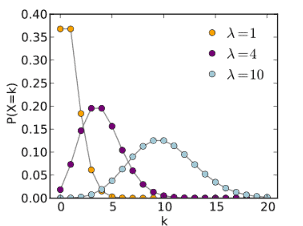
  • The Poisson distribution is the discrete probability distribution that measures the likelihood of a number of events occurring in a given period when the events occur one after another in a well-defined manner.
  • Characteristics that can theoretically take large values but actually take small values have Poisson distribution.
  • Ex: Number of defects, errors, accidents, absentees, etc.
Data Distributions

Picture Source

Hypergeometric distribution

  • The hypergeometric distribution is a discrete distribution that measures the probability of a specified number of successes in (n) trials without replacement from a relatively large population (N). In other words, sampling without replacement.
  • The hypergeometric distribution is similar to the binomial distribution;
  • The basic difference of binomial distribution is that probability of success is the same for all trials, while it is not the same case for hypergeometric distribution.

Geometric distribution

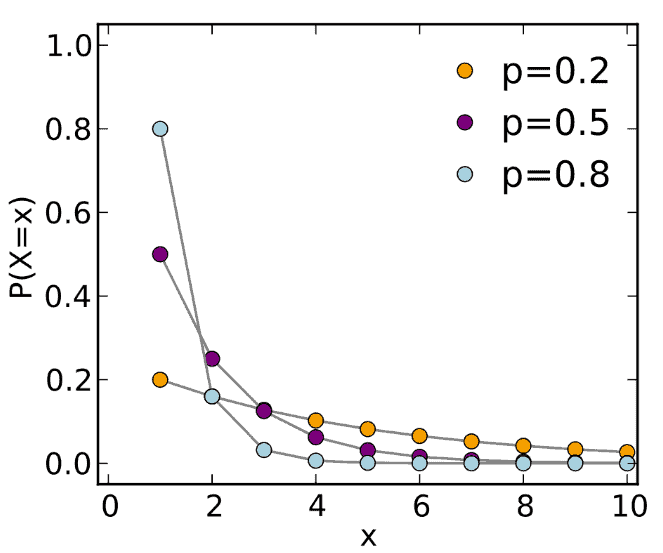
  • The geometric distribution is a discrete distribution that measures the likelihood of when the first success will occur.
  • An extension of it may be considered a negative binomial distribution.
  • Ex: Marketing representative from an advertising agency randomly selects hockey players from various universities until he finds a hockey player who attended the Olympics.

Picture Source

Continuous Distributions

A continuous distribution contains infinite (variable) data points, which it displays on a continuous measurement scale. A continuous random variable is a random variable with a set of possible values that is infinite and uncountable. It measures something rather than just counting; we typically describe it using probability density functions (pdf).

Probability density function (pdf): The probability density function describing the behavior of a random variable. It is normally grouped frequency distribution. Hence probability density function sees it as the ‘shape’ of the distribution.

Continuous = can take many different values

Different types of continuous distributions are

Normal Distribution

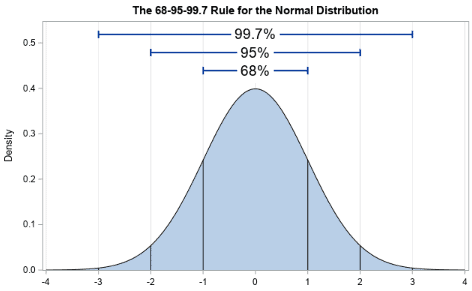
  • Some people also refer to normal distributions as Gaussian distributions. It is a symmetrical bell shape curve with higher frequency (probability density) around the central value. The frequency sharply decreases as values are away from the central value on either side.
  • In other words, we expect a normal distribution to have characteristics like dimensions that fall on either side of the aimed-at value with equal probability.
  • The Mean, Median, and Mode are equal for normal distribution.
Data Distributions

Picture Source

Lognormal distribution

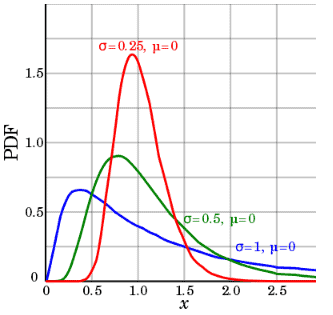
  • A continuous random variable x follows a lognormal distribution if its natural logarithm, ln(x) follows a normal distribution.
  • When you sum the random variables, as the sample size increases, the sum distribution becomes a normal distribution, regardless of the distribution of the individuals. The same scenario applies to multiplication.
  • The location parameter is the mean of the data set after transformation by taking the logarithm, and also the scale parameter is the standard deviation of the data set after transformation.

Picture Source

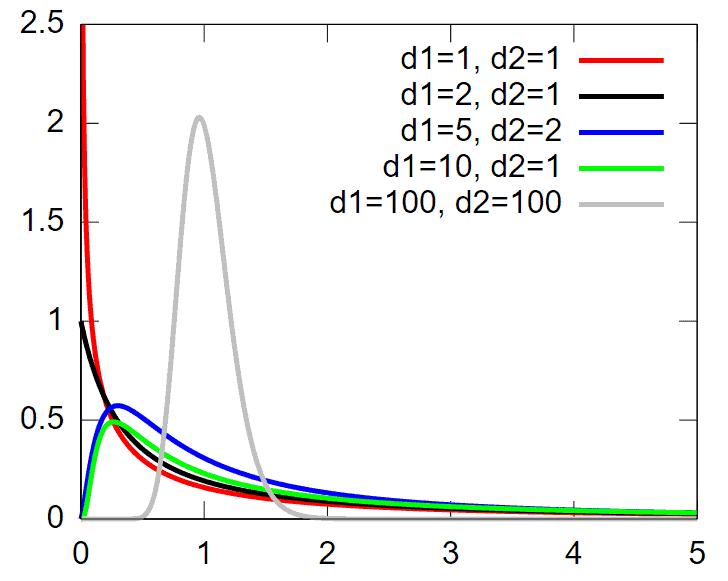
F distribution

  • The F distribution extensively uses to test for equality of variances between two normal populations.
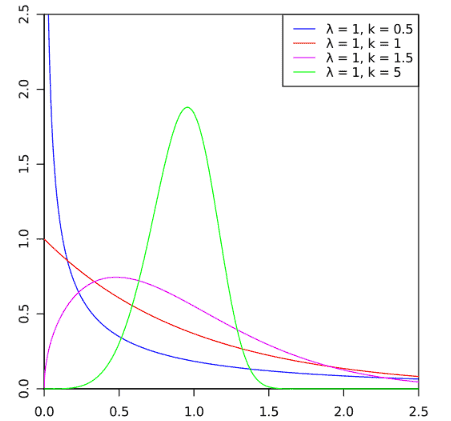
  • The F distribution is an asymmetric distribution that has a minimum value of 0, but no maximum value.
  • Notably, the curve approaches zero but never quite touches the horizontal axis.
Data Distributions

Picture Source

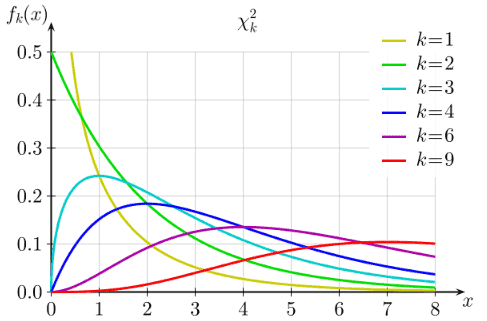
Chi Square distribution

  • The chi square distribution results when independent variables with standard normal distribution are squared and summed.
  • Ex: if Z is the standard normal random variable then:
    • y =Z12+ Z22 +Z32 +Z42+…..+ Zn2
  • The chi square distribution is symmetrical and bounded below zero. And approaches the normal distribution in shape as the degrees of freedom increase.

Picture Source

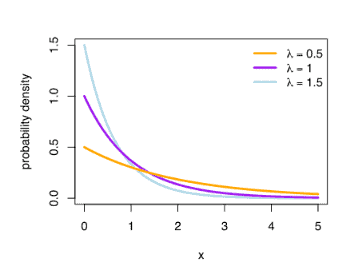
Exponential distribution

  • The exponential distribution is the probability distribution of the widely used continuous distributions. Often used to model items with a constant failure rate.
  • The exponential distribution is closely related to the Poisson distribution.
  • Has a constant failure rate as it will always have the same shape parameters.
  • Ex: The lifetime of a bulb, the time between fires in a city.

Picture Source

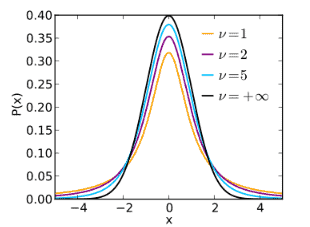
T Student distribution

  • t distribution or student’s t distribution is a bell shape probability distribution, symmetrical about its mean.
  • Commonly used for hypothesis testing and constructing confidence intervals for means.
  • Used in place of the normal distribution when the standard deviation is unknown.
  • Like the normal distribution, when random variables are averages, the average distribution tends to be normal, regardless of the distribution of the individuals.

Picture Source

Weibull Distribution

  • The basic purpose of Weibull distribution is to model time-to-failure data.
  • Widely used in reliability, medical research, and statistical applications.
  • Assumes many shapes depending upon the shape, scale, and location parameters. Effect of Shape parameter β on Weibull distribution:

Picture Source

Non-normal distributions

Generally, a common assumption is that while performing a hypothesis test, the data is a sample from a normal distribution, but that is not always the case. In other words, data may not follow a normal distribution. Hence, we use nonparametric tests when there is no assumption of a specific distribution for the population.

Particularly nonparametric test results are more robust against violation of the assumptions. Different types of nonparametric tests include the Sign test, Mood’s Median Test (for two samples), Mann-Whitney Test for Independent Samples, Wilcoxon Signed-Rank Test for a Single Sample, and Wilcoxon Signed-Rank Test for Paired Samples 

Odd Distributions

Bivariate Distribution:

  • The continuous distribution (like normal, chi square, exponential) and discrete distribution (like binomial, geometric) are the probability distribution of one random variable
  • Whereas bivariate distribution is a probability of a certain event occurring in case two independent random variables exist, it may be a continuous or discrete distribution.
  • Bivariate distribution is unique because it is the joint distribution of two variables.

Bi-modal:

  • A bi-modal distribution has two modes. In other words, two outcomes are most likely to compare the outcomes of their region.
  • 2 sources of data come into a single process screen.

How to Evaluate a Data Distribution

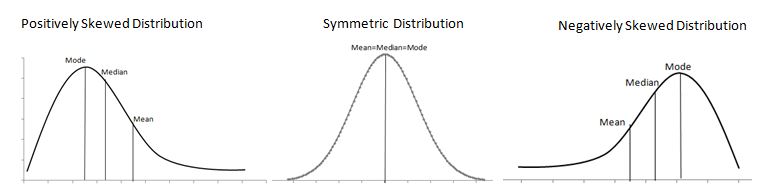
The shape of data distribution is depicted by its number of peaks and symmetry possession, skewness, or uniformity. Skewness is a measure of the lack of symmetry. In other words, skewness measures how much a random variable’s probability distribution deviates from the Normal Distribution.

We classify the skewed distribution as either left-side (a negatively skewed distribution) or right-side (a positively skewed distribution). Both sides of the mean do NOT match.

Symmetric and Asymmetric Distribution

Use Graphical Analysis to show how the points are distributed and the data arranged throughout the set. These distributions graphically illustrate the data’s spread (dispersion, variability, or scatter).

Symmetrical Distribution

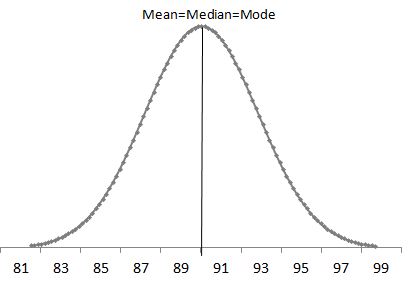
Generally, symmetrical distribution appears as a bell curve. The perfect normal distribution is the probability distribution that has zero skewness. However, it is always impossible to have a perfect normal distribution in the real world, so the skewness is not equal to zero; it is almost zero. Symmetrical distribution occurs when mean, median, and mode occur at the same point, and the values of variables occur at regular frequencies. Both sides of the mean match & mirror each other.

Example: High school students weigh between 80lbs and 100lbs, and the majority of students weigh around 90lbs. The weights are equally distributed on both sides of 90 lbs, which is the center value. This type of distribution is called a Normal Distribution.

Data Distributions

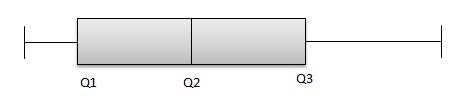
Similarly, symmetric distribution also can be reviewed with boxplot

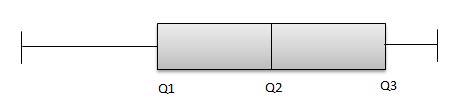
The above graph is a boxplot of symmetric distribution. The distance between Q1 & Q2 and also Q2 & Q3 is equal.

Q3-Q2 = Q2-Q1

Though the distance between Q1 & Q2 and Q2 & Q3 is equal, it is insufficient to conclude that the data follows a symmetric distribution. The team also has to look at the length of the whisker, and if the distance of the whisker is equal, then we can conclude the distribution is symmetric.

Examples of Symmetric data distributions: Normal Distribution, Uniform 

Positively Skewed Distribution

We say that a distribution skews to the right if it has a long tail that trails toward the right side. The skewness value of a positively skewed distribution is greater than zero.

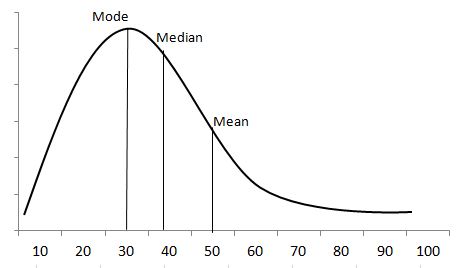
Example: The income details of the Chicago manufacturing employees indicate that most people earn between $20K and $50K per annum. Very few earn less than $10K, and very few earn $100K. The center value is $50K. It is very clear from the graph a long tail is on the right side of the center value. 

Data Distributions

The distribution is positively skewed as the tail is on the positive side of the center value. Unlike symmetric distribution, it is not equally distributed on both sides of the center value. From the graph, it is clearly understood that the mean value is the highest one, followed by the median and mode.

Since the skewness of the distribution is towards the right, the mean is greater than the median and ultimately moves towards the right. Also, the mode of the values occurs at the highest frequency on the left side of the median. Hence, mode < median < mean.

Box plot

From the above boxplot, Q2 is present very near to Q1. So, it is a positive skew distribution.

Q3-Q2>Q2-Q1

So, it clearly indicates that the data is skewness towards positive. But, for instance, if the graph is like the one below, then:

From the above picture, Q2-Q1 and Q3-Q2 are equal. But the distribution is still positive-skewed because the length of the right whisker is much greater than the left whisker. So, we can conclude that the data is positively skewed.

In summary, always check the equality of Q2-Q1 and Q3-Q2. If it is equal, check the whiskers’ length to conclude the data distribution.

Negatively Skewed Distribution

A distribution is said to be skewed to the left if it has a long tail that trails toward the left side. The skewness value of a negatively skewed distribution is less than zero.

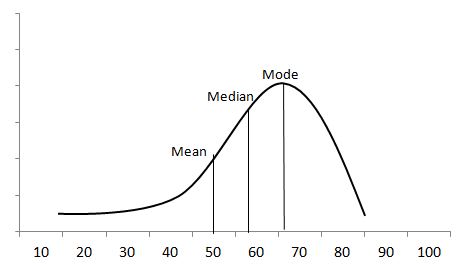
Example: A professor collected students’ marks in a science subject. The majority of students score between 50 and 80, while the center value is 50 marks. The long tail is on the left side of the center value because it is skewed to the left-hand side of the center value. So the data is negative skew distribution.

Data Distributions

Here mean < median < mode

From the above boxplot, Q2 is present very near to Q3. So, it is a negative skew distribution.

Q3-Q2<Q2-Q1

Similarly, like above, Q2-Q1 and Q3-Q2 are equal. But the distribution is still negatively skewed because the length of the left whisker is much greater than the right whisker. So, we can conclude that the data is negatively skewed.

It is good to transform the skewed data into normally distributed data. Data can transform using methods like Power transformation, Log transformation, and Exponential transformation.

Statistical Tests Used to Identify Data Distribution

There are different methods to test the normality of data, including visual or graphical methods and Quantifiable or numerical methods.

Visual method: A Visual inspection approach may be used to assess the data distribution normality, although this method is unpredictable and does not guarantee that the data distribution is normal. However, the visual method somewhat helps the user judge the data normality.

Ex: Histogram), boxplot, stem-and-leaf plot, probability-probability plot, and quantile-quantile plot.

Quantifiable method: Quantifiable methods are supplementary to visual methods. Particularly these tests compare the scores in the sample to a normally distributed set of scores with the same mean and standard deviation.

Ex: Anderson-Darling Test, Shapiro-Wilk W Test, Kolmogorov-Smirnov Test etc.,

Other Data Distribution Notes:

Don’t like or can’t use the existing distribution? So, a data transformation turns the data set into something more easily analyzed.

How to Make a Process Follow a Normal Distribution by Using Transforms

Sometimes you will be analyzing a process, and the data will come out in a non-normal shape. Since normal distributions have wonderful mathematical properties that make analysis and control so much easier, try to transform the data to a normal distribution if possible.

The approach to address the non-normal distribution is to make the transformation to “normalize” the data. Some typical data transformation methods are Box Cox, Log transformation, Square root or power transformation, Exponential and Reciprocal, etc.,

Box Cox transform

  • A Box Cox transformation is a useful power transformation technique used to transform non-normal dependent variables into a normal shape.
  • George Box and Sir D.R.Cox. are the authors of this method
  • The applicable formula is yl =yλ (λ is the power or parameter to transform the data).
  • For instance, λ=2, the data is squared, and if λ=0.5, then a square root is required.

Z transform

  • Z transformation is an analysis tool in signal processing
  • It is a generalization of the Discrete-Time Fourier Transform (DTFT), in particular, it applies to signals for which DFTF doesn’t exist, thus allowing you to analyze those signals
  • It also helps to see the new ideas in the sense of a system with respect to stability and causality
  • Z transform is the discrete-time counterpart to the Lapse transform

Helpful notes.