

Friday Kaizen is my weekly note on how Six Sigma ideas get used in real work. Last week was waiting and overprocessing. This week is the step that comes before any improvement: checking the number you are about to act on.
Our visitor count fell 12% in one week
In October our weekly dashboard showed a jolt. Visitors were down 12% on the week before. Time spent per visitor was up 28%.
Read the headline and you worry about the first number and celebrate the second. Neither reaction would have matched what happened.
Acting on it would have cost us a week chasing a readership problem we did not have.
Measure the measurement first: the instinct behind MSA
Measurement system analysis asks a simple question before any analysis: how much of the change you see comes from the thing you measure, and how much from the way you measure it? A gauge that drifts, or two inspectors who read the same part differently, can make a steady process look like it moved.
A dashboard is a gauge too. So before anyone reacted, we drew a fishbone of every way the number could have moved.
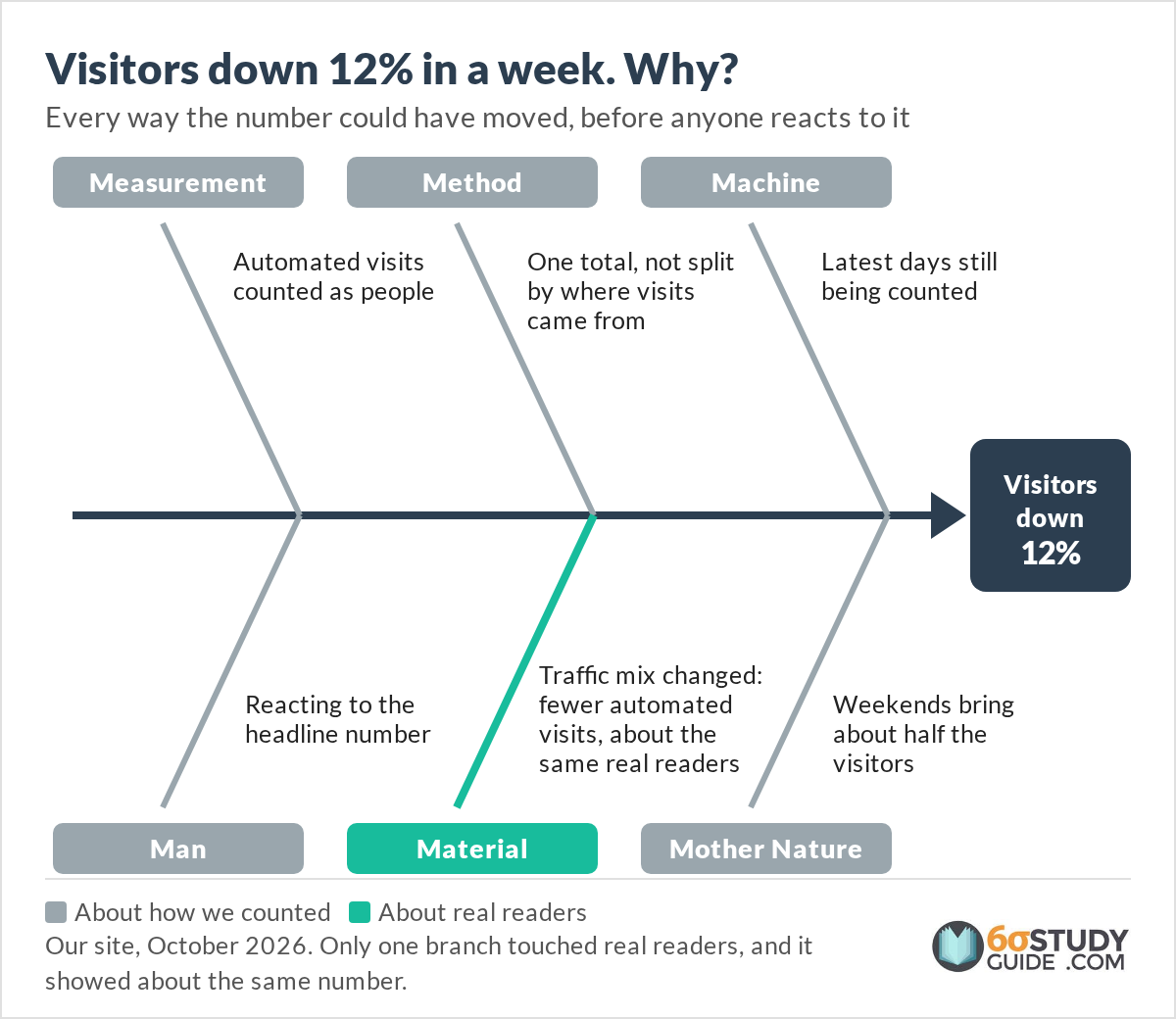
What the fishbone showed
Only one branch was about real readers. The rest were about how we counted.
When we split the total by where visits came from, close to half of the drop sat in one place: visits that looked automated, about four seconds each, almost none of them reading past the first screen. That traffic simply went away. Visitors from search were down about 3% across two complete weeks, and flat over the past two months.
The jump in time per visitor was partly the same effect. When four-second visits leave, the average rises. The real gain was smaller and more useful: visits from search went from about 52 to 65 seconds.
So we did not launch a rescue plan for readers. We changed how we read the dashboard: split by source first, complete weeks only.
The same lesson in a speed test
A lab speed test said our server answered in 0.1 to 0.2 seconds. Real visitors’ phones told a different story: one in four waited 1.7 seconds or more for that first answer.
Both gauges were honest. They measured different things. The lab ran from the US, close to our server. Most of our readers are not in the US. So we rank speed work by what real visitors get, not by the lab score.
Try it this week: check the gauge before the next KPI review
Pick one number your team will discuss this week. Before anyone reacts, ask:
- Who measures this, and how?
- Would two people measuring it get the same number?
- What happens when you split it by its biggest source?
Then compare only complete periods. Many reporting tools need a day or two to finish counting the latest days.
If the change survives all of that, it is real. Now improve it.
Leave a comment and tell me about a number that fooled your team. I read these, and the good ones might show up in a future Friday Kaizen (only with your permission).
Best, Ted.
“It would have been impossible for me to pass the ASQ Six Sigma Black Belt exam without Ted’s help. A tough and competitive exam requires that you nail the concepts, practice the questions, fall during mock tests, learn, improve, and eventually succeed.”
Manish D., LinkedIn Recommendation
When you’re ready, there are a few ways I can help:
First, join 12,000+ other Six Sigma professionals by subscribing to my email newsletter. A short read every Monday to start your work week off correctly. Always free.
* * *
If you’re looking to pass your Six Sigma Yellow Belt, Green Belt or Black Belt exam, I’d recommend starting with my affordable study guide:
1)→ 🟡Pass Your Six Sigma Yellow Belt: built for ASQ, IASSC and ILSSI, 1,700+ practice questions with explanations, and six full-length mock exams for your exam
2)→ 🟢Pass Your Six Sigma Green Belt: a study guide organized by the exam Body of Knowledge, 1,300+ practice questions with detailed answer explanations, and 20 full-length mock exams
3)→ ⚫Pass Your Six Sigma Black Belt: the full Black Belt Body of Knowledge, 2,200+ practice questions with detailed answer explanations, and 20 full-length mock exams
You’ve spent so much effort learning Lean Six Sigma. Why leave passing your certification exam up to chance? This comprehensive study guide offers 1,700+ exam-like questions for Yellow Belts, 1,300+ for Green Belts and 2,200+ for Black Belts with full answer walkthroughs, access to instructors, detailed study material, and more.
Thousands have used this system to prepare. Join them here.