

A lot of people think waste is a factory problem. A digital business has no forklifts, no parts bins and no scrap pile, so where would waste even live? It lives in files, lists and databases, and it piles up the same way.
Friday Kaizen is my weekly note on how Six Sigma ideas get used in real work. Last week was Voice of the Customer. This week is 5S, applied to our practice question bank.
Our question bank had 224 copies it did not need
The bank holds more than 5,000 practice questions. It grew over ten years, course by course.
When we went through the bank in September and October, 224 questions existed twice: the same question, once in each course copy. The tag list that files them had 306 entries. Some names differed only by a space at the front.
Nobody made those copies on purpose. They are a product of the software I use. When I split and copied courses over the years, the course software copied the questions along with them.
In October I opened that tag list to build a quiz and found entries I did not recognise. One was blank. That bugged me.
A 5S example: keep what is needed, give it a place, keep it that way
5S is the housekeeping discipline: Sort, Set in order, Shine, Standardize, Sustain. Keep only what the work needs. Give each thing one place. Clean it. Write the standard down. Then make the cleaning a routine, because it does not stay done.
In most teams, clutter grows the same way. The next person cannot find the original, so they add a copy. The list gets a little messier each time.
What a duplicate costs
I hate finding the same question twice. Every edit has to be made twice, and sooner or later one copy gets missed.
A learner can meet the same question in two quizzes. The second time, a right answer says more about memory than about the topic.
What we did: Sort, Set in order, Sustain
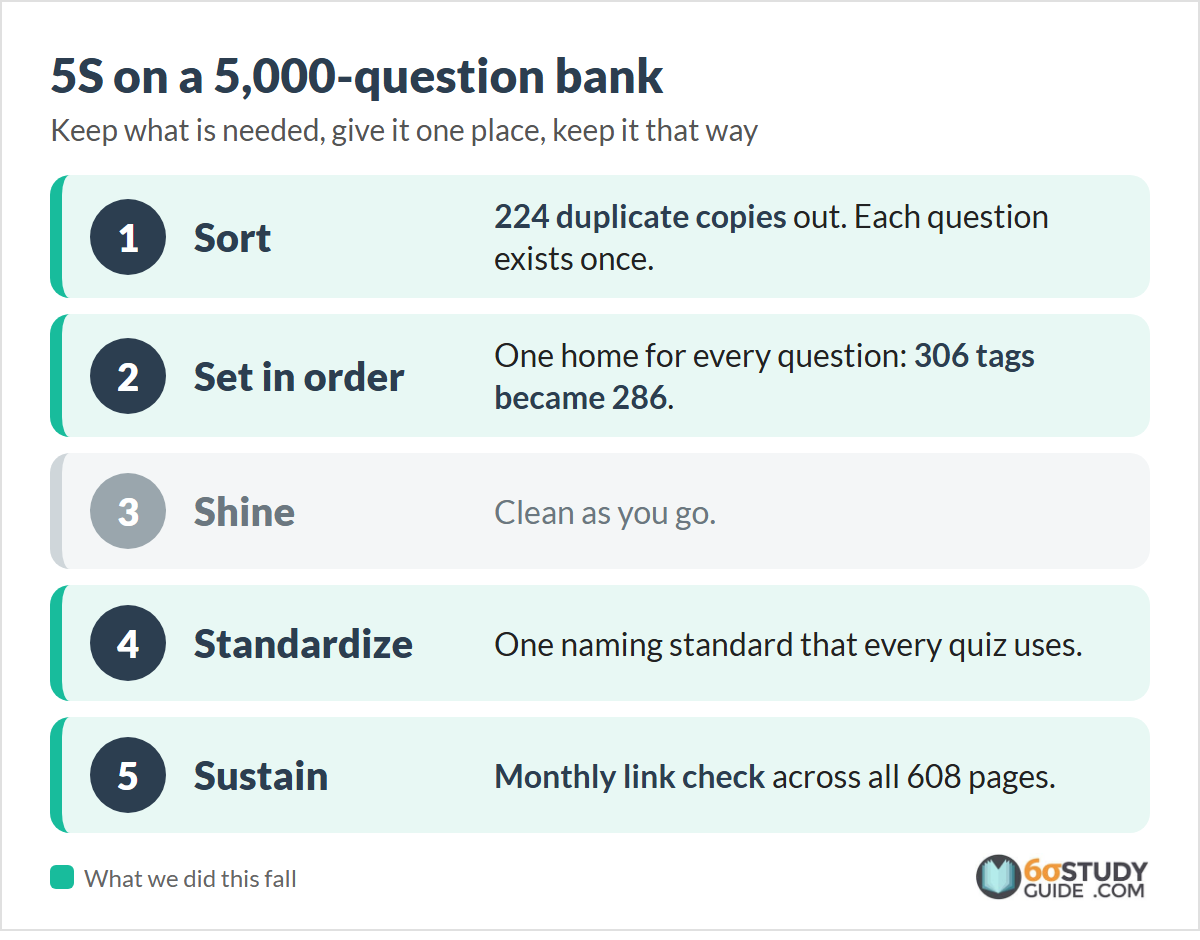
Sort. The 224 duplicate copies came out. Each question now exists once per course. Members’ saved quiz lists were pointed at the kept copy first, so nobody’s history changed.
Set in order and Standardize. Every tag name went onto one naming standard. Near-duplicates were merged, 306 entries became 286, and every quiz now draws from the standard tags. A new question lands in the right pool on its own.
Sustain. In September we checked every internal link across all 608 posts and pages, then put that check on a monthly schedule.
Try a 15-minute Sort this week
Pick one shared space your team uses every week. It works whatever kind of work you do:
- Digital: a shared drive folder, a dashboard list or the tags in your project tool.
- Service: your email templates, intake forms or call scripts.
- Physical: a workbench, a supply shelf or a tool drawer.
Set a timer for 15 minutes. Anything nobody has used in 90 days moves out: archive the file, retire the template, red-tag the part. Anything that exists twice keeps one copy, and the other spot points to it. Then write one line that says what belongs there, and put it where people will see it.
Then put the next 15 minutes on the calendar. Without that entry, it slides back.
Leave a comment and tell me what you threw out. I read these, and the good ones might show up in a future Friday Kaizen (only with your permission).
Best, Ted.
“Ted’s study guide played a big part in helping me to pass my IASSC green belt exam. I appreciate the comprehensiveness of the materials, Ted’s engaging writing style, how well the materials are organized, all the relevant hyperlinks within each page, and Ted’s responsiveness to inquiries.”
Paul M., LinkedIn Recommendation
When you’re ready, there are a few ways I can help:
First, join 12,000+ other Six Sigma professionals by subscribing to my email newsletter. A short read every Monday to start your work week off correctly. Always free.
* * *
If you’re looking to pass your Six Sigma Green Belt or Black Belt exams, I’d recommend starting with my affordable study guide:
1)→ 🟢Pass Your Six Sigma Green Belt: a study guide organized by the exam Body of Knowledge, 1,000+ practice questions with detailed answer explanations, and 15+ full-length mock exams
2)→ ⚫Pass Your Six Sigma Black Belt: the full Black Belt Body of Knowledge, 2,000+ practice questions with detailed answer explanations, and 15+ full-length mock exams
You’ve spent so much effort learning Lean Six Sigma. Why leave passing your certification exam up to chance? This comprehensive study guide offers 1,000+ exam-like questions for Green Belts (2,000+ for Black Belts) with full answer walkthroughs, access to instructors, detailed study material, and more.
Thousands have used this system to prepare. Join them here.