
One Sample T Hypothesis Test (Student’s T-Test)

One Sample T-Tests (Student’s T-Test) are used to resolve Hypothesis tests around comparing process means. The underlying chart makes use of the T-distribution.

Student’s T-distribution uses the T-distribution and is used for finding confidence intervals for the population mean when the population Standard Deviation is unknown. 

What is a One Sample T Hypothesis Test?

The One Sample T Hypothesis Test (Student’s T-Test) allows one to compare the mean of one sample to a hypothesized value to determine if they are significantly different.

For example, if we know the average weight of chickens on a farm is 3lb, and compare the average weight of sample black hens to the population mean value.

When Would You Use a One Sample T Hypothesis Test?

One sample T-Test is a type of parametric test because it assumes the data follow a normal distribution. It tests whether the sample mean is significantly different than a population mean when the standard deviation of the population is unknown. Hence, a T-Test is used when the population standard deviation is unknown, at any sample size. When the population standard deviation is known, use Z-test (for known variance).

Assumptions of One Sample T Hypothesis Test

  • Data is continuous and quantitative at the scale level (in other words, data in ratio or interval).
  • The sample should be randomly selected from the population.
  • Samples are independent of each other.
  • Data should follow a normal probability distribution.
  • Assumes it doesn’t have extreme outliers in the dependent variable.

One Sample T Hypothesis test formula
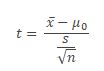
One Sample T Hypothesis Test (Student's T Test)
  • Where
    • x̅ is observed sample mean
    • μ0 is the hypothesized population mean (the value in H0)
    • s is the sample Standard Deviation
    • n is the number of observations in the sample

Steps to Calculate One Sample T Hypothesis Test

  • State the claim of the test and determine the Null Hypothesis and Alternative Hypothesis.
  • Determine the level of significance.
  • Calculate degrees of freedom.
  • Find the critical value.
  • Calculate the test statistics.
  • Make a decision, the Null Hypothesis will be rejected if the test statistic is in the rejection region.
  • Finally, interpret the decision in the context of the original claim.

One Sample T-Test Hypothesis

Null Hypothesis (H0): The difference between the population mean and the hypothesized value is equal to zero.

Alternative Hypothesis (H1):

  • The population mean is not equal to the hypothesized value (Two-tailed).
  • The population mean is greater than hypothesized value (Upper-tailed).
  • The population mean is less than hypothesized value (Lower-tailed).

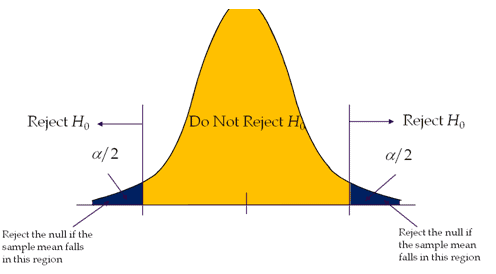
Two-Tailed T Test

A hypothesis test is performed if the population parameter is suspected to be different from the Null Hypothesis’s assumed parameter.

  • H0: μ=μ0
  • H1: μ≠μ0.
One Sample T Hypothesis Test (Student's T Test)

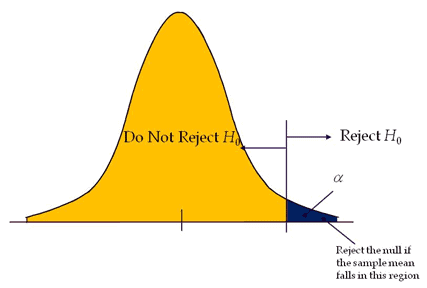
Right-tailed or Upper-tailed test

The Right-tailed test is also called the Upper-tail test. A hypothesis test is performed if the population parameter is suspected to be greater than the assumed parameter of the Null Hypothesis.

  • H0: μ≤μ0
  • H1: μ>μ0
One Sample T Hypothesis Test (Student's T Test)

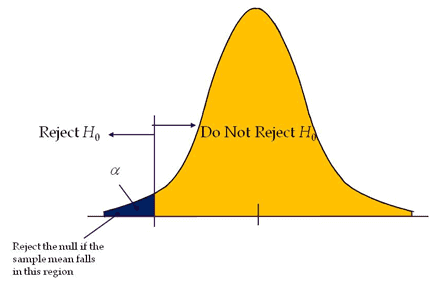
Left-tailed test or Lower-tailed test

The Left-tailed test is also known as a Lower-tail test. A hypothesis test is performed if the population parameter is suspected to be less than the assumed parameter of the Null Hypothesis.

  • H0: μ≥μ0
  • H1: μ<μ0
One Sample T Hypothesis Test (Student's T Test)

Example of a One-Sample T Hypothesis Test in a DMAIC Project

One Sample T-Tests are mostly carried out in Analyze phase of DMAIC to check the significant differences between the population mean and the sample means, while paired T-Tests are often used in the Improve phase to compare results before and after a process change.

Example of Two-Tailed Test

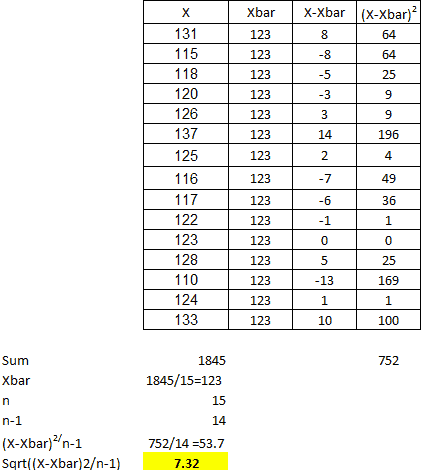
Example: Suppose the accepted average blood pressure for pregnant women is 120 mm Hg. Collected 15 random samples from pregnant women to check whether the sample blood pressure differs from accepted standard blood pressure.
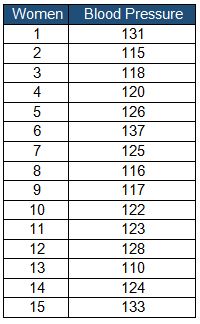
  • Null Hypothesis: H0: μ=120
  • Alternative Hypothesis: H1: μ≠120

Significance level: α=0.05

Degrees of freedom: 15 – 1 = 14

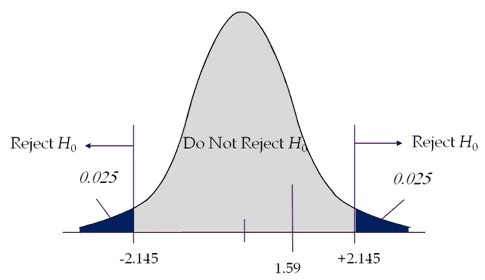
Calculate the critical value
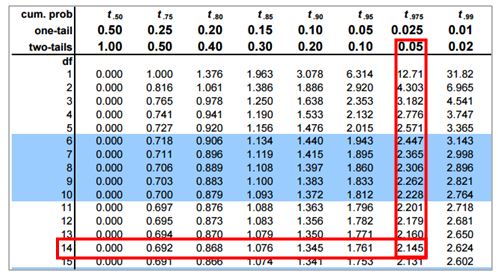
If the calculated t value is less than -2.145 or greater than 2.145, then reject the Null Hypothesis.

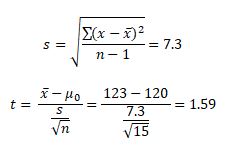
Test Statistics

  • x̅ = 123
  • μ0 = 120
One Sample T Hypothesis Test (Student's T Test)

Interpret the results: Compare t calc to t critical. In hypothesis testing, a critical value is a point on the test distribution compared to the test statistic to determine whether to reject the Null Hypothesis. The calculated t-statistic value is less than the critical value; hence we failed to reject Null Hypothesis.

One Sample T Two-Tailed Test Excel Template

Unlock Additional Members-only Content!

To unlock additional content, please upgrade now to a full membership.
Upgrade to a Full Membership
If you are a member, you can log in here.

Right-tailed test

Example: A software start-up company plans to introduce company transportation based on the town hall meeting’s feedback. The admin manager randomly collected 12 employees’ spending on public transportation for the month. With a 95% confidence level, is there any evidence that the population mean is above $400?
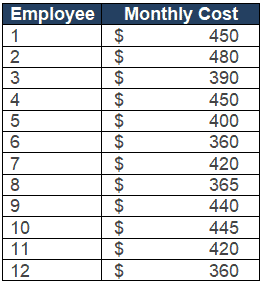
  • Null Hypothesis: H0: μ≤400
  • Alternative Hypothesis: H1: μ>400

Significance level: α = 0.05

Sample size n =12

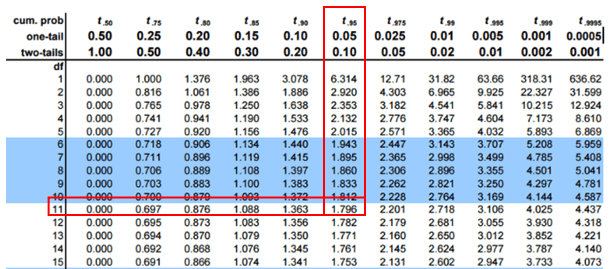
Degrees of freedom: 12 – 1 = 11

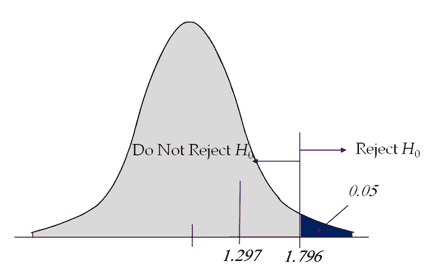
Calculate the critical value
One Sample T Hypothesis Test (Student's T Test)

If the calculated t value is greater than 1.796, then, reject the Null Hypothesis.

Calculate the Test Statistics

  • Sum of all samples =4980
  • x̅ = Σx/n = 4980 / 12=415
  • Σ(X-X̅)2 = 17650
  • Σ(X-X̅)2 /n-1 = 1604.5
  • Standard Deviations = √ Σ(X-X̅)2 /n-1 = 40
  • μ0 = 400
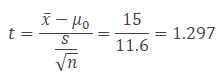
  • x̅- μ0 =15
  • s/√n = 40/√12 = 11.6

Interpret the results: Compare t calc to t critical. In hypothesis testing, a critical value is a point on the test distribution compared to the test statistic to determine whether to reject the Null Hypothesis. Since tcal value is less than t critical value and it is not in the rejection region. Hence we failed to reject the Null Hypothesis. There is no sufficient evidence to claim the population mean is above $400.

One Sample T Right-Tailed Test Excel Template

Unlock Additional Members-only Content!

To unlock additional content, please upgrade now to a full membership.
Upgrade to a Full Membership
If you are a member, you can log in here.

Left-tailed test

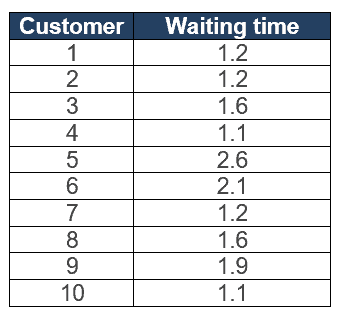
Example: The average waiting time for billing at XYZ restaurant is 1.9 minutes. The restaurant owner updated the billing software to reduce the waiting time. He randomly collected 10 customers waiting time at the billing counter. With a 95% confidence level, is there any evidence that the population’s average waiting time is less than 1.9 minutes?
  • Null Hypothesis: H0: μ≥1.9
  • Alternative Hypothesis: H1: μ<1.9

Significance level: α = 0.05

Sample size n = 10

Degrees of freedom: 10 – 1 = 9

Calculate the critical value
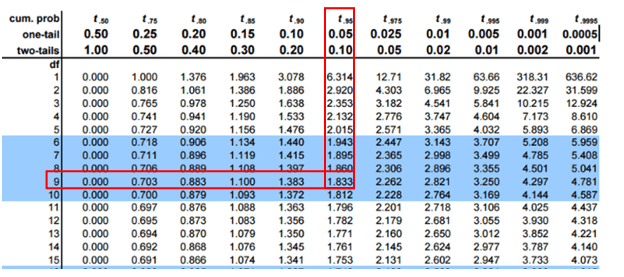
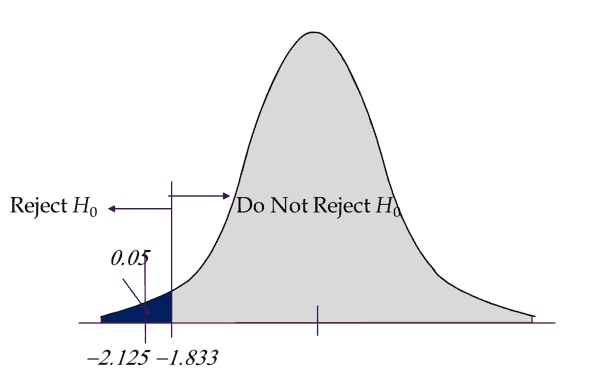
If the calculated t value is less than -1.833, then reject the Null Hypothesis.

Calculate the test Statistics

  • Sum of all samples = 15.6
  • x̅ = Σx/n = 15.6 / 10 = 1.56
  • Σ(X-X̅)2 = 2.3
  • Σ(X-X̅)2 /n-1 = 0.26
  • Standard Deviations = √ Σ(X-X̅)2 /n-1 = 0.51
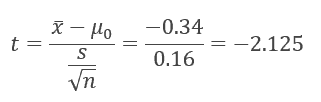
  • μ0 = 1.9
  • x̅- μ0 =-0.34
  • s/√n = 0.51 / √10 = 0.16

Interpret the results: Compare t calc to t critical. In hypothesis testing, a critical value is a point on the test distribution compared to the test statistic to determine whether to reject the null hypothesis. Since tcal value is less than the t critical value and it is in the rejection region. In other words, the absolute value of t calculated is greater than the t critical. Hence we reject the Null Hypothesis. There is sufficient evidence to claim the population mean is less than 1.9 minutes.

One Sample T Left Tailed Test Excel Template

Unlock Additional Members-only Content!

To unlock additional content, please upgrade now to a full membership.
Upgrade to a Full Membership
If you are a member, you can log in here.

One Sample T Hypothesis Test Videos

Additional One Sample T Hypothesis Test Resources

https://www.cliffsnotes.com/study-guides/statistics/univariate-inferential-tests/one-sample-t-test (One sample T-Test)

http://stattrek.com/probability-distributions/t-distribution.aspx

When you’re ready, there are a few ways I can help:

First, join 12,000+ other Six Sigma professionals by subscribing to my email newsletter. A short read every Monday to start your work week off correctly. Always free.

* * *

If you’re looking to pass your Six Sigma Yellow Belt, Green Belt or Black Belt exam, I’d recommend starting with my affordable study guide:

1)→ 🟡Pass Your Six Sigma Yellow Belt: built for ASQ, IASSC and ILSSI, 1,700+ practice questions with explanations, and six full-length mock exams for your exam

2)→ 🟢Pass Your Six Sigma Green Belt: a study guide organized by the exam Body of Knowledge, 1,300+ practice questions with detailed answer explanations, and 20 full-length mock exams

3)→ ⚫Pass Your Six Sigma Black Belt: the full Black Belt Body of Knowledge, 2,200+ practice questions with detailed answer explanations, and 20 full-length mock exams

You’ve spent so much effort learning Lean Six Sigma. Why leave passing your certification exam up to chance? This comprehensive study guide offers 1,700+ exam-like questions for Yellow Belts, 1,300+ for Green Belts and 2,200+ for Black Belts with full answer walkthroughs, access to instructors, detailed study material, and more.

​ Thousands have used this system to prepare. Join them here. 
Z Scores (Z Value) & Z Table

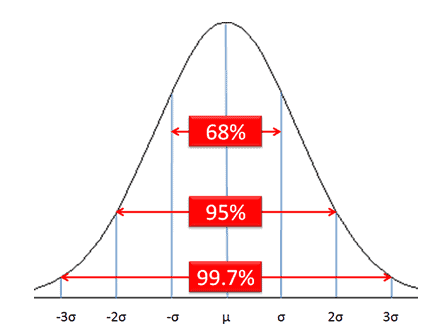
Z scores (Z value) is the number of standard deviations a score or a value (x) is away from the mean. In other words, the Z-score measures the dispersion of data. Technically, a Z-score tells you how many standard deviations value (x) are below or above the population mean (µ). If the Z value is positive, it indicates that the value or score (x) is above the mean. Similarly, if the Z value is negative, it means the value (x) is below the mean.

Z-scores are also how you answer a common question: what is the probability of a defect? The further a data point sits from a specification limit, the higher its Z-score (also called the process sigma), and the higher the process sigma, the less defective the process. This is actually where “Six Sigma” gets its name: a Six Sigma process has six standard deviations (6σ) between the process mean and the nearest specification limit.

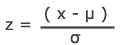
To find that probability yourself, calculate Z = (x – µ) / σ, where x is your sample data point, µ is the process mean, and σ is the standard deviation. Once you have that Z-score, the Z-table below converts it directly into a defect probability.

What is a Standard Normal Distribution?

A Normal Standard Distribution curve is a symmetric distribution where the area under the normal curve is 1 or 100%. The standard normal distribution is a type of special normal distribution with a mean (µ) of 0 and a standard deviation of 1.

A standard normal distribution always has a mean of zero and has intervals that increase by 1. Each number on the horizontal line corresponds to the z-score. Hence, use Z Scores to transform a given standard distribution into something that is easy to calculate probabilities on as it can determine the likelihood of some event happening. 

Z Scores (Z Value) & Z Table & Z Transformations

Any normal distribution with any value of mean (µ) and a sigma can be transformed into the standard normal distribution, where the mean of zero and a standard deviation of 1. This is also called standardization.

A Z-score tells how much standard deviation a value or score is from the mean (µ). For example, if a Z-score is negative 3 means the value (x) is 3 standard deviations left of the mean. Similarly, if the Z-score is positive 2.5 means the value (x) is 2.5 standard deviations to the right of the mean (µ).

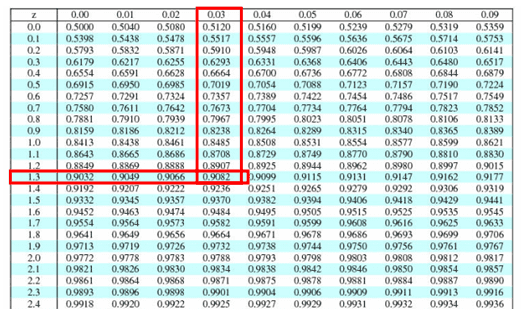
This is a common transformation, so there is a reference chart that allows us to look up values. Those values correlate to the value under the normal distribution curve. In other words, what’s the chance of an event happening? We use the Z table to find the percent chance.

How to Interpret the Z-score Table

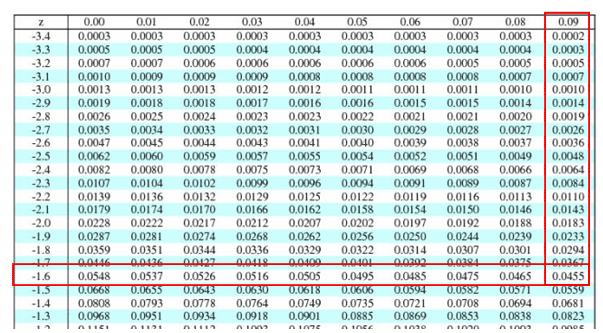
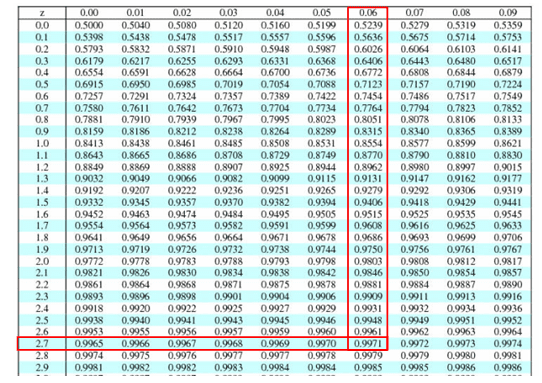
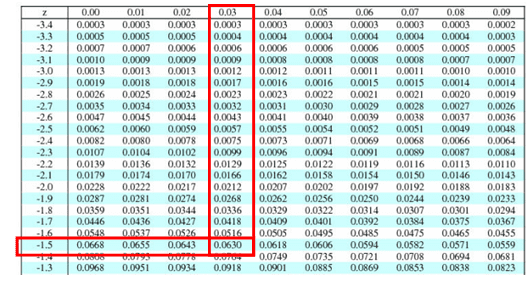
This page uses a cumulative z table: each value is the area to the left of z (z = 1.00 gives 0.8413). If your handbook’s table shows the area from the mean (0 to z), add 0.5 to its value for positive z to match; if it shows the upper tail, subtract its value from 1.

Bringing a book into an open-book exam? Find its tables before exam day. Books print the z table in different layouts, so check which one yours uses. I studied with an earlier edition of The ASQ Certified Six Sigma Black Belt Handbook.

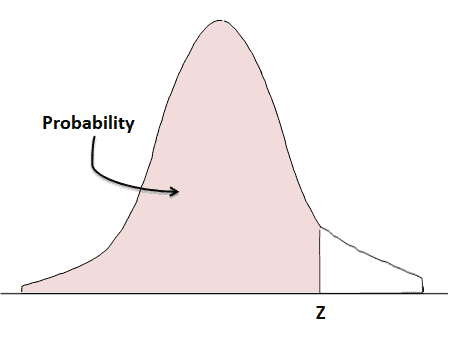
Most importantly, the Z-score helps to calculate how much area that specific Z-score is associated with. A Z-score table is also known as a standard normal table used to find the exact area. The Z-score table tells the total quantity of area contained on the left side of any score or value (x).

Z Scores (Z Value) & Z Table & Z Transformations

Z Score Table Download

Unlock Additional Members-only Content!

To unlock additional content, please upgrade now to a full membership.
Upgrade to a Full Membership
If you are a member, you can log in here.

There are two methods to read the Z-table:

Case 1: Use the Z-table to see the area under the value (x)

The first column in the Z-table top row corresponds to the Z-values and all the numbers in the middle correspond to the areas.

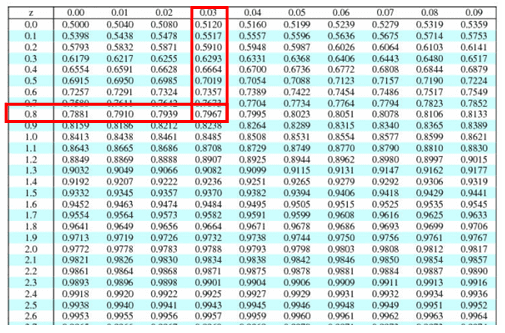
For example, a Z-score of -1.53 has an area of 0.0630 to the left of it. In other words, p(Z<-1.53) = 0.0630.

The standard normal table is also used to determine the area to the right of any Z-value by subtracting the area on the left from 1. 1-AreaLeft = Arearight

For example, a Z-score of 0.83 has an area of 0.7967 to the left of it. So, the Area to the right is 1 – 0.7967 = 0.2033.

Z Scores (Z Value) & Z Table & Z Transformations

Case 2: Use the Z-table to see what that score is associated with a specific area.

P(o<=Z<=x)

  • Pick the right Z row by reading down the right column.
  • Read across the top to find the decimal space.
  • Finally, find the intersection and multiply by 100.

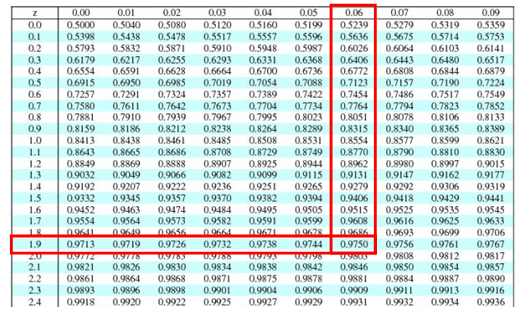
For example, the Value of Z corresponds to an area of 0.9750 to the left of it is 1.96.

What if the Z Score is off the Chart?

Z score tables sometimes only go up to 3. But depending on the spread of the population, z scores could go on for a while. A Z score of 3 refers to 3 standard deviations. That would mean that more than 99% of the population was covered by the z score. There’s not a lot left, but there is some. Use Excel to find the actual value if your table doesn’t go that high.

How do you Calculate a Z Score?

How to Create Z score in Excel

Using the Z score, find the percentage by using the formula: 1-NORMSDIST(Z), where Z is your calculated Z Score.

How to Calculate a Z Score by Hand

There are 2 different situations you need to be aware of when calculating a z score:

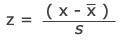
  • Z score for a sample
  • Z score for a population

While the z-score equations look very similar, remember that calculating the standard deviation of a population is different than the way you calculate the standard deviation of a sample.

The formula for transforming a score or observation x from any normal distribution to a standard normal score is :

Calculating a Z Score (generic)

Calculating a Z Score for a Population

z_pop

Instead of memorizing this formula, let’s see what it actually does

Experiment 1: What does a z-score actually measure?

Set μ = 0 and σ = 1.
Now move x to:

  • 1
  • 2
  • 3

Watch how far x moves from the mean.

👉 What you should observe:

  • z = distance in standard deviations
  • spacing is consistent

💡 Insight:

A z-score is not a value. It’s a distance.


Experiment 2: Change the Mean (μ)

Keep x fixed (e.g., x = 2).
Now move μ left and right.

👉 Observe:

  • The entire curve shifts
  • z-score changes even though x didn’t move

💡 Insight:

Z-score is relative, not absolute.


Experiment 3: Change the Spread (σ)

Keep x and μ fixed.
Increase σ from 1 → 4.

👉 Observe:

  • Curve becomes flatter and wider
  • z-score gets smaller
  • shaded probability changes

💡 Insight:

The same distance means different things depending on variability.


Experiment 4: Same x, Different σ → Different Probability

Try:

  • x = 2, μ = 0, σ = 1
  • x = 2, μ = 0, σ = 3

👉 Observe:

  • Same raw value
  • very different probabilities

💡 Insight:

Probability depends on distribution, not just the value.


Experiment 5: Connect to Z-Table Thinking

Adjust x until z ≈ 1.00, 2.00, 3.00

👉 Observe:

  • ~84%, ~97.5%, ~99.9%

💡 Insight:

This is what the Z-table is giving you.

Z Score for a Sample
z_sample

How many parts in a population will be longer or greater than some number?

Z score examples using standard deviation

Example 1: Longer than / Greater than

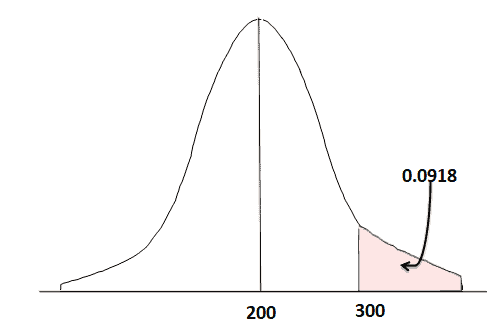
Hospital stays for admitted patients at a certain hospital are measured in hours and were found to be normally distributed with an average of 200 hours and a standard deviation of 75 hours. How many of these stays can be expected to last for longer than 300 hours?

  • x=300
  • μ = 200
  • σ = 75

Z = (x - μ)/σ = (300-200)/75 = 100/75 = 1.33

Z score from the table for 1.33 = 0.9082

Z Scores (Z Value) & Z Table & Z Transformations

Since, we are looking for longer, solution is P(x>300) = P(Z>1.33) = 1- P(Z<1.33)= 1-0.9082 = 0.0918 = 9.18%

Z Score Positive Template

Unlock Additional Members-only Content!

To unlock additional content, please upgrade now to a full membership.
Upgrade to a Full Membership
If you are a member, you can log in here.

Example 1.1

A batch of batteries with an average of 60v and a Standard Deviation of 4v. If 9 batteries are selected at random, what is the probability that the total voltage of the batteries is greater than 530?

Answer

Unlock Additional Members-only Content!

To unlock additional content, please upgrade now to a full membership.
Upgrade to a Full Membership
If you are a member, you can log in here.

Example 2: Less than

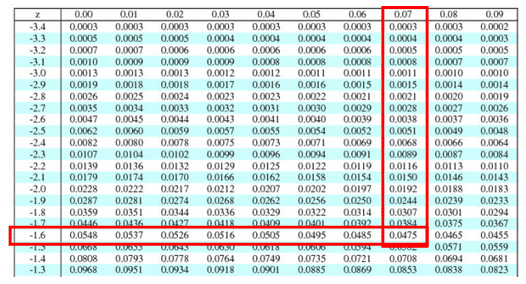
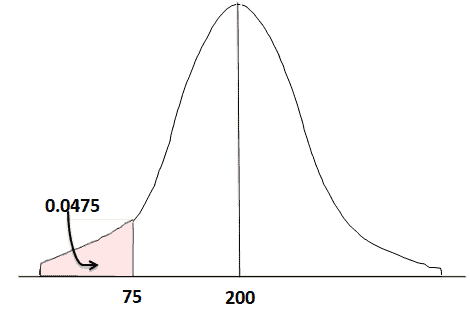
Hospital stays, for admitted patients at a certain hospital, are measured in hours and were found to be normally distributed with an average of 200 hours and a standard deviation of 75 hours. How many of these stays can be expected to last less than 75 hours?

  • x=75
  • μ = 200
  • σ = 75

Z = (x - μ)/σ = (75-200)/75 = -125/75 = -1.667

Z score from the table for -1.667 = 0.0475

Z Scores (Z Value) & Z Table & Z Transformations

Since we are looking for less than, the solution is = 4.75%

Z Score Negative Template

Unlock Additional Members-only Content!

To unlock additional content, please upgrade now to a full membership.
Upgrade to a Full Membership
If you are a member, you can log in here.

Example 2.2

What is the probability that the average voltage is less than 62?

Answer

Unlock Additional Members-only Content!

To unlock additional content, please upgrade now to a full membership.
Upgrade to a Full Membership
If you are a member, you can log in here.

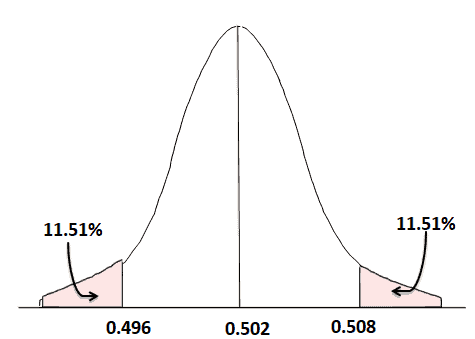
Example 3: Both less than AND greater than. (Percentage outside the range)

The mean inside diameter of a sample of 200 washers produced by a machine is 0.502 inches and the standard deviation is 0.005 inches. The purpose for which these washers are intended allow a maximum tolerance in the diameter of 0.496 to 0.508 inches, otherwise, the washers are considered defective. Determine the percentage of defective washers produced by the machine, assuming the diameters are normally distributed.

Less than

  • x=0.496
  • x̅ = 0.502
  • s=0.005

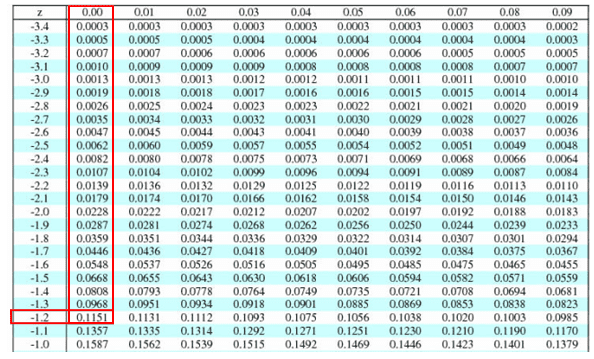
Z = (x - x̅)/s = (0.496-0.502)/0.005= -1.2

Z score from the table for -1.2 = 0.1151

Since we are looking for less than, solution for lower bound = 11.51%

More than

  • x=0.508
  • x̅ = 0.502
  • s=0.005

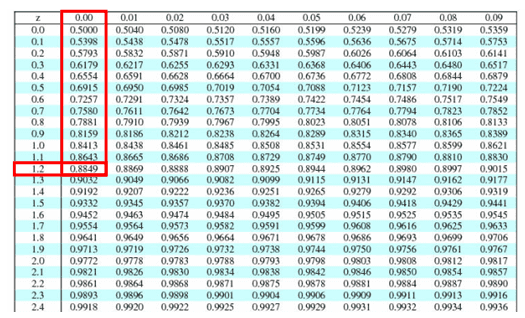
Z = (x - x̅)/s = (0.508-0.502)/0.005= 1.2

Z_score from the table for 1.2 = 0.8849

Since we are looking for more than that, the solution is 1-0.8849 = 0.1151 = 11.51%

So, the total is 23.02%

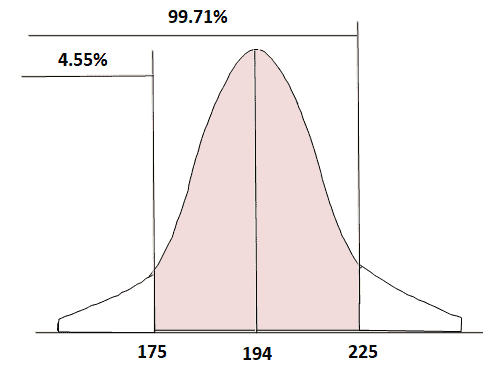
Example 4: Both upper and lower bound. (Percentage Inside the range.)

The weights of 500 American men were taken and the sample mean was found to be 194 pounds with a standard deviation of 11.2 pounds. What percentages of men have weights between 175 and 225 pounds?

P(X<175)

  • x=175
  • x̅ = 194
  • s=11.2

Z = (x - x̅)/s = (175-194)/11.2= -1.6964

Z_score from the table for -1.6964= 0.0455

P(X<175) = 4.55%

P(X<225)

  • x=225
  • x̅ =194
  • s=11.2

Z = (x - x̅)/s = (225-194)/11.2= 2.7678

Z score from the table for 2.7678 = 0.9971=99.71%

Since we are looking for weights between 175 and 225, P(175<x<225) = 99.71%-4.55% = 95.16%

Z Scores (Z Value) & Z Table & Z Transformations

 Additional Notes:

What do you do when the sample size is less than 20?

Great question! You'd apply student t-scores.

Six Sigma Green Belt Z Score Questions

Question: This formula Z = (X - μ)/σ is used to calculate a Z score that, with the appropriate table, can tell a Belt what ____________________________________.

A) Ratio the area under the curve to the total population

B) Number of Standard Deviations between X and μ

C) The Median of the sample population is

D) Proportion of the data is between X and μ

Answer: 

Unlock Additional Members-only Content!

To unlock additional content, please upgrade now to a full membership.
Upgrade to a Full Membership
If you are a member, you can log in here.

Question: A battery manufacturer was considering changing suppliers for a particular part. The purchasing manager required that the average cost of the part be less than or equal to $32 in order to stay within budget. A sample of the 32 initial deliveries had a Mean of the new product upgrade price of $28 with an estimated Standard Deviation of $3. Based on the data provided, the Z value for the data assuming a Normal Distribution is?

A) 0.67

B) 1.33

C) 2.67

D) 4.33

Answer:

Unlock Additional Members-only Content!

To unlock additional content, please upgrade now to a full membership.
Upgrade to a Full Membership
If you are a member, you can log in here.

When you're ready, there are a few ways I can help:

First, join 12,000+ other Six Sigma professionals by subscribing to my email newsletter. A short read every Monday to start your work week off correctly. Always free.

* * *

If you're looking to pass your Six Sigma Yellow Belt, Green Belt or Black Belt exam, I'd recommend starting with my affordable study guide:

1)→ 🟡Pass Your Six Sigma Yellow Belt: built for ASQ, IASSC and ILSSI, 1,700+ practice questions with explanations, and six full-length mock exams for your exam

2)→ 🟢Pass Your Six Sigma Green Belt: a study guide organized by the exam Body of Knowledge, 1,300+ practice questions with detailed answer explanations, and 20 full-length mock exams

3)→ ⚫Pass Your Six Sigma Black Belt: the full Black Belt Body of Knowledge, 2,200+ practice questions with detailed answer explanations, and 20 full-length mock exams

You've spent so much effort learning Lean Six Sigma. Why leave passing your certification exam up to chance? This comprehensive study guide offers 1,700+ exam-like questions for Yellow Belts, 1,300+ for Green Belts and 2,200+ for Black Belts with full answer walkthroughs, access to instructors, detailed study material, and more.

​ Thousands have used this system to prepare. Join them here. 
Chi-Square Goodness of Fit Test

Goodness of fit tests
Photo by darkday

A chi-square goodness-of-fit (GOF) test checks how well an observed categorical data distribution fits an expected distribution. In other words, it tests whether the frequencies observed in different categories match some hypothesized frequencies. This is useful when you have one categorical variable and a theory or historical data about what the distribution of that variable should be. For example, you might want to verify if defect occurrences follow a Poisson distribution, or if customer preferences are evenly distributed among choices. The chi-square GOF test is a non-parametric test (no assumption of normality; it deals directly with category counts).

When to use Chi-Square Goodness of Fit?

A chi square goodness-of-fit test can be conducted when there is one categorical variable with more than two levels. If there are exactly two categories, then a one proportion z test may be conducted.

Reference.

The chi-square goodness-of-fit test requires 2 assumptions2,3:

1. Independent observations;

2. For 2 categories, each expected frequency Ei must be at least 5.

For 3+ categories, each Ei must be at least 1 and no more than 20% of all Ei may be smaller than 5.

Reference

When to use: Use a GOF test in Six Sigma during Measure or Analyze when you need to validate distributional assumptions. For instance, if you assume defects per hour follow a Poisson distribution, a GOF test can confirm or refute that. Or if historical data suggest a certain proportional breakdown of defect causes, you can test if current data still fits that pattern. This helps ensure you’re using the correct statistical models and can reveal changes in process behavior.

Hypotheses: Typically, for a goodness-of-fit test:

  • H₀ (null hypothesis): The observed distribution fits the expected distribution. (No significant difference between observed and expected frequencies.)
  • H₁ (alternative hypothesis): The observed distribution does not fit the expected distribution (at least one category’s frequency is significantly different from expected).

In plain terms, H₀ assumes any differences between observed and expected counts are just due to random chance, while H₁ asserts that the differences are too large to be random, indicating the distribution has changed or the assumption was wrong.

Assumptions: Each observation falls into one of the categories, and you have a sufficiently large sample such that expected counts in each category aren’t too low. A common rule of thumb is that expected counts should be at least 5 in each category (or if that’s not possible, no more than 20% of categories have expected < 5). If expected frequencies are very small, the chi-square approximation may not be accurate (you might need to combine categories or use an exact test).

Steps to Perform a Chi-Square Goodness-of-Fit Test

  1. Define the hypotheses:
    • Null (H₀): The observed category proportions are equal to the expected proportions (no difference between observed and expected distribution).
    • Alternative (H₁): The observed proportions differ from the expected (at least one category is not in line with the expected distribution).
  2. Choose a significance level (α): Commonly α = 0.05 (5% significance) is used, corresponding to 95% confidence.
  3. Collect data and calculate expected frequencies: Determine the expected count for each category under H₀. Often this is done by multiplying the total sample size by the expected percentage for each category. Expected values might be given by a theoretical distribution (e.g., a probability model or historical proportions). Ensure the total of expected counts equals the total observations.
  4. Compute the chi-square statistic:
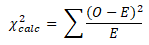
    χ² = Σ (Oi – Ei)² / Ei, summed over i = 1 to k,
    where Oi is the observed frequency for category i and Ei is the expected frequency. Each term (O – E)²/E measures the squared difference relative to expectation. Sum these across all k categories to get χ².
  5. Determine degrees of freedom: For goodness-of-fit, df = (number of categories – 1) minus any parameters estimated from the data. If the expected proportions are completely specified in advance, df = k – 1. (For example, if you have 4 categories, df = 3.) If you estimated parameters (like the mean of a Poisson from the data), subtract those as well.
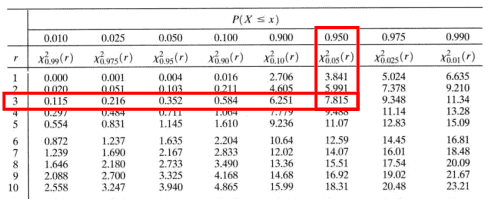
  6. Find the critical value: Because this test is right-tailed (we care about large χ²), find the critical χ² value for the chosen α and the calculated degrees of freedom. This value comes from the chi-square distribution table. For instance, at α = 0.05 and df = 3, the critical value is 7.815 (meaning that 5% of the time, a random χ²(3) would exceed 7.815). If using p-value approach, compute p (the area to the right of your χ² statistic).
  7. Make a conclusion: Compare your χ² statistic to the critical value. If χ²_stat > χ²_critical (or p-value < α), reject H₀. This means the differences between observed and expected are statistically significant: the data do not fit the expected distribution. If χ²_stat is smaller than critical (p > α), you fail to reject H₀, meaning any differences are small enough to be explained by chance, and the distribution fits as assumed.

Goodness-of-Fit Example: Did Our Customer Distribution Change?

To illustrate, consider a realistic Six Sigma scenario: A loyalty program manager wants to know if the age distribution of the company’s priority customers has changed over the last decade. Ten years ago, the company categorized its priority customers by age and found the distribution to be: 15% were under 25, 40% were 25-40 years old, 25% were 40-60, and 20% were over 60. Now, in the Analyze phase of a project, the manager takes a random sample of 500 current priority customers and observes their age breakdown. We can use a chi-square goodness-of-fit test to see if the current sample’s distribution differs from the 2010 baseline.

Expected age distribution of priority customers in 2010 (historical baseline). Each percentage represents the proportion of customers in that age group (SixSigmaStudyGuide.com).

From the 2010 data (expected distribution):

  • Under 25: 15%
  • 25-40: 40%
  • 40-60: 25%
  • Over 60: 20%

If we expect those proportions to still hold, the expected frequencies out of 500 customers would be:
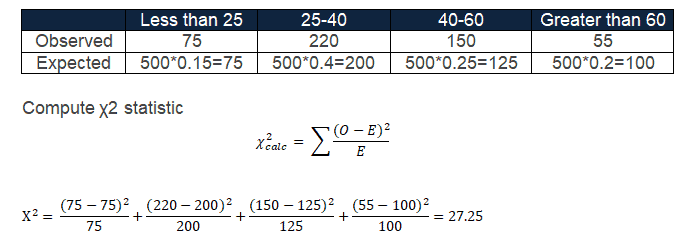
Under 25: 0.15 * 500 = 75
25-40: 0.40 * 500 = 200
40-60: 0.25 * 500 = 125
Over 60: 0.20 * 500 = 100

Observed age distribution of a 2020 sample of 500 priority customers (SixSigmaStudyGuide.com). These are the actual counts in each age group from the sample.

The observed frequencies in the 2020 sample of 500 are:
Under 25: 75
25-40: 220
40-60: 150
Over 60: 55

Let’s run the chi-square GOF test at 95% confidence (α = 0.05). First, state hypotheses:

  • H₀: The 2020 age distribution matches the 2010 distribution (no change).
  • H₁: The 2020 age distribution differs from 2010 (at least one age group has a different proportion).

We already have expected (E) and observed (O) counts. Now calculate the χ² statistic:

  • Under 25: O=75, E=75 ⇒ (75-75)²/75 = 0
  • 25-40: O=220, E=200 ⇒ (220-200)²/200 = (20)²/200 = 400/200 = 2.0
  • 40-60: O=150, E=125 ⇒ (150-125)²/125 = 625/125 = 5.0
  • Over 60: O=55, E=100 ⇒ (55-100)²/100 = (-45)²/100 = 2025/100 = 20.25

χ²_stat = 0 + 2.0 + 5.0 + 20.25 = 27.25 (approximately).

Degrees of freedom = 4 categories – 1 = 3. For df = 3 at α = 0.05, the chi-square critical value is 7.815. Our test statistic (27.25) is much larger than 7.815, falling deep in the right tail beyond the cutoff. This means the probability of seeing a χ² that large under H₀ is extremely low. We therefore reject H₀.

Conclusion: The sample data provide strong evidence that the age distribution of priority customers in 2020 is different from the 2010 distribution. Specifically, the chi-square contributions suggest the biggest differences are in the older age groups (the “Over 60” category had far fewer people than expected, contributing heavily to χ²). In Six Sigma terms, if this was a KPI or a customer demographic critical to quality, we’d note that the customer base has shifted significantly over the decade.

(Notice that this GOF test was one-tailed (right-tail) because only a large χ² (indicating a big deviation) would lead us to reject H₀. Small deviations wouldn’t).

Chi square goodness of fit test specifically tells how well a categorical (nominal or ordinal) sample distribution fit into a hypothetical distribution. In other words, it is the test used to check if the sample data is consistent with a hypothesized distribution of the population. The goodness of fit test is used to determine the observed sample distribution matches or fits the expected values; hence we use the term goodness of fit.

The goodness of fit is a non-parametric test because it does not rely on estimates of a population parameter like mean or variance to make an inference on the characteristics of the population.

Structure of a Chi-Square Goodness of Fit Test

The goodness of fit tests is structured in cells; therefore, the observed frequency goes in each cell. Furthermore, the distribution you are trying to match would have a theoretical frequency. Then, the chi-square is summed across all cells.

Use the data values structured into cells, explicitly requiring a calculated chi-square test statistic. The unknown distribution is tested; likewise, the Degrees of Freedom vary according to the distribution.

GOF Distribution  | Degrees of Freedom

Normal | # cells – 3

Poisson | # cells – 2

Binomial | # cells – 2

Uniform | # cells – 1

Steps to perform Chi-Square goodness of fit

Step1:

Firstly, define the null hypothesis and alternative hypothesis

  • Null hypothesis (H0): There is no difference between the observed value and the expected value
  • Alternative hypothesis (H1): There  is a significant difference between the observed value and the expected value

Step 2:

Secondly, specify the level of significance.

Step 3:

Thirdly, compute the χ2 statistic.

  • O is the observed value
  • E is the expected value

Step 4:

Fourthly, calculate the degree of freedom:

The degrees of freedom in chi-square test depends on the sample distribution

Step 5:

Then, find the critical value based on degrees of freedom.

Step 6:

Finally, draw the statistical conclusion:

If the test statistic value is greater than the critical value, reject the null hypothesis. Hence, we can conclude that there is a significant difference between the observed value and the expected value.

Chi-Square goodness of fit test Example 1: Did the Distribution Change?

Ten years ago, US airlines categorized the priority customers (those who completed 10,000 miles traveled in a year) based specifically on age:

Similarly, in 2020, 500 priority passengers were sampled, and below are the results:

At a 95% confidence level, would you conclude that the population distribution of priority customers changed in the last 10 years?

  • Null hypothesis (H0): The sample data meet the expected distribution.
  • Alternative hypothesis (H1): The sample data does not meet the expected distribution.

Level of significance: α=0.05:

Degrees of freedom = number of categories (n)= 4

n-1 =3

Chi-square critical value for 3 degrees of freedom =7.815

The test statistic value is greater than the critical value; hence, we can reject the null hypothesis.

So, we can conclude that the priority customers in 2020 are different than those expected based on the 2010 population.

Download Chi-Square Goodness of Fit Exemplar

Unlock Additional Members-only Content!

To unlock additional content, please upgrade now to a full membership.
Upgrade to a Full Membership
If you are a member, you can log in here.

Chi-Square Normality Test

Many statistical techniques (regression, ANOVA, t-tests, etc.) rely on the assumption that data is normally distributed. Hence, the chi-square goodness of fit test is one of the good options to check whether the data follows a normal distribution.

Furthermore, the chi-square goodness of fit test is an alternative to the Anderson-Darling test, Kolmogorov-Smirnov (K-S) test, and Shapiro-Wilk test to test the normality.

Similar to other statistical hypothesis tests, the chi-square goodness of fit test also needs to compute the test statistics and find the critical value for a given degree of freedom and confidence level. If the chi-square value is greater than the critical value, reject the null hypothesis.

How to conduct Chi-Square goodness fit normality test

  • Determine the null hypothesis, i.e. data is sampled from a normal distribution and alternative hypothesis.
  • Compute the sample mean as well as the standard deviation.
  • Then, define the confidence level.
  • Bin the data: Determine non-overlapping bins, and then count values in each bin
  • Furthermore, find the cumulative probability for each category endpoint.
  • After that, compute the probability that a randomly selected value would go into each category.
  • Find expected observations for each bin, which is the product of the probability of observation would fall in the bin compared to the sample size (n).
  • Likewise, compute the chi-square statistic. χ2 = Σ [ ( Observed frequency – Exp frequency) 2 / Exp frequency].
  • Find the degrees of freedom based specifically on the number of categories or bins. The degrees of freedom for the chi-square goodness of fit test is the number of categories minus 1, minus the number of parameters estimated from the data. When you estimate both the mean and the standard deviation from the sample, df = k – 1 – 2 = k – 3. If both are given in advance, df = k – 1.
  • Find the critical value based on degrees of freedom.
  • Finally, draw the statistical conclusion: If the test statistic value is greater than the critical value, reject the null hypothesis.

Chi-Square normality test example

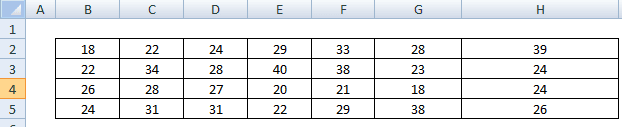
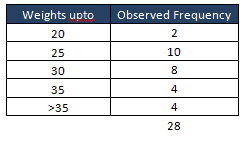
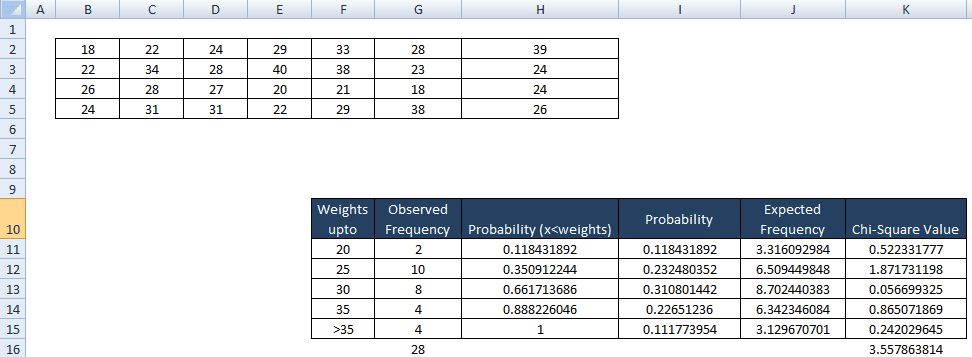
Example: 28 students’ weights (in kgs) are collected in ABC school. Test whether the data is normally distributed, given that the confidence level is 95%.

  • H0: Students’ weights in an ABC school follow a normal distribution
  • H1: Students’ weights in an ABC school do not follow a normal distribution
Firstly, compute the sample mean and standard deviation.
  • Select all the data and enter” =Average(B2:H5)” for mean and “ Stdev(B2:H5)” for standard deviation
  • Confidence level = 95%
Secondly, bin or categories the data and count the values
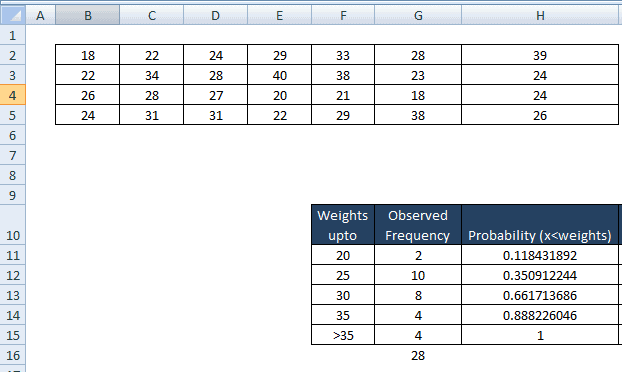
Thirdly, find the cumulative probability for each category endpoint.
  • In cell H11 type NORMDIST (20, L2, L4, TRUE),
  • Similarly H12 =  NORMDIST (25, L2, L4, TRUE),
  • H13 =  NORMDIST (30, L2, L4, TRUE),
  • H14=  NORMDIST (35, L2, L4, TRUE),
  • H15 = 1 (the cumulative probability up to infinity is 1),
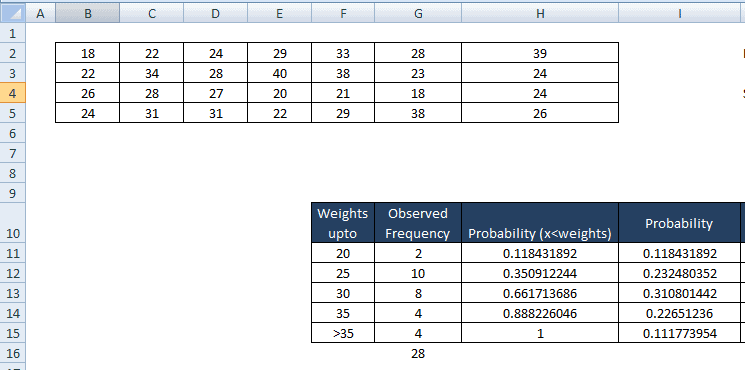
Fourthly, compute the probability that a randomly selected value would go in each category.
  • For I 11 cell, ie less than 20 copy the same value ie 0.118431892
  • In cell I 12, i.e. values between 25 to 20= H12-H11 = 0.350912244-0.118431892 = 0.232480352
  • Similarly for I13 = H13-H12=0.310801442
  • I14 = H14-H13 = 0.226512236
  • I15 = H15-H14 = 0.111773954
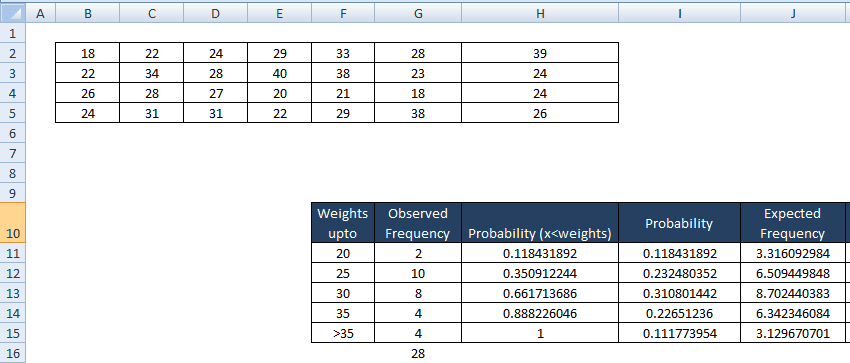
Then, find expected observations in each bin, which is the product of the probability of observation would fall in the bin to the sample size (n) =28.
  • J11 = I11*$G$16 = 3.316092984
  • Similarly, J12=I12*$G$16=6.509449848
  • J13=I13*$G$16=8.702440383
  • J14=I14*$G$16=6.342346084
  • J15= I15*$G$16=3.129670701
Finally, find the chi-square statistic. χ2 = Σ [ ( Observed frequency – Exp frequency) 2 / Exp frequency]
  • K11 = (G11-J11)2/J11 = 0.522331777
  • Similarly, K12 =  (G12 – J12)2 / J12 = 1.871731198
  • K13=(G13-J13)2/J13=0.056699325
  • K14=(G14-J14)2/J14 = 0.865071869
  • K15=(G15-J15)2/J15 = 0.242029645
  • Then, find the sum of chi-square values = K16= sum(K11:K15) =3.55786
  • Following that logic, the Degrees of freedom = No of categories -3 =5-3 =2
  • Consequently, the Critical value =5.991

Conclusion: The chi-square value of 3.558 is less than the critical value of 5.991. In hypothesis testing, a critical value is a point on the test distribution that is compared to the test statistic to determine whether to reject the null hypothesis. If the calculated chi-square is smaller than the critical value, we fail to reject the null hypothesis. So we have no evidence that the students’ weights are not normal. That is not proof that they are normal. Note also that two bins have expected counts under 5 (3.3 and 3.1). With only 28 values the chi-square test is rough here, so check a normal probability plot as well. The bins are: under 20, 20 to under 25, 25 to under 30, 30 to under 35, and 35 or more.

Download Chi-Square Test of Normality Exemplar

Unlock Additional Members-only Content!

To unlock additional content, please upgrade now to a full membership.
Upgrade to a Full Membership
If you are a member, you can log in here.

Chi-Square Normality Testing

Dispersion

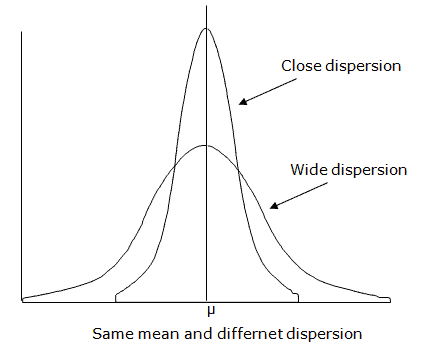
Dispersion is the degree of variation in the data. In other words, the extent of the spread of values from the mean. Items in a data set tend to differ from each other and the mean. So, dispersion measures the extent to which different items tend to disperse away from the central tendency.

The measure of central tendency gives the central value around which all the values spread along with the central value, but that does not give the correct picture of the variability of the data.

The better method to find the spread or scatter of the data is the measure of dispersion. It attempts to quantify the variability or spread of the data. The measure of dispersion tells how the data spreads or scatters around the center value. Dispersion is nothing but “distance from the average”.

Why Measure of Dispersion Is Important

For Example, Set-1 household income data is $70K, $60K, and $50K respectively; the average is $60K. Set-2 household income is $20K, $50K, and $100K; the average is $60K.

Dispersion

Dispersion indicates the extent of uniformity. Uniformity and degree of variation are inversely proportional. In other words, more uniformity, less variation. From the above example, though the average salary of the two sets is the same ($60K), the first set of household data indicates more uniformity. Similarly, the second set of data shows more variation around the center.

If the means of two or more series are the same, do not think of them as similar because their other characteristics (dispersion, skewness, kurtosis), may differ. Hence, the method of dispersion helps to find the correct variation of the data.

Objective of Dispersion

  • To determine the reliability of an average
  • Compare two or more data sets with regard to the variability
  • Facilitate computations of other statistical measures
  • To indicate the level of uniformity of variables

Different types of Measures of Dispersion

There are several measures of dispersion, the most common being are

Range

Range is the difference between the maximum and the minimum value.

Example: The age of the randomly sampled audience in a theatre is 55, 16, 23, 65, 45, 34, 28, 37, 58, and 24. Find the Range.

Arrange the values in ascending order: 16, 23, 24, 28, 34, 37, 45, 55, 58, 65

Range = Maximum-Minimum = 65 -16 = 49

  • The range can be used with ordinal or interval ratio variables but cannot be used with a nominal scale.
  • The disadvantage of Range: it completely depends upon the extreme values. Thus, the range is affected by the outliers.

Variance

Variance measures the dispersion of a set of data points around their mean value.

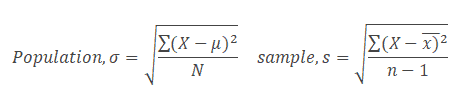
Population variance, denoted by sigma squared, is equal to the sum of squared differences between the observed values and the population mean, divided by the total number of observations.

Sample variance is denoted by s squared and is equal to the sum of squared differences between observed sample values and the sample mean, divided by the number of sample observations minus 1.

Standard Deviation

Standard Deviation is the most popular measure of dispersion. The symbol for the measurement of dispersion in a population is denoted by the Greek letter sigma σ. Similarly, the sample standard deviation denoted by s (or sd) is a point estimate for the population standard deviation / the dispersion statistic for samples.

Dispersion

Standard deviation is the positive square root of the arithmetic mean of the squares of the deviations of all the observations from their mean.

Unlike range, the standard deviation takes each data point into account while calculating the dispersion.

The lower the standard deviation, the lower the process variability. In other words, data points are closer to the mean or average value.

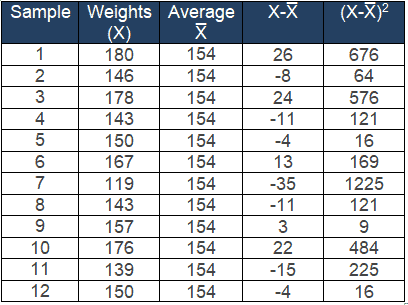
Example: Determine the standard deviation of the weights (in lbs) of 12 samples.

n =12 and n -1 =11

Average of 12 samples X̅= ΣX/n = 1848 / 12 = 154

Compute the deviation i.e (X-X̅) and then square each deviation (X-X̅)2

Dispersion

Sample standard deviation s= √Σ(X-X̅)2 / n-1 = √3702 / 11 = 18.3

s is the standard deviation of the sample (18.3) which is used as an estimate for the population from which the sample was taken.

Coefficient of Variation

The Coefficient of Variation is the standard deviation relative to the mean. In other words, the Coefficient of Variation is equal to the standard deviation divided by the mean, and it is expressed as a percentage. It is also known as relative standard deviation. See the dedicated Coefficient of Variation page for the full formula walkthrough, worked examples, and how to interpret it.

COV = s/ X̅ * (100%) or COV = σ / µ * 100%

Example: From the above example s = 18.3 and X̅ = 154

Coefficient of Variation COV = s/ X̅ * (100%) = 18.3 / 154 * 100 = 11.9%

Inter Quartile range

Inter quartile range is one of the measures of dispersion. It is defined as the difference between the first and third quartiles.

IR = Q3 – Q1

Example: Find the Inter Quartile range of 10 students’ marks in a science subject.

56, 78, 35, 89, 92, 52, 66, 72, 84, 96

  • Arrange the values in ascending order
  • 35, 52, 56, 66, 72, 78, 84, 89, 92, 96
  • n=10
  • Calculate Q1 = ¼ (n+1) = 11 / 4 = 2.75th term = 52 + (0.75) * (56 – 52) = 55
  • Calculate Q3 = ¾ (n+1) = 3 * 11 / 4 = 8.25th term = 89 + (0.25) * (92 – 89) = 89.75

Inter Quartile range = Q3-Q1 = 89.75 – 55 = 34.75

Kurtosis

Kurtosis is a statistical measure to determine whether the data are heavy-tailed or light-tailed relative to a normal distribution.  In other words, Kurtosis is a measure of the thickness of the tails of a distribution.

Kurtosis is a measure of the peakedness of a distribution. The larger the kurtosis, the more peaked the distribution. The standard normal distribution has a kurtosis of 3.

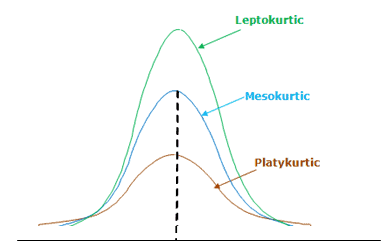
There are three types of Kurtosis

  • Leptokurtic: It is a curve having a high peak than the normal curve. Too much concentration of the items near the center. Leptokurtic distribution has positive kurtosis values. Most financial returns are Leptokurtic.
  • Platykurtic: It is a curve having a low peak (flat) than the normal curve. There is less concentration of items near the center. A platykurtic distribution shows a negative excess kurtosis.
  • Mesokurtic: It is a curve having a normal peak or the normal curve. There is an equal distribution of items around the center values. Mesokurtic has zero value kurtosis value. In other words, Mesokurtic is the same as the normal distribution.

 What is Excess Kurtosis?

It is a metric that compares the kurtosis of a normal distribution to the kurtosis of a distribution. The normal distribution kurtosis value is 3.

Hence, Excess Kurtosis = Kurtosis – 3.

We need six points (strata, units of measure) under the upper control limit of the range in order to have sufficient measurement discrimination. This is due to rounding. Too much rounding causes a loss of information about dispersion in a sample.

http://www.six-sigma-material.com/Measures-of-Dispersion.html (Measures of Dispersion)

Important Videos on Dispersion

When you’re ready, there are a few ways I can help:

First, join 12,000+ other Six Sigma professionals by subscribing to my email newsletter. A short read every Monday to start your work week off correctly. Always free.

* * *

If you’re looking to pass your Six Sigma Yellow Belt, Green Belt or Black Belt exam, I’d recommend starting with my affordable study guide:

1)→ 🟡Pass Your Six Sigma Yellow Belt: built for ASQ, IASSC and ILSSI, 1,700+ practice questions with explanations, and six full-length mock exams for your exam

2)→ 🟢Pass Your Six Sigma Green Belt: a study guide organized by the exam Body of Knowledge, 1,300+ practice questions with detailed answer explanations, and 20 full-length mock exams

3)→ ⚫Pass Your Six Sigma Black Belt: the full Black Belt Body of Knowledge, 2,200+ practice questions with detailed answer explanations, and 20 full-length mock exams

You’ve spent so much effort learning Lean Six Sigma. Why leave passing your certification exam up to chance? This comprehensive study guide offers 1,700+ exam-like questions for Yellow Belts, 1,300+ for Green Belts and 2,200+ for Black Belts with full answer walkthroughs, access to instructors, detailed study material, and more.

​ Thousands have used this system to prepare. Join them here. 
Box Plots (aka Box and Whisker Plots)

What is a Box and Whisker Plot?

Box plots are graphical tools that let you easily visually compare variations between the data sets evaluated. It also makes comparisons quickly and easily. In other words, Box plots are used in statistics to graphically display various parameters at a glance.

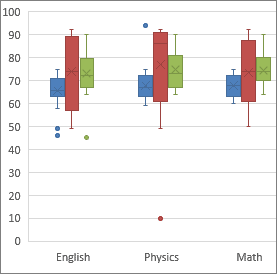
Graphical analysis is one of the best ways to analyze the problems in Six Sigma projects. It is an effective way to visualize data patterns and provides key insights into the data. Different graphical tools, such as Run charts, Scatter diagrams, Histograms, and Pareto Chart depict different data features such as trend, frequency, dispersion, and shape of the distribution. Box plot, a.k.a Box and Whisker plot, is a pictorial representation of continuous data. Box plots show the max, min, median, interquartile range Q1, Q3, and outlier.

Box Plot
From Microsoft

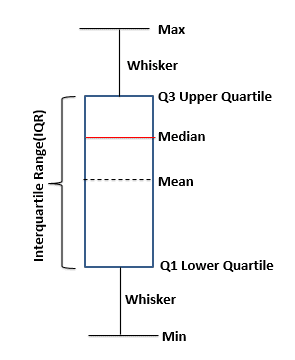
The box runs from the first quartile (Q1) to the third quartile (Q3), so it holds the middle 50% of the data. A line inside the box marks the median. The whiskers extend from each end of the box to the smallest and largest values that are not outliers. They show the spread outside the middle 50%.

  1. Median.
  2. Maximum.
  3. Minimum
  4. First quartile (25th percentile)
  5. Third quartile (75th percentile)

Why Box Plots

Box plots are very effective and easy to read. Graphically it shows the variation between multiple variables and the variations within the ranges.

It is also called a box-and-whisker plot. It displays the five-number summary: the minimum, first quartile, median, third quartile and maximum. It shows how the data scattered within those ranges will help for effective decision-making.

When to use Box plot?

  • Box plots compare multiple data sets from independent sources that may have some relationship.
  • To compare the process changes before and after the improvements
  • Box plots help to display various parameters at a glance.
  • To read the median, interquartile range, and outliers in the data set
  • When the data is in metric scale levels such as age, temperature, etc.

What Can Box Plots Tell Us?

  • Middle values: The box indicates the range in which the middle 50% of all data lies
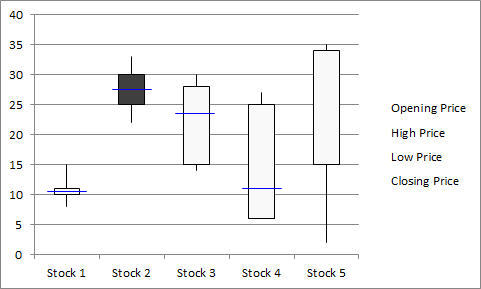
  • Median: The blue horizontal line indicates the median of the group.
  • 1st Quartile and 3rd Quartile: The lower end of the box is the 1st quartile, and the upper end is the 3rd quartile.
    • Useful in visualizing most of the spread of variation.
    • Ex. Stock 1 typically has the least variation.
  • Skewness: By looking at a box plot you can tell if your data distribution is skewed if the line inside the box is not centered.
    • Ex. Stock 4’s median is not centered. Thus this data is skewed.
  • Extreme values: The vertical lines (whiskers) extend to the most extreme data points that are still within 1.5 x IQR of the box (Q1 – 1.5 x IQR and Q3 + 1.5 x IQR). If there are no outliers, the whiskers end at the max and min values.
    • Ex. Stock 5 tends towards larger values.
  • Data points beyond the whiskers (more than 1.5 x IQR outside the box) are plotted as outliers with dots, small circles, or stars.
  • Some of the box plots also make use of an additional character to represent the mean of the sample data.
  • Some of the box and whisker plots make use of a cross-hatch that is placed on the whiskers. All the box plots will definitely have whiskers.
Box plots
Box plots

How to Make a Box and Whisker Plot?

Now, coming to the creation of box and whisker plots, you will need to follow the points given below:

  • Gather the data: Get the data for which you need to create plots.
  • Organize this data: Order the data by sorting them numerically, in ascending or increasing order.
  • Calculate Medians: Find out the Median of this data range. This Median will divide the data into halves. And to find out the quartiles, compute the Medians of the 2 halves. If the data set has an odd set of numbers, the Median would have an equal amount of numbers on both sides. And, if the data set has an even set of numbers, the 2 numbers in the middle would have to be added up and averaged.
  • Calculate 1st and 3rd quartiles: This can be found out by finding out the Median of each of the halves.
  • Draw plot lines: Now, you will need to draw plot lines and mark the Median and quartiles.

Box Plot Example

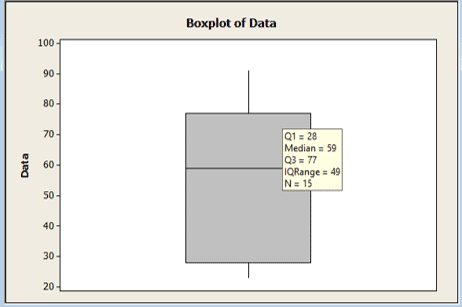
Example: Draw a Box plot for the following 15 points

23,28,44,72,66,54,89,91,26,24,59,74,81,36,77

Step 1: Organize the data: Arrange the data in ascending order

23,24,26,28,36,44,54,59,66,72,74,77,81,89,91

Step 2: Calculate median: 23,24,26,28,36,44,54,59,66,72,74,77,81,89,91

59 is the median value

Step 3: Find 1st Quartile: find the median of the lowest half of the data set

23,24,26,28,36,44,54

28 is the median value

Step 4: Find the 3rd Quartile: find the median of the upper half of the data set

66,72,74,77,81,89,91

77 is the median value

Step 5: Draw a 5-number summary: Draw plot lines and mark the Lowest, Highest points, Median, and quartiles.

Uses of Box and Whisker Plot

There are various uses for this plot. Given below are some of the main features and advantages:

  • Easy to use: It is a convenient way to depict the numerical data groups in a graphical manner, especially with the help of quartiles.
  • No Assumptions: These display the variations in samples without making any kind of assumptions on the statistical distributions.
  • Skewness and dispersion: Box plots are nonparametric. The spacing between the parts of the box shows the skewness and dispersion in the data.
  • Various statistical values: Other than the points, these plots also help estimate range, mid-range, mid-hinge, inter-quartile ranges, and tri-mean. They show the Median, Maximum, Minimum, 1st Quartile (25%) and 3rd Quartile (75%). A standard box plot does not show the standard deviation or other percentiles.
  • Uniformity: These plots are quite uniform. The box’s top and bottom are the first and third quartiles. The bands inside the box are the second quartile or the Median.
  • Easier comparisons: It also makes the comparisons between the data sets easier and quicker.
  • Symmetry: If the data are symmetric, as in a normal distribution, the median sits in the middle of the box and the two whiskers are about the same length.

How to Make Box and Whisker Plots in Excel?

The emergence of Excel has made life easier for all analysts and statisticians. It is so much easier to present data in various forms on Excel. There are pivot tables, bar graphs, and box and whisker plots, which help represent the data in a more understandable format. This article will give you detailed information about how to make a box and whisker plot. But, before we start with that, we need to understand the basic question: “What is a box and whisker plot?” and how does that help us?

Given below are the steps for making these plots in Excel:

  1. Type the sample data in the worksheet.
  2. Select the cells that have data. Now, click on Chart on the Insert menu.
  3. On the tab, Standard types, click on Stock under the Chart Type. Then, click on the fourth chart from there.
  4. Now, click on the Next tab and click on Data Series in Rows under Data Range.
  5. Then on the tab Legend, uncheck the Show Legend check box.
  6. On the tab Axes, uncheck the Value (Y) Axis under the Secondary Axis and then click on Finish.

This way, you would have created your box and whisker plots. Hope you have learned how to make box and whisker plots and could do them on your own.

Helpful Videos

When you’re ready, there are a few ways I can help:

First, join 12,000+ other Six Sigma professionals by subscribing to my email newsletter. A short read every Monday to start your work week off correctly. Always free.

* * *

If you’re looking to pass your Six Sigma Yellow Belt, Green Belt or Black Belt exam, I’d recommend starting with my affordable study guide:

1)→ 🟡Pass Your Six Sigma Yellow Belt: built for ASQ, IASSC and ILSSI, 1,700+ practice questions with explanations, and six full-length mock exams for your exam

2)→ 🟢Pass Your Six Sigma Green Belt: a study guide organized by the exam Body of Knowledge, 1,300+ practice questions with detailed answer explanations, and 20 full-length mock exams

3)→ ⚫Pass Your Six Sigma Black Belt: the full Black Belt Body of Knowledge, 2,200+ practice questions with detailed answer explanations, and 20 full-length mock exams

You’ve spent so much effort learning Lean Six Sigma. Why leave passing your certification exam up to chance? This comprehensive study guide offers 1,700+ exam-like questions for Yellow Belts, 1,300+ for Green Belts and 2,200+ for Black Belts with full answer walkthroughs, access to instructors, detailed study material, and more.
​ Thousands have used this system to prepare. Join them here.