

There are two ways to deal with defects. You can catch them after they’re made, or you can stop them from being made. Most organizations lean heavily on the first and say they believe in the second. Prevention vs detection is one of the oldest ideas in quality improvement, and it still shapes where the money goes. Villanova covers it under quality improvement concepts at Black Belt, and it runs through FMEA, control plans and cost of quality.
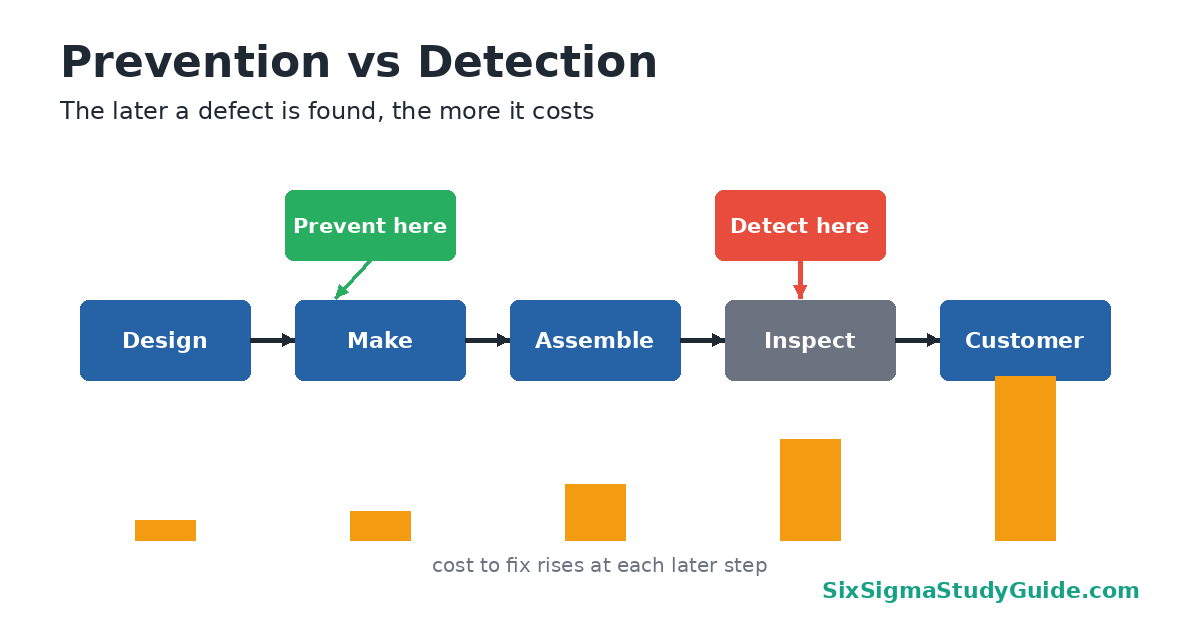
Detection: finding defects after they happen
Detection means finding a problem once it exists. Examples:
- final inspection of finished goods
- testing a batch before release
- a proofreader checking a report
- a customer complaint (the most expensive detector of all)
Detection has its place. Some risks are too serious to leave to anything else. But it has built-in limits.
- It doesn’t reduce the defect rate. The process keeps making the same defects. You just catch some of them.
- It’s never perfect. Inspectors miss things, especially when defects are rare and the work is repetitive. Attribute agreement studies often show this.
- It adds cost and time. Every inspection step is non-value-added work.
- It happens late. By the time you find a defect, you’ve spent money making it.
Prevention: stopping defects from being made
Prevention means changing the product or process so defects don’t occur, or occur far less often. Examples:
- mistake-proofing (poka-yoke) that makes an error impossible
- robust design that tolerates variation in materials or use
- statistical process control that flags a drift before parts go out of spec
- training and clear work instructions
- supplier development, so incoming material is right
- FMEA during design, to find and fix failure modes before launch
Prevention works on the causes. Detection works on the results.
Brushing your teeth is prevention. A filling is detection and repair. Both have a place. But nobody thinks the best dental plan is to skip brushing and get more fillings.
Deming and mass inspection
W. Edwards Deming made this point strongly. Point 3 of his 14 points for management calls on organizations to stop depending on inspection to achieve quality, and to build quality into the product in the first place. His argument: inspection is too late, unreliable and costly. Improving the process is where quality comes from.
Our article on the founding fathers of the quality movement covers Deming and the other pioneers.
Quality characteristics and target values
Villanova pairs prevention vs detection with a second idea in the same BOK line: quality characteristics and how they relate to target values. Every measured characteristic falls into one of three types.
- Nominal-is-best. There is a target, and any move away from it in either direction is worse. A shaft diameter or a fill volume. Taguchi’s loss function is L = k(y − m)², where m is the target.
- Smaller-is-best. Zero is ideal. Wear, noise, impurities, wait time. L = k y².
- Larger-is-best. More is always better. Bond strength, battery life. L = k / y².
The type changes what prevention aims at. For nominal-is-best, a part just inside the spec still costs more than one on target, so the goal is to center the process and shrink its spread, not just to pass inspection. Detection only asks whether a part is inside the limits. Capability indexes that reward hitting the target, such as Cpm, follow the same logic.
Prevention vs detection and the cost of quality
The cost of quality model makes the economics clear. It splits quality costs into four groups.
| Category | Type | Examples |
|---|---|---|
| Prevention | Cost of good quality | Training, process design, FMEA, mistake-proofing, supplier development |
| Appraisal | Cost of good quality | Inspection, testing, audits, calibration |
| Internal failure | Cost of poor quality | Scrap, rework, re-inspection, downtime from defects |
| External failure | Cost of poor quality | Warranty claims, returns, complaints, lost customers |
Appraisal is detection spending. Prevention spending goes to the causes.
The argument for prevention is that money spent there usually saves more in failure cost. Quality writers often illustrate this with a “1-10-100” rule of thumb: a defect costs about 1 unit to prevent, 10 to catch internally and 100 once it reaches a customer. Treat those numbers as an illustration of the escalation, not a measured law. The real ratios vary by industry.
Our cost of poor quality and financial measures guides cover cost of quality in more detail.
Worked example: paint defects on appliance panels
Say an appliance plant paints steel panels (illustrative numbers). Defects like runs, dust spots and thin coverage are found at a final inspection station. Panels that fail are sanded and repainted.
The current state (detection-heavy):
- Final inspection catches most defects but misses some. Customers occasionally return units with paint flaws.
- About 8% of panels are repainted.
- Two inspectors per shift.
Monthly quality cost picture:
- Prevention: low. A little operator training.
- Appraisal: two inspectors per shift, plus inspection lighting.
- Internal failure: repaint labor, materials, line delays.
- External failure: warranty repaints and replacement panels.
Failure costs are the largest share.
The project. A Black Belt team uses a Pareto chart to rank defect types. Dust spots lead. Root cause analysis points to the air handling in the paint booth and to panels waiting uncovered before painting.
Prevention actions:
- Improved filters and a positive-pressure booth to keep dust out.
- Covered staging racks for panels waiting to be painted.
- SPC on film thickness, measured at the start of each shift and after each color change.
- A simple checklist for booth cleaning, with a visual standard.
Result after six months:
- Repaint rate drops to around 2%.
- One inspector per shift is reassigned to process monitoring, which is more prevention.
- Warranty paint claims fall.
- Total quality cost drops, even though prevention spending went up.
Detection didn’t disappear. Final inspection still exists. But it now catches far fewer defects, because far fewer are made.
Hospital medication errors
A hospital pharmacy relies on pharmacist double-checks to catch dispensing errors. That’s detection. It catches many errors, but double-checks become routine and miss things.
Prevention measures change the system:
- barcode scanning at dispensing and at the bedside, so the wrong drug can’t be scanned through without an alert
- separated storage for look-alike, sound-alike drugs
- standard order sets in the electronic record to reduce prescribing errors
The double-check stays for high-risk drugs. But the number of errors reaching the double-check falls sharply, and the check itself becomes more effective because people aren’t overwhelmed.
Why organizations stay detection-heavy
If prevention pays, why do so many operations still rely on inspection?
- Detection costs are visible and budgeted. Inspectors have job titles. Failure costs are scattered across scrap reports, warranty accounts and overtime.
- Prevention pays later. A new fixture costs money this quarter. The savings arrive over the next year.
- Inspection feels safe. A manager can point to the inspection station and say “we check everything.”
- Nobody owns the cause. The defect is made in one department and caught in another.
Pulling failure costs together into one number makes them visible next to the inspection budget.
How to shift a process from detection to prevention
- Measure the cost of quality. You can’t argue for prevention without showing what failure costs. Start with rough estimates if needed.
- Look upstream of every inspection point. For each defect found, ask where it was created.
- Use FMEA early. In design and process planning, use FMEA to find failure modes before they happen. FMEA’s own controls distinguish prevention controls from detection controls, which is worth noticing.
- Mistake-proof the highest-risk steps. See preventative techniques.
- Monitor inputs, not just outputs. Control charts on key process variables catch problems before they turn into defects. See statistical process control.
- Keep detection where risk demands it. Safety-critical items may need both.
On the exam: prevention vs detection
Villanova lists this under quality improvement concepts. Expect:
- Definitions. Prevention stops defects from occurring. Detection finds them after they occur.
- Cost of quality categories. Prevention, appraisal (detection), internal failure, external failure. Know which examples belong where.
- Economics. Investing in prevention usually lowers total quality cost.
- Deming. Cease dependence on mass inspection; build quality in.
- Quality characteristics. Nominal-is-best, smaller-is-best and larger-is-best, and why a target matters more than just meeting spec.
- Examples. Mistake-proofing, SPC and FMEA are prevention. Inspection and testing are detection.
A common trap puts inspection under prevention. Inspection is appraisal. It detects.
When you’re ready, there are a few ways I can help:
First, join 12,000+ other Six Sigma professionals by subscribing to my email newsletter. A short read every Monday to start your work week off correctly. Always free.
* * *
If you’re looking to pass your Six Sigma Yellow Belt, Green Belt or Black Belt exam, I’d recommend starting with my affordable study guide:
1)→ 🟡Pass Your Six Sigma Yellow Belt: built for ASQ, IASSC and ILSSI, 1,700+ practice questions with explanations, and six full-length mock exams for your exam
2)→ 🟢Pass Your Six Sigma Green Belt: a study guide organized by the exam Body of Knowledge, 1,300+ practice questions with detailed answer explanations, and 20 full-length mock exams
3)→ ⚫Pass Your Six Sigma Black Belt: the full Black Belt Body of Knowledge, 2,200+ practice questions with detailed answer explanations, and 20 full-length mock exams
You’ve spent so much effort learning Lean Six Sigma. Why leave passing your certification exam up to chance? This comprehensive study guide offers 1,700+ exam-like questions for Yellow Belts, 1,300+ for Green Belts and 2,200+ for Black Belts with full answer walkthroughs, access to instructors, detailed study material, and more.
Thousands have used this system to prepare. Join them here.