

A project team writes a beautiful new procedure. It’s twelve pages long. It covers who approves what, which forms to file, and how the process links to the quality manual. Then a new operator tries to use it at the machine and can’t find the step they need. The team wrote the wrong kind of document. Work instructions vs SOPs is a real distinction, and getting it right decides whether your Control phase holds. ASQ lists both at Yellow Belt and Black Belt.
The document hierarchy
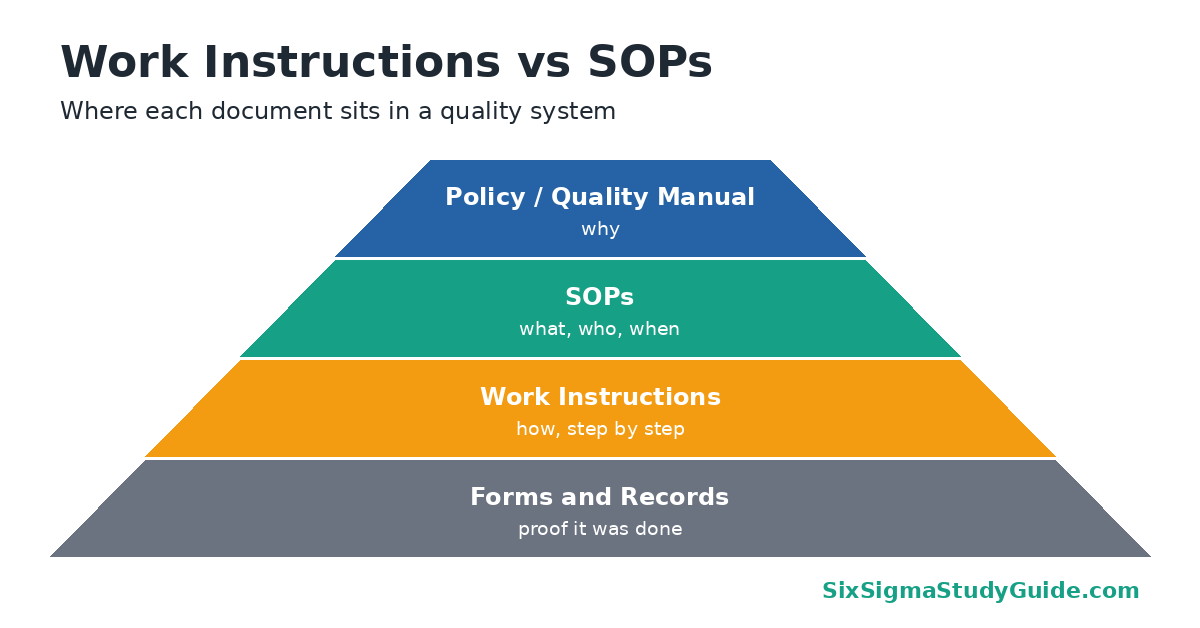
Most quality systems arrange documents in a pyramid. Each level answers a different question.
- Policy / quality manual. Why and what at the top level. The organization’s commitments.
- Procedures (SOPs). What is done, who does it, and when. Usually crosses roles or departments.
- Work instructions. How to do one specific task, step by step.
- Forms and records. The evidence that the work was done.
The higher you go, the fewer documents and the broader the scope. The lower you go, the more documents and the more detail.
What is an SOP?
A standard operating procedure describes a process at the level of activities and responsibilities. A typical SOP includes:
- purpose and scope
- roles and responsibilities
- the sequence of activities (often as a flowchart)
- inputs, outputs and handoffs
- references to related work instructions and forms
- records to keep
An SOP for handling nonconforming material, for example, might say: the operator tags and segregates the part, the quality technician logs it within one shift, the material review board decides on disposition, and the quality engineer opens corrective action when a defect repeats.
It tells you what happens and who owns each step. It doesn’t tell the operator how to fill in the tag.
Flowcharts are a natural fit for SOPs. A swimlane flowchart shows each role’s activities and the handoffs between them. Our process mapping guide and flowchart symbols page cover how to draw them.
What is a work instruction?
A work instruction tells one person how to do one task. It’s written for the point of use: at the machine, the desk or the bedside.
Good work instructions:
- start each step with a verb (“Insert,” “Tighten,” “Verify”)
- keep one action per step
- use photos or diagrams generously
- call out key points: safety, quality and the “knack” that makes the step work
- give the reason for any step that looks optional
A LEGO building booklet is a near-perfect work instruction. It has almost no words. Each page shows one small step, the parts needed, and what the result should look like. A seven-year-old can follow it. Aim for that.
Work instructions vs SOPs side by side
| SOP | Work instruction | |
|---|---|---|
| Answers | What, who, when | How |
| Scope | A process, often across roles | A single task for one role |
| Level of detail | Activities and responsibilities | Individual steps and key points |
| Typical format | Text plus flowchart | Numbered steps with photos |
| Used | For planning, training, audits | At the point of work |
| Changes when | Responsibilities or flow change | The method or equipment changes |
An SOP will often reference several work instructions. “Tag the part per WI-214” sends the operator to the right detail without cluttering the procedure.
Reading work instructions in the Analyze phase
Work instructions are not only Control-phase outputs. In Analyze, they are a tool for finding gaps. The ASQ Black Belt BOK lists work instructions and flowcharts among its process analysis tools, and the Green Belt BOK asks you to review written procedures, work instructions and flowcharts to identify gaps.
Walk the process with the work instruction in hand. Mark every step people do differently from the document. Mark every step people do that the document skips. Then ask why. Each gap is a candidate cause: an instruction nobody can follow, a step that no longer fits the equipment, or a workaround that hides a real problem. Our Analyze phase guide covers how to test those candidate causes.
Worked example: a changeover improvement
Say a Six Sigma team reduced changeover time on a blister-packing machine (an illustrative case). The new method had three parts: pre-staging tooling, a new sequence for swapping forming plates, and a first-article check with a go/no-go gauge.
The team’s first draft was a single 12-page document. Operators didn’t use it. In the Control phase, the Black Belt split it.
SOP-PK-07, Packaging Line Changeover. Two pages plus a swimlane flowchart.
- Scheduler issues the changeover order one shift ahead.
- Material handler stages the tooling cart using the checklist.
- Operator performs the changeover per WI-PK-07a.
- Quality technician performs the first-article check per WI-PK-07b and signs the release.
- Shift lead records changeover time on the board.
WI-PK-07a, Forming Plate Swap. One page, laminated at the machine.
- Lock out the machine. (Photo of the lockout point.)
- Loosen the four plate clamps, upper left first. Key point: a quarter turn only. The clamps stay on the bolts.
- Slide the plate out on the guide rails.
- Slide the new plate in until the locator pin clicks. Reason: the pin sets alignment. No click means the plate is off-center.
- Tighten clamps in a cross pattern to the marked torque.
WI-PK-07b, First-Article Check. One page with photos of a good pack and the three common defects.
The difference showed up quickly. Operators used the laminated sheet at the machine. The SOP went into training and the audit checklist. When the torque tool was later replaced, only WI-PK-07a needed a revision. The SOP didn’t change.
Card disputes at a bank call center
Take a bank call center that created an SOP for handling disputed card charges. It covered which team owns each stage, the time limits, and when a case escalates to a supervisor.
Separate work instructions covered the screen-by-screen steps in the case system and the exact wording agents must read for the dispute disclosure. When the case system was upgraded, the team swapped out the screen-by-screen instructions in a day. The procedure stayed the same.
Why this matters in the Control phase
New methods slip back when they live in people’s heads. Writing them down at the right level is how the gains survive staff turnover. Here’s what to check before you close a project:
- The SOP reflects the new flow and owners. Old responsibilities are removed, not just added to.
- Work instructions exist for every task that changed. And they’re at the point of use.
- Old versions are pulled. Version control matters. Two copies at a machine are a defect waiting to happen.
- People were trained on the new documents. Training records are part of the evidence.
- The control plan references them. See our control plan guide.
Work instructions also feed standard work, which adds takt time, work sequence and standard inventory to the “how.”
Tips for writing documents people use
- Write with the people who do the work. They know the knack. They’ll also follow what they helped write.
- Test it on someone new. If a new hire can’t do the task from the instruction, revise it.
- Use pictures before paragraphs. A photo of a correct part beats a description of one.
- Keep the SOP short. Push detail down into work instructions.
- Date and number everything. Revision control is basic, but it’s often the first thing an audit finds missing. Our Six Sigma documentation guide covers what else to keep.
On the exam: work instructions vs SOPs
Expect:
- Hierarchy questions. Policy at the top, then procedures, then work instructions, then records.
- Definition questions. SOPs describe what, who and when. Work instructions describe how.
- Scenario questions. “A new operator needs to know how to set up the machine.” The answer is a work instruction.
- Control phase links. Documentation, training and the control plan work together to sustain gains.
- Flowcharts. Know that flowcharts are a common way to document procedures and show handoffs.
Watch for answer choices that treat the two as interchangeable. On the exam, the level of detail is the deciding factor.
When you’re ready, there are a few ways I can help:
First, join 12,000+ other Six Sigma professionals by subscribing to my email newsletter. A short read every Monday to start your work week off correctly. Always free.
* * *
If you’re looking to pass your Six Sigma Yellow Belt, Green Belt or Black Belt exam, I’d recommend starting with my affordable study guide:
1)→ 🟡Pass Your Six Sigma Yellow Belt: built for ASQ, IASSC and ILSSI, 1,700+ practice questions with explanations, and six full-length mock exams for your exam
2)→ 🟢Pass Your Six Sigma Green Belt: a study guide organized by the exam Body of Knowledge, 1,300+ practice questions with detailed answer explanations, and 20 full-length mock exams
3)→ ⚫Pass Your Six Sigma Black Belt: the full Black Belt Body of Knowledge, 2,200+ practice questions with detailed answer explanations, and 20 full-length mock exams
You’ve spent so much effort learning Lean Six Sigma. Why leave passing your certification exam up to chance? This comprehensive study guide offers 1,700+ exam-like questions for Yellow Belts, 1,300+ for Green Belts and 2,200+ for Black Belts with full answer walkthroughs, access to instructors, detailed study material, and more.
Thousands have used this system to prepare. Join them here.