

Most people batch without thinking about it. Fold all the letters, then stuff all the envelopes, then seal them all. It feels efficient. Each step gets a nice rhythm. But the first finished envelope doesn’t appear until almost the end, and any mistake gets copied across the whole pile. Single piece flow takes the opposite approach. Each item moves through every step, one at a time, before the next one starts. ILSSI includes single-piece flow at Yellow Belt, because it’s one of the clearest ways to see how Lean thinking cuts lead time.
What is single piece flow?
Single piece flow (also called one-piece flow or continuous flow) means making and moving one unit at a time through each step of a process, with no waiting between steps.
- In batch-and-queue production, a group of items finishes one step before any of them moves to the next.
- In single piece flow, one item moves from step to step as soon as each step is done.
It’s an ideal. Real processes often use small batches, such as a tray of 5 instead of a pallet of 500. The direction of travel is toward smaller and smaller transfer quantities.
Worked example: batch vs. single piece flow
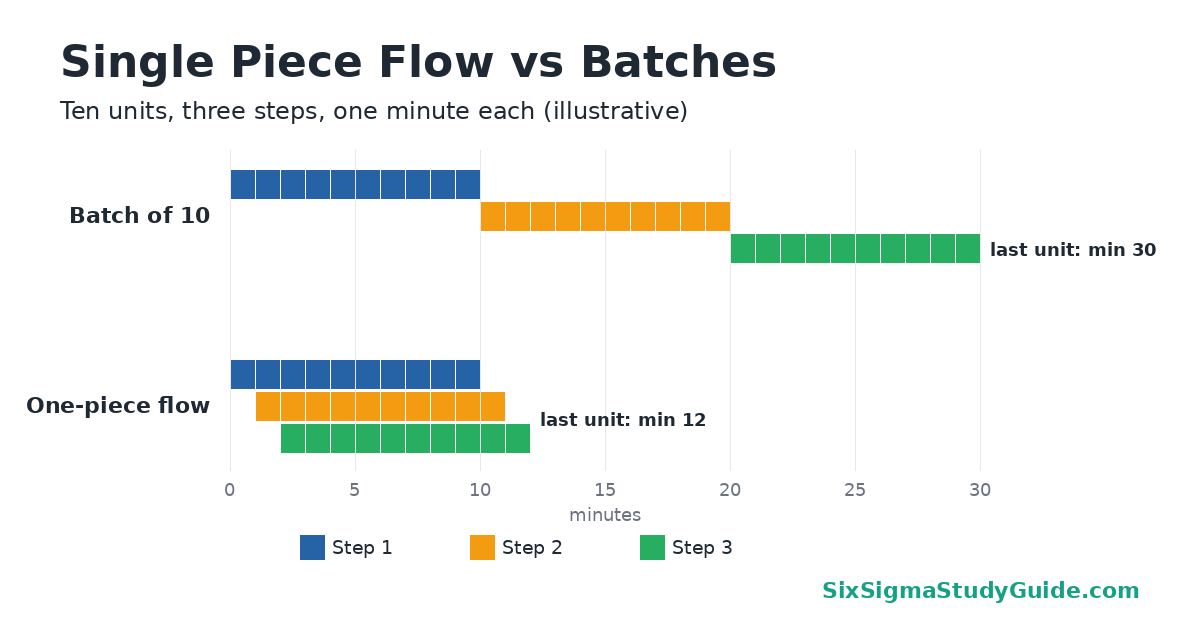
Here is the classic demonstration (illustrative numbers). A small cell has three steps, each taking 1 minute per unit. You need to make 10 units.
Batch of 10:
- Step 1 processes all 10 units: minutes 0 to 10.
- Step 2 processes all 10: minutes 10 to 20.
- Step 3 processes all 10: minutes 20 to 30.
First finished unit: minute 21. All 10 finished: minute 30.
One-piece flow:
- Unit 1 goes through steps 1, 2 and 3: finished at minute 3.
- Unit 2 starts step 1 at minute 1, finished at minute 4.
- Each following unit finishes one minute after the last.
First finished unit: minute 3. All 10 finished: minute 12.
| Batch of 10 | One-piece flow | |
|---|---|---|
| First good unit | 21 minutes | 3 minutes |
| All 10 units | 30 minutes | 12 minutes |
| Work in process between steps | Up to 10 | 0 to 1 |
| Units affected if step 1 has a defect | Up to 10 before step 2 sees it | 1 |
Same people, same steps, same time per unit. Lead time drops by more than half, and the first good unit arrives seven times sooner.
The defect row matters as much as the speed. In the batch, if step 1 makes a mistake, step 2 doesn’t see it until all 10 are done. In single piece flow, step 2 sees the first bad unit a minute later.
Why flow helps
- Shorter lead time. Items don’t wait in queues between steps.
- Less work in process. Less inventory, less space, less handling.
- Faster feedback on quality. Defects show up at the next step almost immediately.
- Problems become visible. With no buffers to hide behind, any delay stops the flow and gets attention.
- Flexibility. Small quantities make it easier to switch between products and respond to orders.
Little’s Law makes the lead-time link concrete. For a stable process, lead time = work in process ÷ throughput. Cut work in process while throughput stays the same, and lead time falls in proportion. Our Lean metrics page covers this.
What one-piece flow requires
Flow doesn’t work everywhere by default. Several conditions help.
- Balanced steps. If one step takes much longer than the others, work piles up in front of it. Balance work content to takt time. See theory of constraints for handling the bottleneck.
- Steps close together. Operations are arranged in a cell, often U-shaped, so items move a short distance by hand.
- Short changeovers. If switching products takes an hour, you’ll batch to avoid switching. See SMED.
- Reliable equipment. With no buffer, a breakdown stops the whole cell.
- Capable processes. Frequent defects interrupt flow. Quality has to be built in.
- Cross-trained people. Operators who can do more than one step help balance the line.
- Standard work. Each step done the same way, in the same time. See standard work.
Where these aren’t yet in place, use small batches and work toward flow.
Control panel assembly cell
A plant assembles control panels. In the old layout, each department (wiring, mounting, testing, packing) works on batches of 50 panels. Each batch waits in a queue between departments. Lead time from start to shipping is several days, though actual work time per panel is under an hour.
The team creates a U-shaped cell with all four operations side by side. Each panel moves to the next operation as soon as it’s ready. Two operators are cross-trained to cover wiring and mounting.
After the change, panels move from start to finish in well under a day. Work in process drops from hundreds of panels to a handful. Test failures are traced back to the wiring step within minutes, instead of days later. Floor space for queues is freed up.
Loan applications
Service processes batch too. A loan office collects applications all morning, then checks them all in the afternoon, then sends approved ones for signature the next day.
Moving to flow means each application goes through checking, approval and signature as soon as it arrives. Customers get decisions in hours rather than days. Errors in one step get caught on the next application, not after a whole day’s worth have gone through.
Kitchens that cook each order as it comes in work this way. A buffet that cooks large trays and holds them works in batches. Each has its place, but the made-to-order kitchen gets fresher food to the customer faster.
How to start moving toward flow
You don’t need to rebuild the plant on day one. A practical path:
- Map the current process and mark every queue between steps.
- Measure how long items wait in each queue compared with how long they’re worked on.
- Pick the longest queue and halve the transfer batch feeding it.
- Move the two steps on either side of that queue closer together.
- Watch what breaks. Each problem that shows up (a slow step, an unreliable machine, a missing skill) is the next thing to fix.
Repeat until the queues are small. Then look at combining steps into a cell.
When small batches still make sense
Full one-piece flow isn’t always practical right away.
- Long, unavoidable setup times (some ovens, furnaces and chemical processes) favor batching until setups are reduced.
- Very short process times at one step may make it more efficient to move small groups.
- Shared equipment serving several product lines may need batching unless it’s dedicated.
The goal is to reduce batch sizes step by step, not to force one-piece flow where the process can’t support it yet.
On the exam: single piece flow
ILSSI lists single-piece flow at Yellow Belt. Expect:
- Definition. Moving one unit at a time through each step, without waiting between steps.
- Benefits. Shorter lead time, less work in process, faster defect detection, more visible problems.
- Requirements. Balanced steps, cell layout, short changeovers, reliable equipment, cross-training.
- Batch comparison. Given steps and times, calculate lead time for batch vs. one-piece flow.
- Link to pull and kanban. Flow and pull work together in Lean.
- Higher belts. ASQ lists continuous flow at Black Belt as a cycle-time reduction tool, alongside SMED and heijunka.
A common distractor claims batching always increases efficiency. It can increase the efficiency of a single step, but it lengthens total lead time and hides defects.
When you’re ready, there are a few ways I can help:
First, join 12,000+ other Six Sigma professionals by subscribing to my email newsletter. A short read every Monday to start your work week off correctly. Always free.
* * *
If you’re looking to pass your Six Sigma Yellow Belt, Green Belt or Black Belt exam, I’d recommend starting with my affordable study guide:
1)→ 🟡Pass Your Six Sigma Yellow Belt: built for ASQ, IASSC and ILSSI, 1,700+ practice questions with explanations, and six full-length mock exams for your exam
2)→ 🟢Pass Your Six Sigma Green Belt: a study guide organized by the exam Body of Knowledge, 1,300+ practice questions with detailed answer explanations, and 20 full-length mock exams
3)→ ⚫Pass Your Six Sigma Black Belt: the full Black Belt Body of Knowledge, 2,200+ practice questions with detailed answer explanations, and 20 full-length mock exams
You’ve spent so much effort learning Lean Six Sigma. Why leave passing your certification exam up to chance? This comprehensive study guide offers 1,700+ exam-like questions for Yellow Belts, 1,300+ for Green Belts and 2,200+ for Black Belts with full answer walkthroughs, access to instructors, detailed study material, and more.
Thousands have used this system to prepare. Join them here.