

At a theme park, the ride lasts three minutes. The queue lasts ninety. Nobody pays for the queue, but it’s most of the experience. Business processes are often the same. When you map a process and time every step, most of the elapsed time goes to waiting, moving, checking and fixing. Lean calls these non-value-added activities. Learning to spot them, and to tell them apart from the work customers actually pay for, is the first step in any Lean analysis. Villanova lists value-added and non-value-added activities at Black Belt.
The three tests for value-added work
An activity is value-added (VA) only if it passes all three tests:
- The customer is willing to pay for it. If customers knew about this step, would they want it?
- It changes the product or service in form, fit or function. Something physically or informationally moves closer to what the customer wants.
- It’s done right the first time. Rework fails this test, even if the original step was value-added.
Machining a part to shape passes all three. Inspecting it fails the second test: the part isn’t changed. Re-machining a part that was cut wrong fails the third.
In a service, entering a customer’s order correctly passes. Re-entering it after an error fails. Moving the order from one queue to another fails.
Two kinds of non-value-added activities
Not every non-value-added step can be eliminated tomorrow. Lean practitioners usually split them into two groups.
Non-value-added but required (NVA-R), sometimes called business value-added or necessary waste:
- steps required by law, regulation or contract (safety checks, audit trails, tax filings)
- steps needed to run the business with current methods (payroll, some approvals)
Non-value-added (NVA), or pure waste:
- steps that add nothing and aren’t required. Waiting, unnecessary movement, duplicate approvals, rework, overproduction, excess inventory, storage and the floor space it takes up.
The approach differs:
- VA: optimize it. Make it faster, more consistent.
- NVA-R: minimize it. Simplify, automate, combine, or challenge whether it’s still required.
- NVA: eliminate it.
Be careful with “required.” Many steps are labeled required out of habit. Ask who requires it and why. A surprising number turn out to be optional.
The eight wastes
Most non-value-added activities fall into one of the classic Lean wastes. A common memory aid is DOWNTIME:
- Defects
- Overproduction
- Waiting
- Not using people’s talent
- Transportation
- Inventory
- Motion
- Extra processing
See our page on the classic wastes for more on each.
Process cycle efficiency
Once you’ve classified every step, you can calculate a simple measure of how lean the process is.
Process cycle efficiency (PCE) = value-added time / total lead time
In most unimproved processes, PCE is low. Value-added time is a small sliver of the whole. Low PCE usually means work spends most of its time waiting between steps. It says little about how hard people work.
The theme park ride makes the point. A 3-minute ride after a 90-minute queue gives a PCE of about 3 ÷ 93, or roughly 3%. Parks know this, which is why some invest in reservation systems and virtual queues.
Our Lean metrics page covers PCE alongside takt time and lead time.
Worked example: a small business loan application
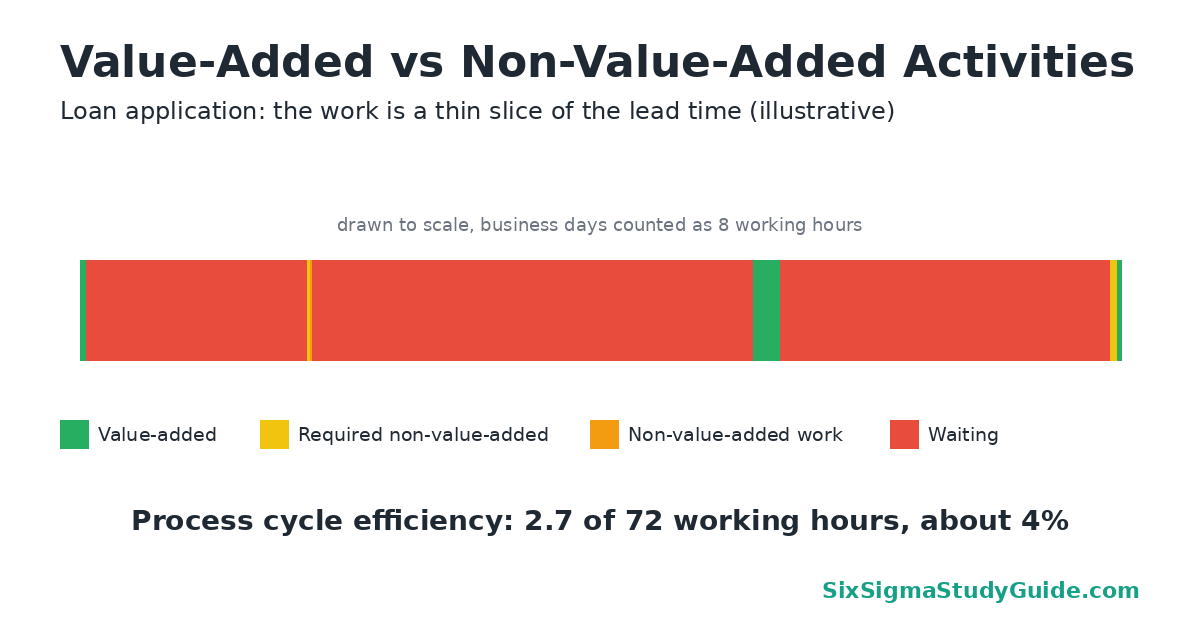
Say a bank wants to understand why small business loan decisions take so long. A Black Belt team follows applications through the process and times each step (illustrative times).
| Step | Time | Classification | Reason |
|---|---|---|---|
| Customer submits application online | 30 min | VA | Customer wants to apply; captures needed information |
| Application waits in intake queue | 2 days | NVA | Waiting |
| Clerk checks application for completeness | 15 min | NVA-R | Required, but adds no value to the decision |
| Clerk requests missing documents | 10 min | NVA | Rework caused by an unclear form |
| Waits for missing documents | 4 days | NVA | Waiting caused by rework |
| Credit analyst reviews financials | 2 hours | VA | Core of the decision the customer wants |
| Waits for second-level approval | 3 days | NVA | Waiting |
| Manager approves | 10 min | NVA-R | Policy control; may be simplifiable |
| Compliance check | 20 min | NVA-R | Regulatory requirement |
| Decision letter sent | 10 min | VA | Customer receives the answer |
Totals (approximate):
- Value-added time: 30 min + 2 h + 10 min = 2 h 40 min
- Total lead time: about 9 business days
Counting business days as 8 working hours, total lead time is about 72 working hours. PCE ≈ 2.7 / 72 ≈ 4%.
What the team does with this.
- Eliminate NVA: redesign the online form so it can’t be submitted without the key documents. That removes the request-and-wait loop, the biggest single delay.
- Reduce waiting: replace the daily intake batch with continuous processing.
- Minimize NVA-R: raise the loan size threshold that needs second-level approval, after checking with risk management. Combine the completeness check with the online form validation.
- Optimize VA: give analysts a standard template, so financial reviews are more consistent.
After the changes, the team expects lead time to drop to a few days. Value-added time hardly changes. The improvement comes almost entirely from cutting non-value-added time.
This is the outcome Villanova’s outline asks for: identify the waste, then reduce cycle time to improve throughput. Less waiting means fewer applications sitting in queues. By Little’s Law, if the office keeps the same number of applications in process while each one moves through faster, it completes more of them per week.
Bracket orders in a machine shop
Say a machine shop maps the path of a bracket order. Cutting, bending, drilling and painting take under an hour in total. The order spends most of its two-week lead time in queues between departments, moving around the plant by forklift, and waiting for a weekly paint batch. The shop’s improvement plan focuses on a cell layout and a daily paint run. Neither touches the value-added steps.
Who is the customer for an internal step?
Many steps serve an internal customer: the next department, not the person who pays. That can blur the classification.
A useful rule: trace the step forward to the external customer. If the internal step ultimately changes what the external customer receives, and is done right the first time, it can count as value-added. A credit analyst’s review feeds the loan decision the customer wants, so it qualifies. A report produced for a manager who files it unread doesn’t.
When an internal customer insists a step is essential, ask what they do with its output. If the answer is “check it” or “file it,” it’s probably non-value-added. If the answer is “use it to build what the customer receives,” it may be value-added after all.
Tips for classifying activities
- Classify from the customer’s point of view, not the department’s.
- Walk the process. Steps that don’t appear in the procedure, like searching or re-keying, often hide here.
- Time the waits. They’re usually the biggest category and the least visible.
- Don’t argue too long over borderline cases. The value comes from seeing the big pattern.
- Respect the people doing NVA work. The waste sits in the process design. Frame it that way, or the analysis turns into blame.
Use a value stream or process map to record the classification visually.
On the exam: non-value-added activities
Villanova lists value-added and non-value-added activities at Black Belt. Expect:
- Classification questions. Given a step, decide whether it’s VA, NVA-R or NVA.
- The three criteria. Customer would pay, changes the product or service, done right the first time.
- Treatment. Optimize VA, minimize NVA-R, eliminate NVA.
- Process cycle efficiency. Calculate VA time divided by total lead time.
- The eight wastes. Recognize examples of each.
A common trap: classifying inspection as value-added because it’s important. Inspection is usually non-value-added but required. It doesn’t change the product.
When you’re ready, there are a few ways I can help:
First, join 12,000+ other Six Sigma professionals by subscribing to my email newsletter. A short read every Monday to start your work week off correctly. Always free.
* * *
If you’re looking to pass your Six Sigma Yellow Belt, Green Belt or Black Belt exam, I’d recommend starting with my affordable study guide:
1)→ 🟡Pass Your Six Sigma Yellow Belt: built for ASQ, IASSC and ILSSI, 1,700+ practice questions with explanations, and six full-length mock exams for your exam
2)→ 🟢Pass Your Six Sigma Green Belt: a study guide organized by the exam Body of Knowledge, 1,300+ practice questions with detailed answer explanations, and 20 full-length mock exams
3)→ ⚫Pass Your Six Sigma Black Belt: the full Black Belt Body of Knowledge, 2,200+ practice questions with detailed answer explanations, and 20 full-length mock exams
You’ve spent so much effort learning Lean Six Sigma. Why leave passing your certification exam up to chance? This comprehensive study guide offers 1,700+ exam-like questions for Yellow Belts, 1,300+ for Green Belts and 2,200+ for Black Belts with full answer walkthroughs, access to instructors, detailed study material, and more.
Thousands have used this system to prepare. Join them here.