

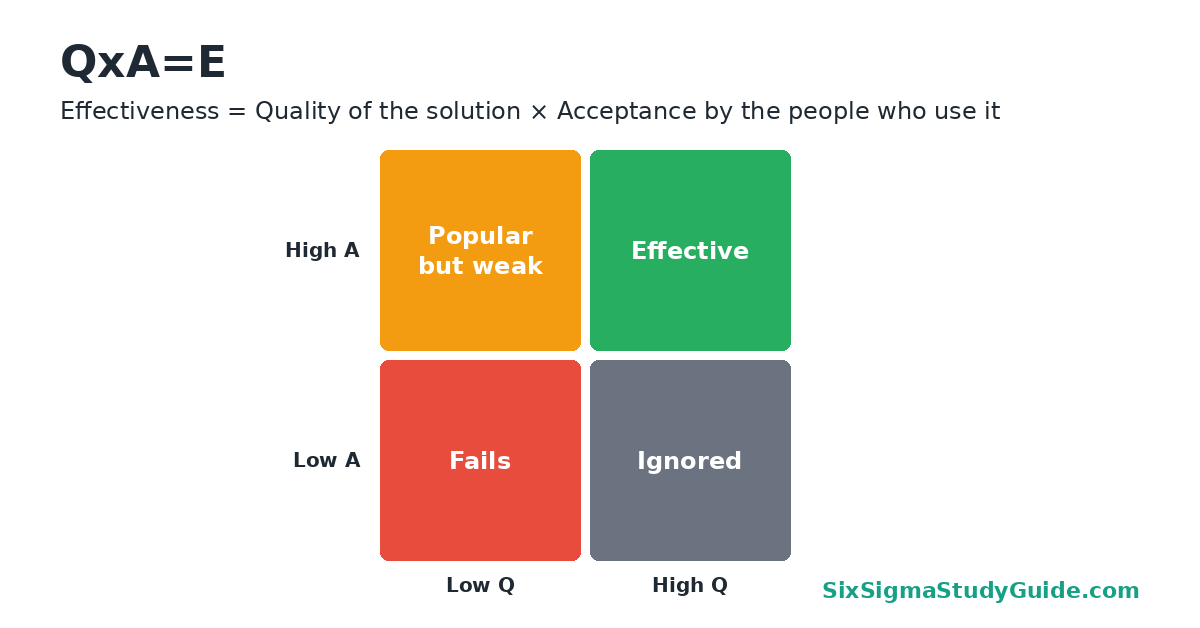
Green Belts spend most of their training on finding the best technical solution. Root cause analysis, hypothesis tests, designed experiments. Then the solution goes live and nobody uses it. QxA=E is a short formula that explains why. The effectiveness of a solution depends on its quality and on how well the people who must use it accept it. Villanova lists QxA=E in its Green Belt material, and it’s one of the most useful ideas a new practitioner can carry into a project.
What QxA=E means
- Q = Quality. The technical quality of the solution. Does it address the root cause? Is it sound, reliable, well designed?
- A = Acceptance. How much the people affected accept and support the solution. Will they use it as intended?
- E = Effectiveness. The real-world result.
The formula multiplies the two terms. If acceptance is zero, effectiveness is zero, no matter how good the quality. A brilliant solution that people work around delivers nothing.
The formula comes from GE’s Change Acceleration Process (CAP), the change management model GE built in the late 1980s and early 1990s. Accounts of its origin differ in the details, but the formula is the same everywhere it appears. Our change agent page covers the people who lead that kind of change.
A simple scoring example
Some teams score Q and A on a 1 to 10 scale to compare options. These are illustrative scores, not measured values.
| Option | Quality (Q) | Acceptance (A) | Effectiveness (E = Q × A) |
|---|---|---|---|
| A: Technically ideal, imposed from above | 9 | 3 | 27 |
| B: Good, designed with the users | 7 | 8 | 56 |
| C: Weak, but popular | 3 | 9 | 27 |
Option B wins clearly. It scores lower on quality than Option A, but people will use it.
Option C shows the other side. High acceptance can’t rescue a weak solution. A popular fix that doesn’t address the root cause still fails.
There’s a familiar version of this outside work. Ask a dietitian about the best diet, and many will say it’s the one you can stick to. A perfect plan you quit in two weeks loses to a decent plan you follow for a year.
How to gauge acceptance before rollout
Acceptance is harder to measure than quality, but you can get a useful read.
- Ask directly. A short anonymous survey of the people affected: “How likely are you to use this as designed?” on a 1 to 5 scale.
- Watch the pilot. Count workarounds, skipped steps and complaints. Behavior is a better signal than opinion.
- Listen for specifics. “It’ll slow me down at the end of shift” is a fixable concern. Vague negativity often points to a trust problem.
- Check with informal leaders. The experienced operator everyone asks for help often predicts how the floor will react.
Treat a low acceptance reading as data about the solution design. Redesign before you push harder.
Why acceptance gets ignored
- Technical training. Six Sigma training spends far more time on statistics than on people.
- Data confidence. “The data proves it works” feels like it should be enough.
- Time pressure. Involving people takes time the schedule didn’t allow for.
- Distance. The project team may not do the work the solution changes.
How to raise acceptance
Acceptance is built through the whole project, not bolted on at the end.
- Involve the people who do the work early. Put them on the team, interview them, invite them to try-storming and pilots. People support what they help create.
- Share the data. Show the baseline and the root cause. If people see the problem the way the team sees it, the solution makes more sense.
- Answer “what’s in it for me?” Be specific about how the change affects each group, good and bad.
- Address concerns directly. Use stakeholder analysis to find likely resistance and talk to those people early.
- Pilot first. A small pilot lets people see the solution work and suggest improvements. Early adopters become advocates.
- Make it easy. Simple work instructions, good training, tools at the point of use. A solution that’s hard to use will be resisted.
- Recognize the effort. Thank and credit the people who made the change work.
Sometimes it’s worth trading a little quality for a lot of acceptance. If operators strongly prefer a slightly less optimal layout, and the difference in performance is small, their version may be more effective in practice.
Worked example: a warehouse labeling solution
Say a distribution center has a high rate of picking errors (illustrative case). Analysis shows that look-alike items stored side by side cause most of them. The Green Belt team considers two solutions.
Option 1: voice-directed picking. Pickers wear headsets. The system tells them where to go and asks them to read back a check digit. Technically strong. It addresses the look-alike problem and more. But it’s expensive, and the pickers, many of whom have worked there for years, are skeptical. Several say they’ll “get used to ignoring it.”
- Q: high. A: low.
Option 2: re-slotting plus color-coded labels. Look-alike items move apart. Labels get large color bands and photos. The team designs the labels with a group of pickers, who test three versions on the floor and pick the one they find easiest.
- Q: moderate to good. A: high.
The team pilots Option 2 on one aisle. Errors in that aisle drop sharply. Pickers from other aisles ask for the labels. The team rolls it out site-wide.
Six months later, errors remain low. The site may still adopt voice picking in the future, but now it can do so from a base of trust and with pickers involved in the design.
What the team learned. By the formula, Option 2 was more effective even though Option 1 was the better technical design. And the high acceptance of Option 2 created the conditions to raise quality later.
Hand hygiene in a hospital
A hospital wants better hand hygiene compliance. A technically strong solution is electronic badges that track staff hand-washing and send alerts. Staff see it as surveillance. Acceptance is low, and some staff find ways around the badges.
A different approach involves staff in redesigning where sanitizer dispensers go, uses peer observers rather than managers, and shares unit-level results openly. Acceptance is higher, and compliance improves more. The badge system might return later, but only once staff see it as helping rather than policing.
QxA=E across DMAIC
- Define: identify who will be affected and how. Plan their involvement.
- Measure and Analyze: involve process experts in data collection and root cause work. Their insight improves Q, and their involvement improves A.
- Improve: score solutions on both Q and A. Pilot with users. See improve phase.
- Control: train, document and support. Acceptance needs maintaining. See maintaining solutions.
On the exam: QxA=E
Villanova lists QxA=E at Green Belt. Expect:
- Definition. Effectiveness = Quality × Acceptance.
- Why multiply. Zero acceptance means zero effectiveness, whatever the quality.
- Application. Choose the solution with the best combination of quality and acceptance, not the best quality alone.
- Raising acceptance. Involvement, communication, piloting, training and addressing resistance.
If a scenario describes a technically excellent solution that staff ignore, the concept being tested is acceptance, and the fix involves people, not more analysis.
When you’re ready, there are a few ways I can help:
First, join 12,000+ other Six Sigma professionals by subscribing to my email newsletter. A short read every Monday to start your work week off correctly. Always free.
* * *
If you’re looking to pass your Six Sigma Yellow Belt, Green Belt or Black Belt exam, I’d recommend starting with my affordable study guide:
1)→ 🟡Pass Your Six Sigma Yellow Belt: built for ASQ, IASSC and ILSSI, 1,700+ practice questions with explanations, and six full-length mock exams for your exam
2)→ 🟢Pass Your Six Sigma Green Belt: a study guide organized by the exam Body of Knowledge, 1,300+ practice questions with detailed answer explanations, and 20 full-length mock exams
3)→ ⚫Pass Your Six Sigma Black Belt: the full Black Belt Body of Knowledge, 2,200+ practice questions with detailed answer explanations, and 20 full-length mock exams
You’ve spent so much effort learning Lean Six Sigma. Why leave passing your certification exam up to chance? This comprehensive study guide offers 1,700+ exam-like questions for Yellow Belts, 1,300+ for Green Belts and 2,200+ for Black Belts with full answer walkthroughs, access to instructors, detailed study material, and more.
Thousands have used this system to prepare. Join them here.