

5S Workplace Organization is a visual system. Teams often kick off 5S with a Kaizen event, but 5S itself is an ongoing way of organizing the workplace, not the event.
5S derives its name from five Japanese terms beginning with the “s.” These terms are tools for creating a workplace suited for visual control and lean production. Collectively, the 5S’s detail how to create a workplace that is visibly organized, free of clutter, neatly arranged, and very clean. A 5S system is often a starting place for managers to apply lean operation concepts.
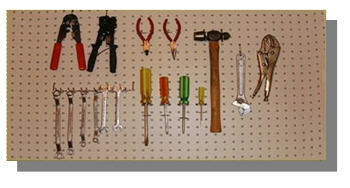
5S in lean Six Sigma is an approach that ensures smart workspace organization–known as ‘Good Housekeeping.’ In order to perform at a high standard, the workplace of the organization should be clean, and 5S guarantees that. The strategy is to engage the process teams in an effort to facilitate improvement and keep out the waste on a daily basis. 5S not only helps to reduce defects and waste but also maintains positive changes over the long term.
The 5S finds its origin in five Japanese words. Each word captures an action that builds on the others, so you must carry them out in a particular order. The sections below explain these 5S words:
The 5S are:
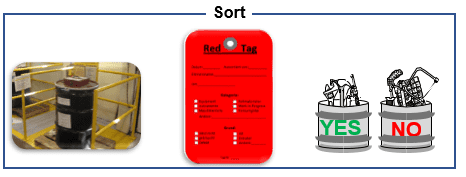
- Sort: Remove unneeded items from the work area. Red tag all items that are not needed. (Cleaning comes later, in Shine.)
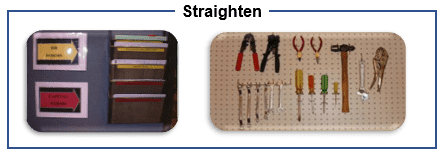
- Straighten: Organizing remaining items, adopt visual controls.
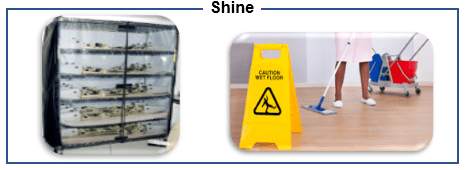
- Shine: Clean the work area as well as inspect the machinery.
- Standardize: Set standards; make 5S a way of life.
- Sustain: Maintaining continued compliance.
Step1: Seiri or Sort
Sorting is the first step towards good housekeeping. The operator must revisit all the material, equipment, machinery, tools, and other resources to determine what the workplace needs. Keep the resources the process requires. Return the others to the right department, or scrap, recycle, or sell them after seeking proper authority.
Keep critical, often-used items nearby, and store items you won’t need in the near future elsewhere. You will need to sort the items to keep, items to reuse (red tag them to decide later whether or not to use them), and items to move to waste bins.
Example: Employees walk through the area and sort the office supplies, old fax machines, shredding machines, paper cutters, etc. Then they separate the items to use from items that belong in waste bins.
Step 2: Seiton or Straighten (or store)
Once you have marked the important resources to keep, and the others for the trash, make a unique place for each and every tool and piece of equipment. This will help the staff to know where to search for what. Also, once you stock an item or material, you can source the same item without wasting time finding a place for it.
Example: Nameplates, labels, colored tags
Step 3: Seiso or Sweep (Or Shine)
A team member should clean the office or place of work daily so that the proper organization of equipment does not change. This will also foster a positive attitude and better output throughout the workplace. This, in turn, will lead to a safer work environment and a greater ability to detect defects and wastes.
Example: Cleaning the workplace and equipment to ensure it is free from oil, burrs, grease, waste, etc.
Step 4: Seiketsu or Standardize
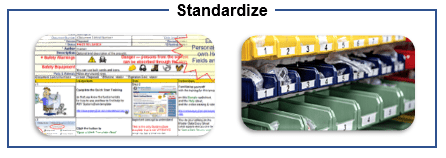
Create a 5S system for all the worksites consistently. You should organize and standardize the worksite to help manage change as effectively as possible. Suppose a worker shifts from one worksite to another–standardizing the worksites will help the worker learn the new processes without wasting time and effort. It also improves productivity multi-fold by standardizing the workplace. Additionally, see Standard Work.
Example: Creating standards for keeping the workplace, machines, and pathways neat and clean. And also make sure to implement these standards across the organization.
Step 5: Shitsuke or Sustain
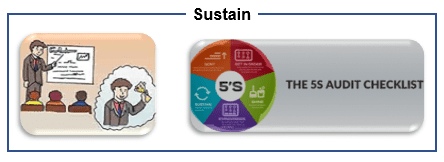
This ‘S’ means facilitating training and discipline so the entire organization follows the initial 4S. This will help to develop an improvement-oriented culture in the organization. Create a proper schedule such that everyone follows the other S’s simultaneously. Moreover, implementing the 5S’s should be the responsibility of every organization member.
Example: Implementing 5S training into daily work life, following work procedures, conducting periodic 5S audits, 5S communication across the organization, etc.
Control Methods of 5S:
One should consider some important things while implementing the strategy of 5S:
- In order to be effective, make the 5S visual by using colors, shadow boards, and taped-off identification lines
- Train employees on 5S
- Design a unique 5S system for every task or process
- Tie red tags to all the items you remove from the work area
- Use aisle markings, placement for forklifts, boxes, pallets, etc
- Clean each item in the workplace, including equipment, computers, printers, etc
- Use visual management tools such as color-coding, markings, and labels
- Management should participate in, audit, and review the 5S system at regular times. This keeps it productive and helps build an improvement-oriented culture
5S Videos
Six Sigma Green Belt Certification 5S Questions:
Question: A Belt has used the 5S approach of Lean to set up a control method with frequently used tools organized as shown in this graphic. The Belt has applied the ______________ principle of 5S. (Taken from IASSC sample Black Belt exam.)
a) Shining
b) Sorting
c) Straightening
d) Sustaining
Answer:
A: 5S. The phrase cluttered workstation should be the tip-off to the answer. Using 5S to standardize, for example by putting all of the tools in the right place, would eliminate variation. SMED, or Single Minute Exchange of Die, is a method for reducing changeover (setup) time and does not address clutter. Preventive maintenance indicates taking care of tools to ensure their operating efficiency, so that’s not a great answer. Visual factory could work, but 5S is clearly the best choice.
Comments (4)
Hey Ron,
I am in New Zealand, searching google on housekeeping and up popped your video.
Brilliant,
I love it.
Thought you might like to hear how far your marketing is reaching.
Hope you are well and healthy.
I have moved from Canada to New Zealand and really enjoying life. We are not quite to the Flowserve standard but getting there in baby steps.
Keep well.
Rach
Hah! That’s awesome, Rach. Hope you are having a great time ‘down’ there!
The 5S video has been redone and it is much better than the original (the messy bookcase in the original one is very distracting ;-)). https://youtu.be/jPXYa3FQP8k?si=IxuP8ypDbnpZZLnL
Thank you for sharing, Nathalie. I will replace!
Best, Ted.