

Friday Kaizen is my weekly note on how Six Sigma ideas get used in real work. Last week was the readiness meter and the rule behind it. This week is where that meter came from: Voice of the Customer.
What over 1,000 students told me they needed most
One question in our audience survey asks students for their single biggest study challenge.
Most answers are a line or two. Some run to a paragraph. Two of them stuck with me.
“I’m studying consistently but I don’t have a clear benchmark for what exam-ready looks like.”
“Knowing where to focus my study time.”
Different words for the same worry. Am I ready for my certification exam, and if not, what do I study next?
I hate the thought of someone studying hard with no way to tell if it is working.
A Voice of the Customer example: their words first, then the requirement
Voice of the Customer is the practice of collecting what customers say they need, in their own words, and translating it into requirements.
We grouped the answers into nine themes. The biggest was statistics, which test to use when. We answered that one first, in several places: our hypothesis test decision trees, Which Test, When?, and a simple guide to which tool fits which problem. The second was this one: am I ready, and where should I focus. Dozens of answers landed there.
Why we asked first
Without the survey I would have built from my own list. The students’ answers set the order instead.
Visual indicators we built from theme two: the readiness card
Since mid-October, every paid member’s study plan shows a readiness view and a strengths and weak areas card.
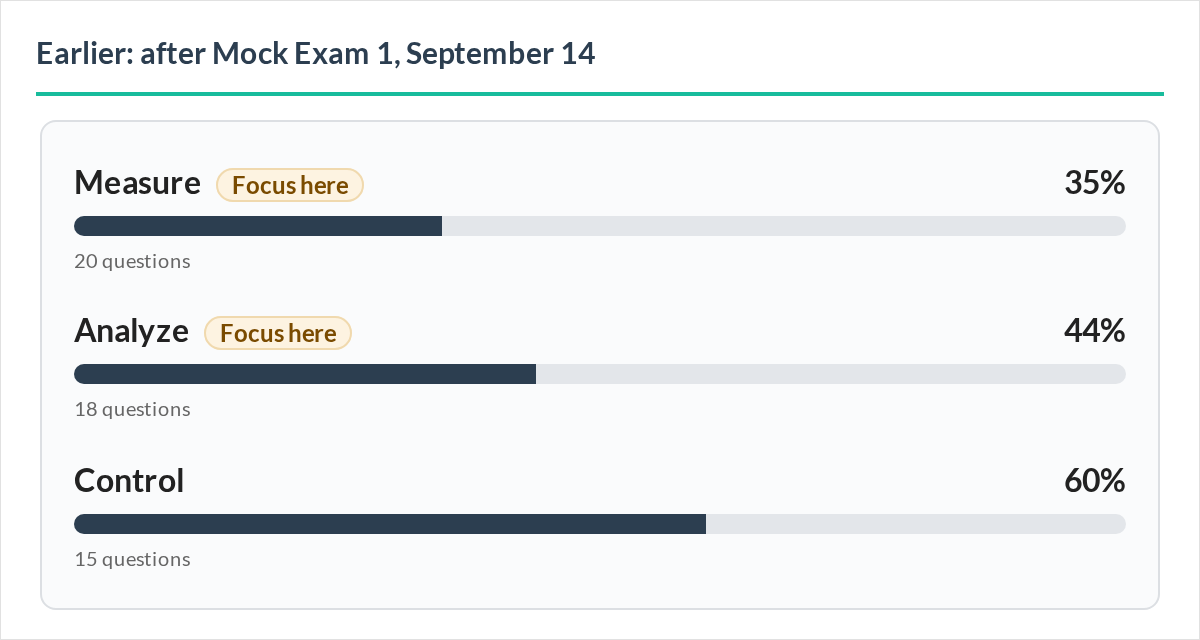
The card reads the member’s own quiz history. It scores each exam domain, the same domains their exam body’s published Body of Knowledge tests, and marks the lowest ones “Focus here”. Under it is one next step.
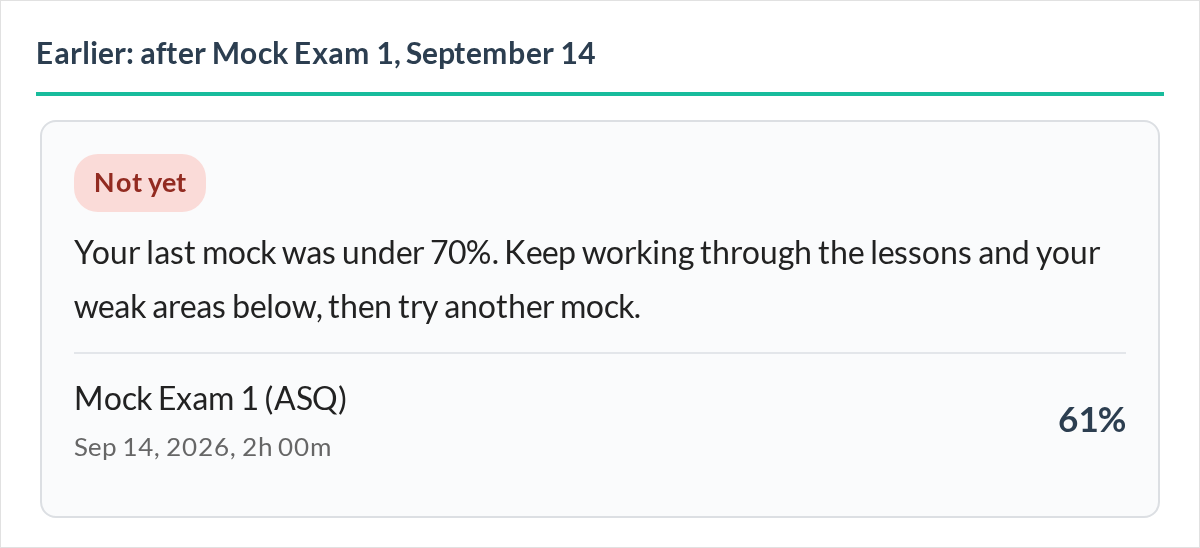
Here is what that looks like for a test account I set up. The scores are made up. No real member data.
After the first mock exam, the band at the top says Not yet. A 61% is under the 70% line.
The card below it scores each exam area. Measure and Analyze come out lowest, so they get the Focus here label.
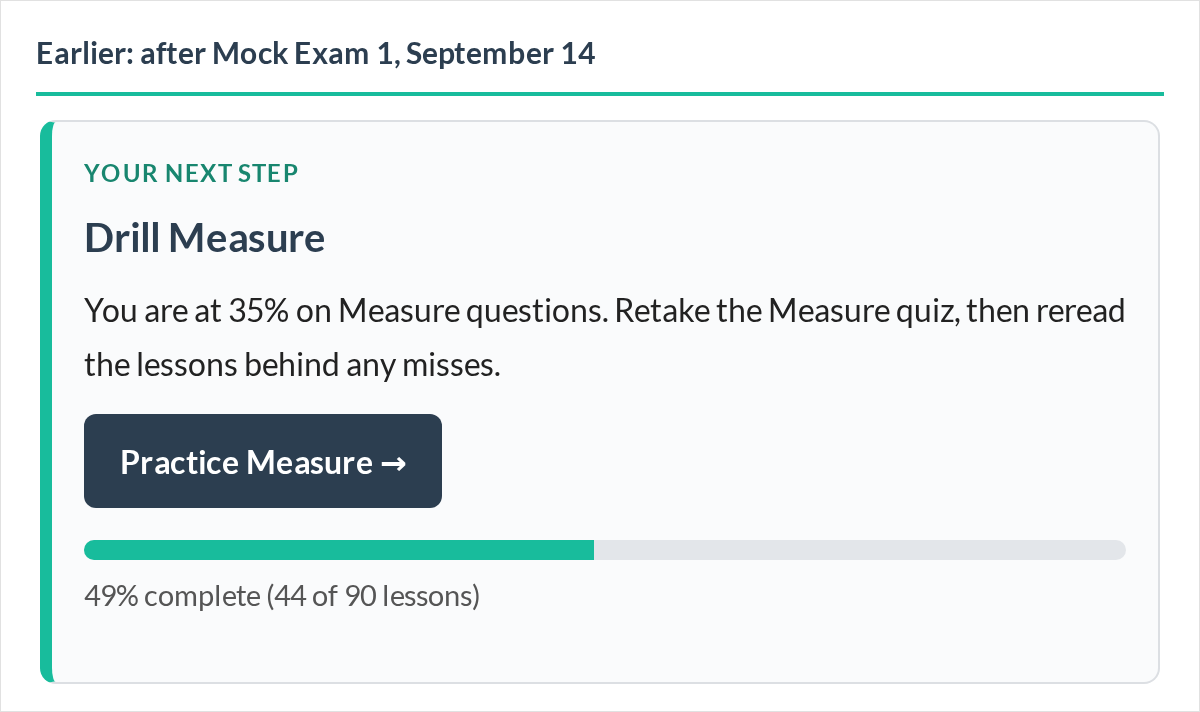
The next step points at the weakest area. There is one button to press.
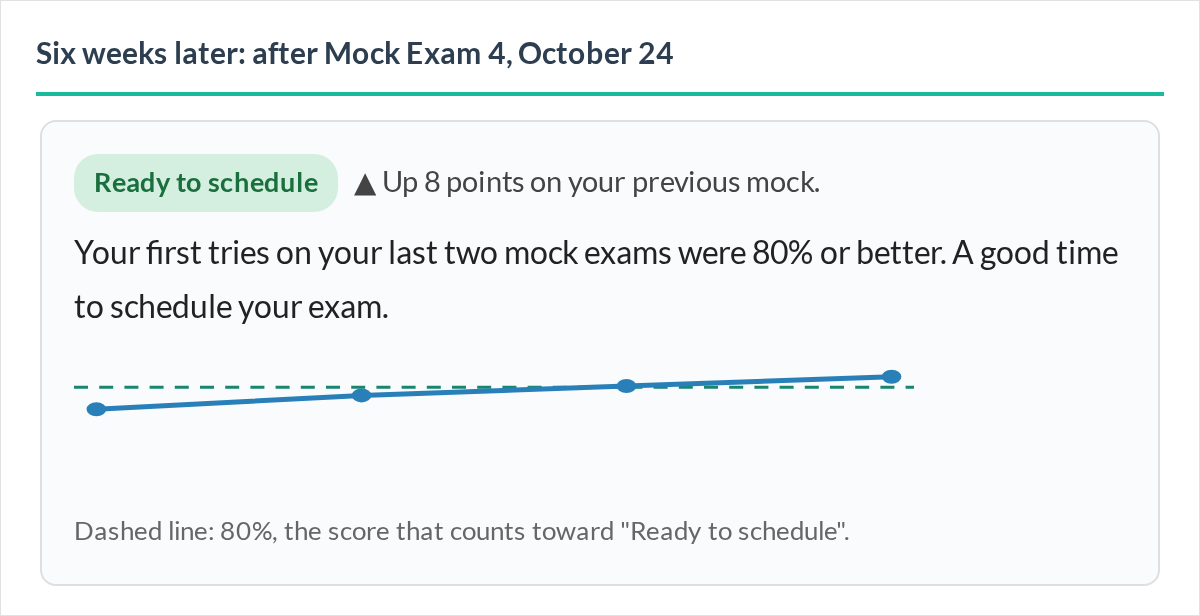
Six weeks and three more mock exams later, the band says Ready to schedule. The trend line shows each first try climbing to the 80% line.
Measure moved from 35% to 58%. Analyze moved from 44% to 73%. Both still say Focus here, because they are still the lowest.
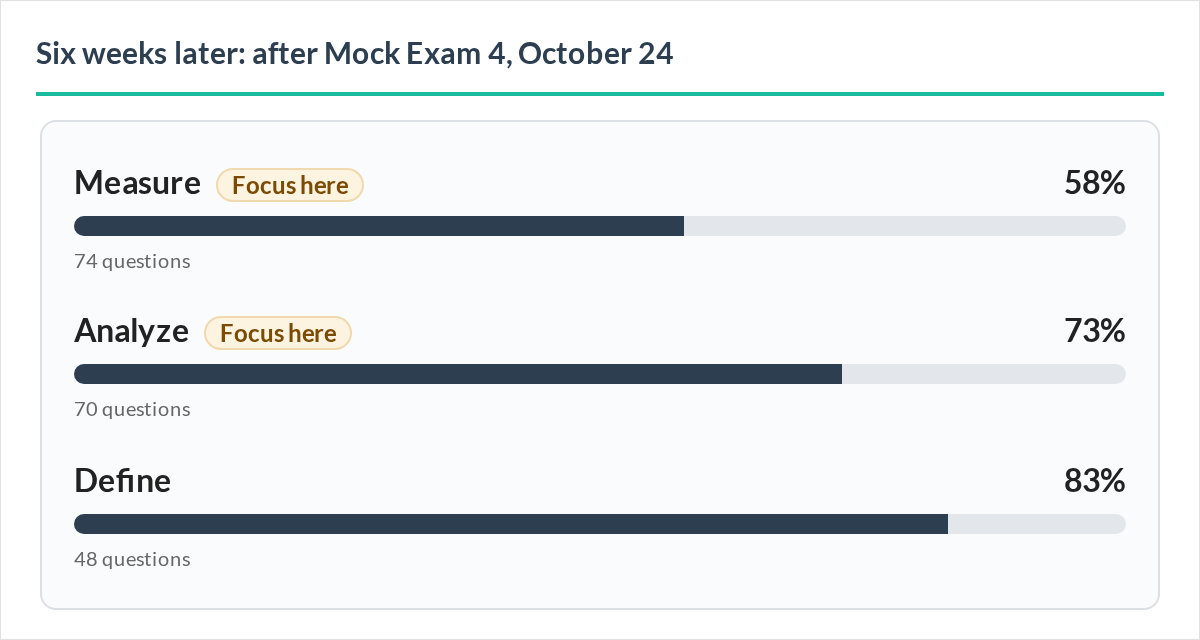
So the next step still says Drill Measure. Most of the lessons are done, and Measure is where the next points are.
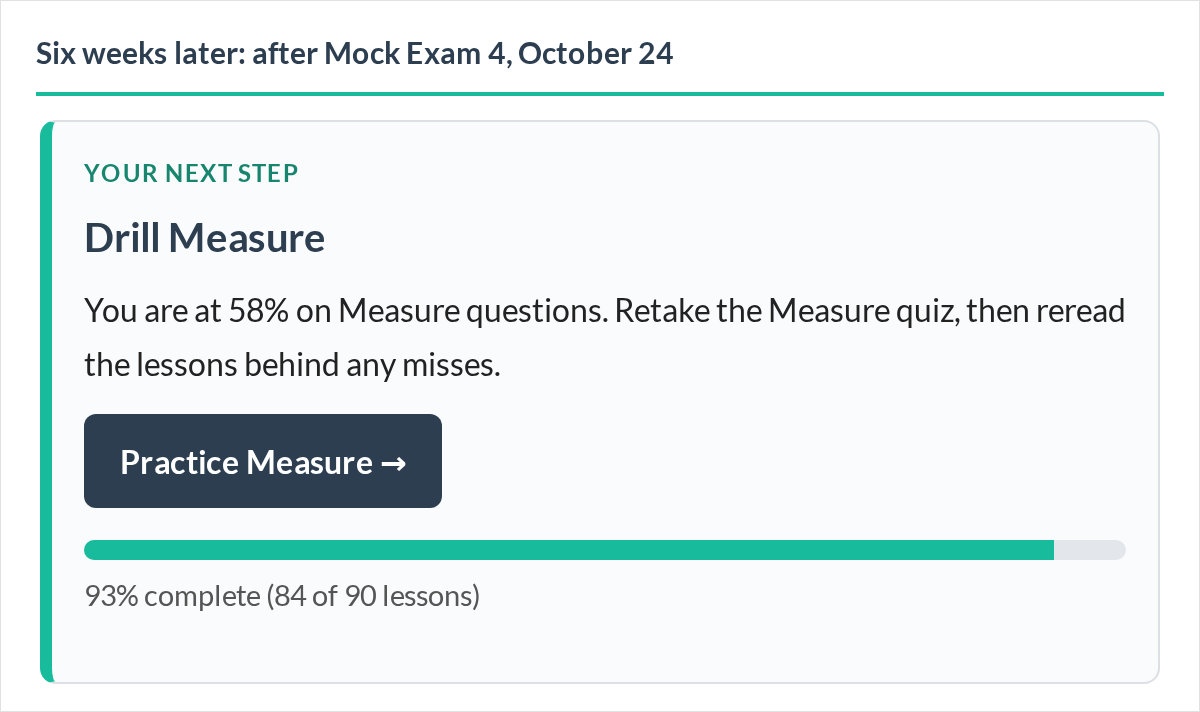
It is visual factory thinking applied to studying. A student sees their progress at a glance, and sees it move as their weak areas get stronger.
The thresholds are my rules, built from more than a decade of running this site: the quiz results, the exam results members reported back, and the lessons we documented along the way. Nothing on that card predicts a pass.
Try Voice of the Customer this week
Pick one process you own. Find five people who receive what it produces. Internal customers count.
Ask each of them one open question. What would make this easier for you? Write the answer down in their words. Resist solving anything on the spot.
Then sort the answers into themes. Act on the biggest theme first, even when it is not the one you expected.
Leave a comment and tell me the theme that came up most. I read these, and the good ones might show up in a future Friday Kaizen (only with your permission).
Best, Ted.
“The ability to complete sample assessments, being it on a specific topic, or a recap on previous study material, allowed me to gauge when I was ready to sit the IASSC Six Sigma Green Belt exam, which I passed on the first attempt.”
Wiebke Z., LinkedIn Recommendation
When you’re ready, there are a few ways I can help:
First, join 12,000+ other Six Sigma professionals by subscribing to my email newsletter. A short read every Monday to start your work week off correctly. Always free.
* * *
If you’re looking to pass your Six Sigma Green Belt or Black Belt exams, I’d recommend starting with my affordable study guide:
1)→ 🟢Pass Your Six Sigma Green Belt: a study guide organized by the exam Body of Knowledge, 1,000+ practice questions with detailed answer explanations, and 15+ full-length mock exams
2)→ ⚫Pass Your Six Sigma Black Belt: the full Black Belt Body of Knowledge, 2,000+ practice questions with detailed answer explanations, and 15+ full-length mock exams
You’ve spent so much effort learning Lean Six Sigma. Why leave passing your certification exam up to chance? This comprehensive study guide offers 1,000+ exam-like questions for Green Belts (2,000+ for Black Belts) with full answer walkthroughs, access to instructors, detailed study material, and more.
Thousands have used this system to prepare. Join them here.