

Some changes stall even when everyone agrees they’re a good idea. Others push through despite loud objections. The difference usually comes down to the balance of forces around the change. Force field analysis is a simple tool for making those forces visible. You list what’s pushing the change forward and what’s holding it back, weigh them, and decide where to act. ASQ includes force-field analysis at Yellow Belt as a root cause tool, and it is standard change management practice at every level.
Where the tool comes from
The social psychologist Kurt Lewin developed the idea in the 1940s. He saw any current situation as a balance between two sets of forces:
- Driving forces push toward change.
- Restraining forces push back toward the status quo.
When the forces balance, nothing moves. To create change, you either strengthen driving forces or weaken restraining forces. Lewin’s three-stage change model (unfreeze, change, refreeze) grew from the same thinking.
How to run the analysis, step by step
You need a whiteboard or a sheet of paper, the right people, and about an hour.
- State the change. Write it in the middle of the page as a specific goal. “Move all shift handoffs to a standard written checklist by June.”
- List driving forces on the left. What supports the change? Customer demand, cost savings, safety, leadership support, staff frustration with the current way.
- List restraining forces on the right. What resists it? Time, habit, cost, fear of blame, lack of skills, competing priorities.
- Score each force. Use a simple scale, often 1 (weak) to 5 (strong). Draw arrows with lengths that match the scores.
- Total each side. This shows the overall balance. It’s a rough guide, not a precise calculation.
- Plan actions. For each strong force, decide how to strengthen it (driving) or weaken it (restraining).
- Assign owners. Every action needs a name and a date.
The scores are team judgments, and that’s acceptable for this tool. The value comes from the discussion, and from agreeing where to focus.
Why weakening restraints usually works better
Lewin noticed something useful. Adding more driving force often creates more resistance. Push harder, and people push back harder. The tension rises and the change still doesn’t move.
Reducing restraining forces tends to let change happen with less friction. If people resist a new system because they don’t know how to use it, more pressure from management won’t help. Training will.
So look at the restraining side first. Which of these forces can you remove or reduce?
Worked example: standard shift handoffs in a factory
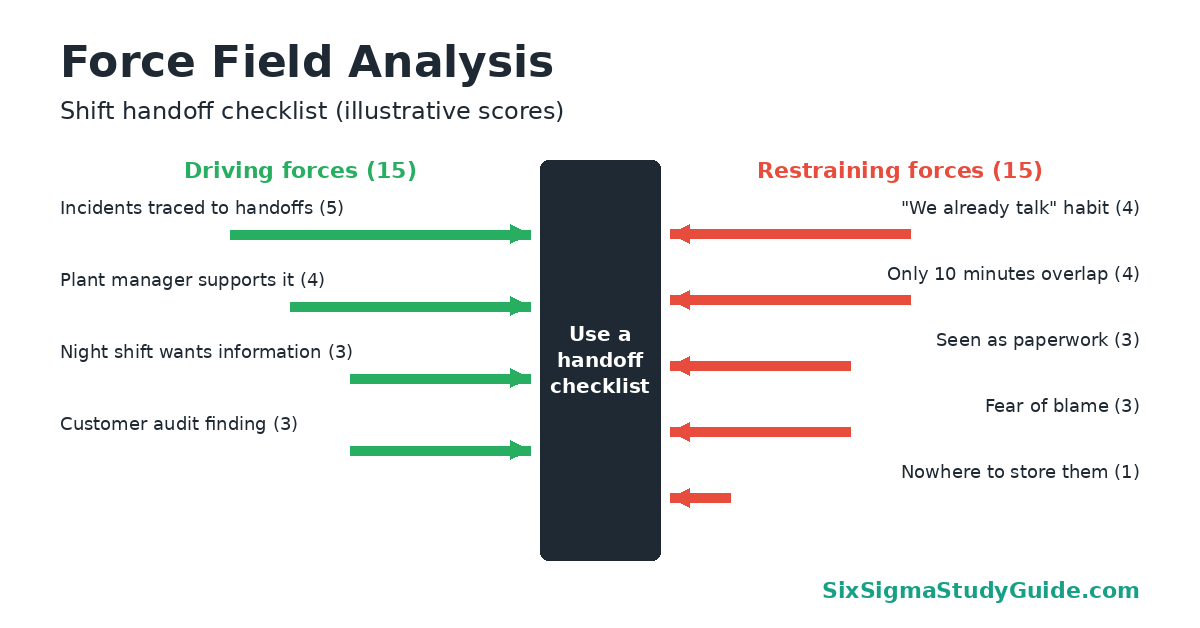
Say a chemical plant has had several quality incidents traced to poor communication at shift change (an illustrative case). A Yellow Belt is helping roll out a standard handoff checklist. The team runs a force field analysis.
Change: “All shift handoffs use the standard checklist, reviewed face to face, within 8 weeks.”
| Driving forces | Score | Restraining forces | Score |
|---|---|---|---|
| Recent incidents traced to handoffs | 5 | “We already talk at handoff” (habit) | 4 |
| Plant manager supports it | 4 | Handoff overlap is only 10 minutes | 4 |
| Night shift wants better information | 3 | Checklist seen as paperwork | 3 |
| Customer audit finding on communication | 3 | Fear checklist will be used to blame people | 3 |
| No place to store completed checklists | 1 | ||
| Total | 15 | Total | 15 |
The forces are balanced at 15 each. That explains why previous attempts faded out.
Actions on restraining forces:
- Handoff overlap (4). Work with the scheduler to extend overlap to 15 minutes for a trial. Owner: production manager.
- Seen as paperwork (3). Cut the checklist to one page, with tick boxes and a short notes section. Build it with operators from each shift. Owner: Yellow Belt.
- Fear of blame (3). The plant manager states in a shift meeting that the checklist is for information, not discipline. Owner: plant manager.
- Habit (4). Pair each shift lead with a “handoff buddy” for the first two weeks. Owner: shift leads.
- Storage (1). Add a wall pocket at the control room. Owner: Yellow Belt.
Actions on driving forces:
- Night shift support (3). Ask two night-shift operators to present the incident data at the kickoff. Owner: Yellow Belt.
After the actions, the team re-scores. Restraining forces drop to about 9. Driving forces rise to about 16. The checklist is in steady use within the target time, and the team tracks completion on a simple visual board.
Training for a marathon
The tool works on personal goals too, which makes it easy to practice.
Say your goal is to run your first marathon next autumn.
- Driving forces: you want to get fitter (4), a friend is training too (3), you’ve already paid the entry fee (3).
- Restraining forces: long work days (4), winter weather (3), a sore knee from last year (3), no training plan (2).
Pushing harder on motivation won’t fix a sore knee. The best moves are on the restraining side: see a physio about the knee, find a plan with short weekday runs, and join a group with indoor options in winter.
Self-service kiosks at a bank branch
A bank branch wants customers to use self-service kiosks for simple deposits. Driving forces include shorter lines, lower costs, and a group of customers who prefer self-service. Restraining forces include older customers’ unfamiliarity with the kiosks, a kiosk that often jams, and staff worried about job cuts.
The analysis shows the jamming kiosk is a strong restraint that’s also easy to fix. Fixing it first, and placing a staff member beside the kiosks for a month to help, removes two restraints at once. Leadership addresses the job concern directly by explaining how staff time will be redeployed.
Force field analysis as a root cause tool
The Yellow Belt BOK lists force field analysis next to 5 Whys, process mapping, 8D and matrix charts as a way to identify root causes. The link is Lewin’s equilibrium idea. A problem that persists at a steady level is being held there by forces. Ask the team to list the forces that keep performance where it is, and the restraining forces against improvement turn out to be candidate causes: no time at handoff, a habit, a missing standard. Each one can then be checked with data or a 5 Whys. The shift handoff table above works this way. Its restraining column is a list of reasons the incidents keep happening.
When to use it
- Define phase: to judge whether a project is likely to succeed and what support it needs.
- Improve phase: to plan the rollout of a solution.
- Change management: to understand resistance before it shows up. See stakeholder analysis, which pairs well with it.
- Team decisions: to structure a discussion about whether to proceed.
It’s a qualitative tool. It doesn’t replace data. It helps a team share what they know about the people side of a change.
Force field analysis vs. other planning tools
A few tools look similar. Here’s how they differ.
- Stakeholder analysis maps people and groups by influence and attitude. The force field maps forces, which can include people but also time, money, systems and rules.
- Cause and effect (fishbone) diagrams look backward at the causes of a problem. A force field usually looks forward at what helps or blocks a change.
- Cost-benefit analysis puts money on each side. A force field uses rough strength scores and covers things that are hard to price, like fear or habit.
Many teams use it alongside these. The fishbone finds the cause, the solution gets chosen, and the force field plans how to make it stick.
Tips for a useful force field analysis
- Include people who’ll be affected. They know the real restraints.
- Be specific. “Culture” is too vague to act on. “Supervisors are measured on output, not quality” is specific.
- Don’t argue over exact scores. Agree roughly and move on.
- Focus on the few strongest forces. You don’t need an action for every line.
- Revisit it. Re-score after actions to check that the balance has shifted.
On the exam: force field analysis
ASQ includes force-field analysis at Yellow Belt. Expect:
- Definition. A tool that identifies the driving and restraining forces affecting a change.
- Origin. Kurt Lewin.
- Strategy. Change happens by strengthening driving forces, weakening restraining forces, or both. Weakening restraints usually meets less resistance.
- Use. Planning change and understanding resistance. It’s a qualitative team tool.
- Root cause context. The Yellow Belt BOK lists it with 5 Whys, process mapping, 8D and matrix charts as a way to identify root causes.
A common distractor describes it as a statistical tool or a way to rank project financials. The tool is qualitative. It maps the forces around a change.
When you’re ready, there are a few ways I can help:
First, join 12,000+ other Six Sigma professionals by subscribing to my email newsletter. A short read every Monday to start your work week off correctly. Always free.
* * *
If you’re looking to pass your Six Sigma Yellow Belt, Green Belt or Black Belt exam, I’d recommend starting with my affordable study guide:
1)→ 🟡Pass Your Six Sigma Yellow Belt: built for ASQ, IASSC and ILSSI, 1,700+ practice questions with explanations, and six full-length mock exams for your exam
2)→ 🟢Pass Your Six Sigma Green Belt: a study guide organized by the exam Body of Knowledge, 1,300+ practice questions with detailed answer explanations, and 20 full-length mock exams
3)→ ⚫Pass Your Six Sigma Black Belt: the full Black Belt Body of Knowledge, 2,200+ practice questions with detailed answer explanations, and 20 full-length mock exams
You’ve spent so much effort learning Lean Six Sigma. Why leave passing your certification exam up to chance? This comprehensive study guide offers 1,700+ exam-like questions for Yellow Belts, 1,300+ for Green Belts and 2,200+ for Black Belts with full answer walkthroughs, access to instructors, detailed study material, and more.
Thousands have used this system to prepare. Join them here.