

The 5 Whys is a root cause analysis technique used in the Analyze phase of Six Sigma DMAIC (Define, Measure, Analyze, Improve, Control). You state the problem, ask why it happened, then ask why again about each answer until you reach a cause you can actually fix. The goal of the 5 Whys is to get past the symptom to the root cause and stop the problem from coming back.
To understand why we use the 5 Whys, picture a child asking her dad “Why” repeatedly. It might drive him mad, but it teaches the child (and us) an important lesson in the Six Sigma Quality chapter.
5 Whys does not contain hypothesis testing, regression analysis, data segmentation, or other types of advanced statistical tools. Rather, it is a simple technique. Here, we ask “Why” until we can’t ask “Why” again. The number 5 is a good rule of thumb, but it is of course, arbitrary. You are free to ask “Why” as many times as needed. By doing so, we can quickly reach the underlying causes of a problem.
Origin
Sakichi Toyoda, one of the fathers of the Japanese industrial revolution and the founder of Toyota Industries Corporation, developed this technique in the 1930s. By the 1970s, this method became popular, and Toyota and many other firms still use it to solve problems.
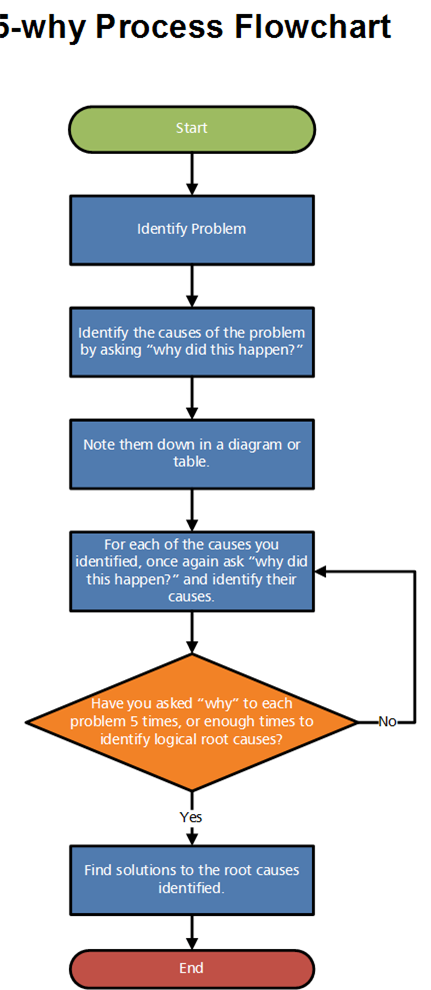
How to Complete the 5 Whys
Step 1. Form a Team
Here the team members who gathered should be the ones familiar with the details, affected by the problem, or noticed the problem.
After this, select a master for the meeting who will lead the discussion, ask the 5 whys, and assign responsibility for the solutions the group comes up with.
Step 2. Define the Problem
After observing the problem, write down a clear problem statement that is acceptable to all team members.
Step 3. Ask Why Five Times
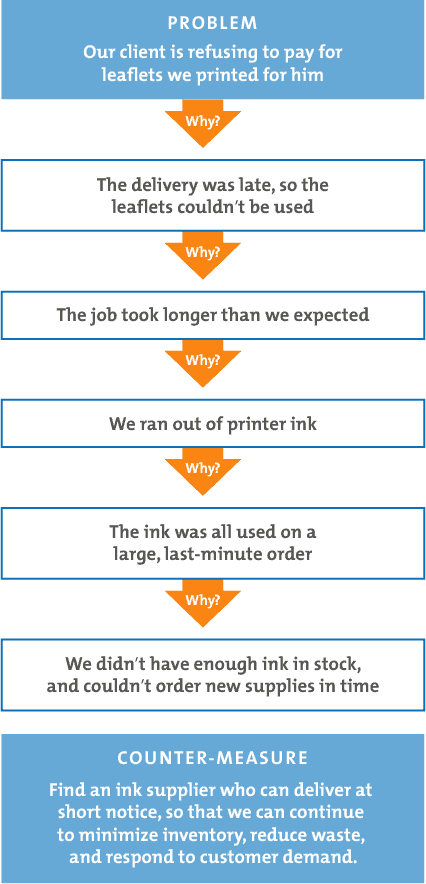
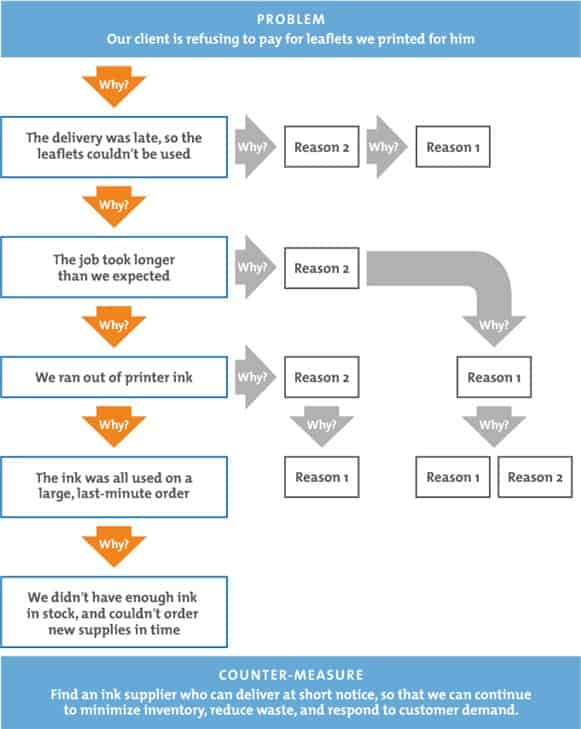
Answer at least five levels of “whys.” This seems to be easy, but sometimes it turns out to be the difficult part. The key part of this step is to start with the right question. The team can adapt two types of approaches in this step, such as single lane 5 Whys or multiple lane 5 Whys.
Single Lane Process
Multi-Lane Process
Step 4. Address the Root Cause and Assign Owners
After identifying the true root cause of the problem, the team needs to discuss and agree on the practical and the most effective countermeasures that fit their case to prevent the recurrence of the problem.
Step 5. Monitor the Countermeasures
Continue monitoring the countermeasures until the problem statement is eliminated effectively or completely. Repeat the steps of 5 Whys if necessary to ensure that you’ve identified the correct root cause.
5 Whys Example: Late Customer Shipments
Here is a simple 5 Whys example from a warehouse. The problem statement: orders shipped late to customers in the last two weeks of the quarter.
- Why were orders late? Pickers could not find stock for many orders on the first try.
- Why could they not find stock? The system showed items in bin locations that were empty.
- Why were the bin records wrong? Replenishment moves were not scanned when stock was put away.
- Why were put-away moves not scanned? Temporary staff hired for the quarter-end peak had no scanner login.
- Why did they have no login? The onboarding checklist for temporary staff does not include system access.
The fifth answer is a process gap you can fix: add scanner access to the temporary staff checklist. Notice that the first answer (pickers are slow) would have led to the wrong fix, such as adding more pickers. Check the chain by reading it backward with “therefore.” If each step still makes sense, the logic holds.
Jefferson Memorial Example
Limitations of the 5 Whys
5 whys will not help us analyze the root cause if the cause is unknown. We cannot reach the countermeasure if the person or team doing this type of analysis doesn’t know the problem or provide meaningful answers to the questions. Sometimes assumptions that we make in each step might not be the real underlying cause of the problem–there may be more causes to the problem. Also, the 5 Whys are clearly unable to differentiate between causal factors and root causes, and the lack of rigor where users aren’t required to test for sufficiency of the root causes generated by the method. The success of this method completely depends, to a degree, upon the skill with which the method is applied.
5 Whys make use of the countermeasures approach rather than giving priority to a solution approach. In countermeasure, which is a robust method, a set of actions are taken to prevent the reappearance of the root cause problem. Still, in the case of the solution approach, we have to give priority to symptoms by finding out the real solution for the root cause rather than preventing it from recurring.
In industries such as nuclear, health care, aviation, and aerospace, the 5 Whys are inadequate for problem-solving and need more advanced root cause analysis techniques.
5 Whys vs Fishbone Diagram
The 5 Whys follows one chain of cause and effect. A fishbone (Ishikawa) diagram spreads out to list many possible causes across categories such as the 6Ms. Many teams use both. Brainstorm on the fishbone first, then run the 5 Whys on the two or three causes the data supports. For complex failures with several causes acting together, fault tree analysis is a better fit.
Additional Videos
Studying for one of these exams? Get the free 7-day exam bootcamp.
One short email a day: what's really on your exam, how to study the highest-weight topics first, and how students who passed did it.
You'll also get my weekly Six Sigma newsletter. Unsubscribe anytime.
When you’re ready, there are a few ways I can help:
First, join 12,000+ other Six Sigma professionals by subscribing to my email newsletter. A short read every Monday to start your work week off correctly. Always free.
* * *
If you’re looking to pass your Six Sigma Green Belt or Black Belt exams, I’d recommend starting with my affordable study guide:
1)→ 🟢Pass Your Six Sigma Green Belt: a study guide organized by the exam Body of Knowledge, 1,000+ practice questions with detailed answer explanations, and 8 full-length mock exams
2)→ ⚫Pass Your Six Sigma Black Belt: the full Black Belt Body of Knowledge, 2,000+ practice questions with detailed answer explanations, and 8 full-length mock exams
You’ve spent so much effort learning Lean Six Sigma. Why leave passing your certification exam up to chance? This comprehensive study guide offers 1,000+ exam-like questions for Green Belts (2,000+ for Black Belts) with full answer walkthroughs, access to instructors, detailed study material, and more.
Thousands have used this system to prepare. Join them here.
Is this on your exam? Try 2 practice questions.
Real questions from the Six Sigma Study Guide question bank, with the full explanation.
Question 1. What is the main objective of the 5 Whys or Why-Why technique?
Question 2. To identify the root cause of a problem using the 5 Why method, how many times do we need to ask “Why”?
Want the full question bank, organized by exam topic, with an explanation for every answer? See the Green Belt study guide.

Comments (4)
I’m from DC and never knew that story
It’s a neat one, right?
how to identify Non Conformity or how to work NC with root causes and corrective action ?
Good question. Nonconformity work usually runs in four steps:
1. Identify and contain it. A nonconformity is anything that doesn’t meet a requirement: a spec, a drawing, a procedure, a customer requirement. Record what was found, where, and how much, then contain it (segregate, hold, or sort the suspect product) so it can’t reach the customer while you investigate.
2. Find the root cause. Define the problem with data first, then dig in with the 5 Whys described here, a fishbone diagram, or both. Keep asking until you reach a cause you can actually control, usually a process or system gap, not “operator error.”
3. Take corrective action that removes that cause, not just the symptom. Then verify it worked by checking the data afterward, not just the paperwork.
4. Lock it in. Update the procedure, control plan or training so it can’t come back.
The 8D method is a good structure for the whole sequence, and the Root Cause Analysis guide covers the tools in more depth.