

Monday is chaos. Friday is quiet. One week the line runs flat out on product A, the next it’s all product B, and the parts suppliers can never keep up. Uneven schedules create waste everywhere: overtime, idle time, big inventories, rushed quality. Heijunka production leveling is the Lean answer. You smooth both the volume and the mix of work over a short period, so every day looks much like the next. ASQ lists heijunka at Black Belt under cycle-time reduction, next to continuous flow and SMED.
What is heijunka production leveling?
Heijunka (平準化) is a Japanese term usually translated as “leveling.” It’s one of the foundations of the Toyota Production System.
It has two parts:
- Volume leveling. Produce the same total quantity each day (or shift), based on average demand, instead of chasing daily swings.
- Mix leveling. Within that quantity, produce each product in small, repeating amounts, instead of long batches of one product.
The goal is a steady, predictable pattern of work that upstream processes and suppliers can match.
Why uneven production causes waste
Toyota describes three related problems, often called the 3 Ms:
- Muda: waste, such as waiting, inventory and rework.
- Mura: unevenness in volume or mix.
- Muri: overburden on people or equipment.
Mura is the trigger. An uneven schedule overloads people on busy days (muri) and leaves them idle on slow days (muda). It also forces upstream steps to hold large stocks “just in case.” Heijunka attacks mura directly, which reduces the other two.
Batching vs. leveled production
Picture a line making three products in a five-day week.
Batched schedule:
- Monday and Tuesday: product A only
- Wednesday and Thursday: product B only
- Friday: product C only
Simple to plan. But a customer who wants product A on Thursday waits until next Monday or gets it from finished goods stock. Suppliers of A’s parts see huge demand twice a week and nothing in between.
Leveled schedule: every day, some A, some B and some C, in a repeating sequence. Each product’s parts are consumed evenly. Finished goods stock can shrink, because each product is made every day.
Worked example: leveling a three-product line
Say a small appliance plant assembles three toaster models on one line (illustrative numbers). Weekly demand averages:
- Model A: 1,000 units
- Model B: 500 units
- Model C: 500 units
- Total: 2,000 units per week, 5 days
Step 1: level the volume. 2,000 / 5 = 400 units per day.
Step 2: level the mix. Daily: 200 A, 100 B, 100 C. The ratio is 2 : 1 : 1.
The leveled sequence spreads the high-volume model as evenly as it can:
A, B, A, C
Repeat it 100 times a day. Each product now flows to packing, and each product’s parts are pulled from stores, at a steady rate all day.
Step 3: check against takt time. Available time per day: 1 shift of 480 minutes, less breaks, say 450 minutes = 27,000 seconds. Takt time = 27,000 / 400 = 67.5 seconds per unit.
The line must produce one toaster about every 67.5 seconds, regardless of model. If model A takes much longer to build than C, the sequence A, B, A, C keeps the work content from bunching up. A, A, B, C has the same ratio but stacks the two A’s together, which is what leveling the mix is meant to avoid. A batched day of 200 A’s in a row could overload stations that do A-specific work. See improving cycle time for more on takt.
Step 4: set the pitch. Toasters move to shipping in cartons of 10. Pitch = takt × pack size = 67.5 × 10 = 675 seconds, or 11.25 minutes.
Every 11.25 minutes, a new kanban card for one carton goes to the line, and a finished carton is collected.
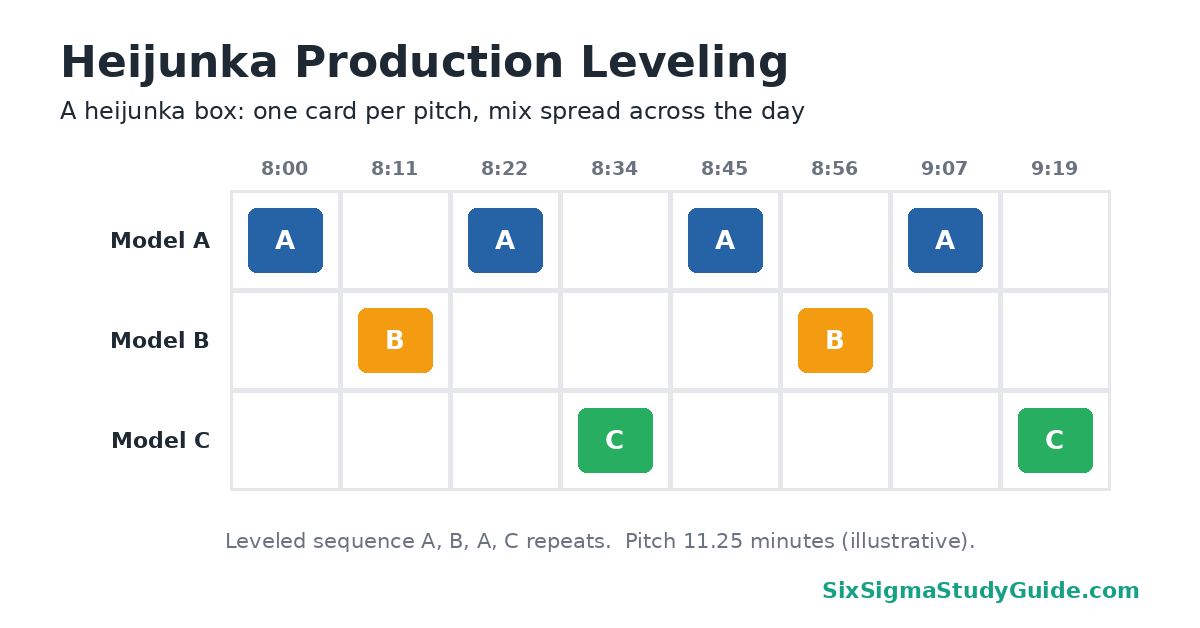
The heijunka box
A heijunka box (leveling box) is the visual tool that runs this schedule. It’s a grid on the wall.
- Rows: one per product (A, B, C).
- Columns: one per pitch interval (for example, 8:00, 8:11, 8:22…).
- Slots: each holds a kanban card authorizing one pitch’s worth of a product.
A material handler collects the cards from the next column at each pitch interval and takes them to the line. If a column’s cards aren’t finished by the next collection, everyone can see the line is behind. The box makes the schedule, the pace and any problem visible at a glance.
Our kanban and visual factory pages cover the card systems and visual controls that support it.
What leveling requires
Heijunka doesn’t work on its own. It needs:
- Short changeovers. If switching from A to B takes an hour, you can’t switch four times an hour. SMED work usually comes first.
- Stable processes. Frequent breakdowns or quality problems break the rhythm. Maintenance and reliability work (TPM) supports this, and Lean metrics show whether it’s working.
- Some finished goods buffer. Real orders don’t arrive perfectly level. A small stock absorbs daily swings while the schedule stays level.
- Standard work. Operators need clear methods for each model. See standard work.
A primary care clinic
Heijunka isn’t only for factories. A clinic books long appointments (40 minutes, new patients) in the morning and short appointments (10 minutes, follow-ups) in the afternoon. Mornings overrun. Afternoons have gaps. Lab and nursing support is swamped at certain hours.
A leveled schedule mixes appointment types through the day in a repeating pattern, for example: one long, two short, one long, two short. The total doctor time per hour stays roughly the same. Nurses and the lab see a steady flow. Waiting room crowding drops.
The clinic also levels volume across the week. Instead of booking Monday full and Friday light, it holds a share of slots each day for same-day demand, which tends to spike on Mondays.
Heijunka and pull
Leveling and pull work together. Pull says produce only what’s consumed downstream. Leveling makes that consumption steady. Without leveling, a pull system passes demand spikes straight back to suppliers, who then hold large stocks to cope. With leveling, the pull signal is smooth, and every step can work with small, predictable stocks.
Starting small
You don’t have to level a whole plant at once. A practical first step:
- Pick one line or cell with a few high-volume products.
- Calculate average daily demand for each over the last few months.
- Cut changeover time on that line until switching several times a day is realistic.
- Move from weekly batches to daily batches of each product. That’s partial leveling, and it already shrinks stock.
- Then move from daily batches toward a repeating mixed sequence.
Each step is a measurable gain on its own. Track finished goods inventory and on-time delivery before and after.
Common problems
- Sales promotions that create spikes. Leveling works best when sales and production plan together.
- Long changeovers left unfixed. Teams try to level the mix and give up when changeovers eat the day.
- Leveling to forecast instead of actual average demand. Re-check the averages regularly.
- Box ignored. If people bypass the heijunka box to “rush” a hot order, the schedule falls apart. Agree a rule for genuine emergencies.
On the exam: heijunka production leveling
At Black Belt, expect:
- Definition. Heijunka levels both volume and product mix over time.
- Purpose. Reduce mura (unevenness), which drives muda and muri.
- Mixed-model sequence. Given demand ratios, pick the leveled sequence (for 2:1:1, A B A C, with the high-volume model spread out).
- Heijunka box. A visual scheduling tool using kanban cards in pitch-interval slots.
- Prerequisites. Short changeovers and stable processes.
A common trap is an option that describes heijunka as producing the largest batch possible to reduce changeovers. That’s the opposite of leveling.
When you’re ready, there are a few ways I can help:
First, join 12,000+ other Six Sigma professionals by subscribing to my email newsletter. A short read every Monday to start your work week off correctly. Always free.
* * *
If you’re looking to pass your Six Sigma Yellow Belt, Green Belt or Black Belt exam, I’d recommend starting with my affordable study guide:
1)→ 🟡Pass Your Six Sigma Yellow Belt: built for ASQ, IASSC and ILSSI, 1,700+ practice questions with explanations, and six full-length mock exams for your exam
2)→ 🟢Pass Your Six Sigma Green Belt: a study guide organized by the exam Body of Knowledge, 1,300+ practice questions with detailed answer explanations, and 20 full-length mock exams
3)→ ⚫Pass Your Six Sigma Black Belt: the full Black Belt Body of Knowledge, 2,200+ practice questions with detailed answer explanations, and 20 full-length mock exams
You’ve spent so much effort learning Lean Six Sigma. Why leave passing your certification exam up to chance? This comprehensive study guide offers 1,700+ exam-like questions for Yellow Belts, 1,300+ for Green Belts and 2,200+ for Black Belts with full answer walkthroughs, access to instructors, detailed study material, and more.
Thousands have used this system to prepare. Join them here.