

When I ask readers what would help them most, one answer keeps coming back in different words: real examples. Show me how this works outside the exam.
So here’s a new Friday series. Friday Kaizen takes one Lean Six Sigma idea each week, shows it working on something real (usually this site), and ends with a way to use it in your own job.
The idea
Kaizen means continuous improvement: small changes, made often, by the people closest to the work. It isn’t a big launch or a reorganization. It’s the habit of leaving something a little better than you found it, then doing that again tomorrow.
The exam tests whether you can define it. The job tests whether you actually do it.
What we did
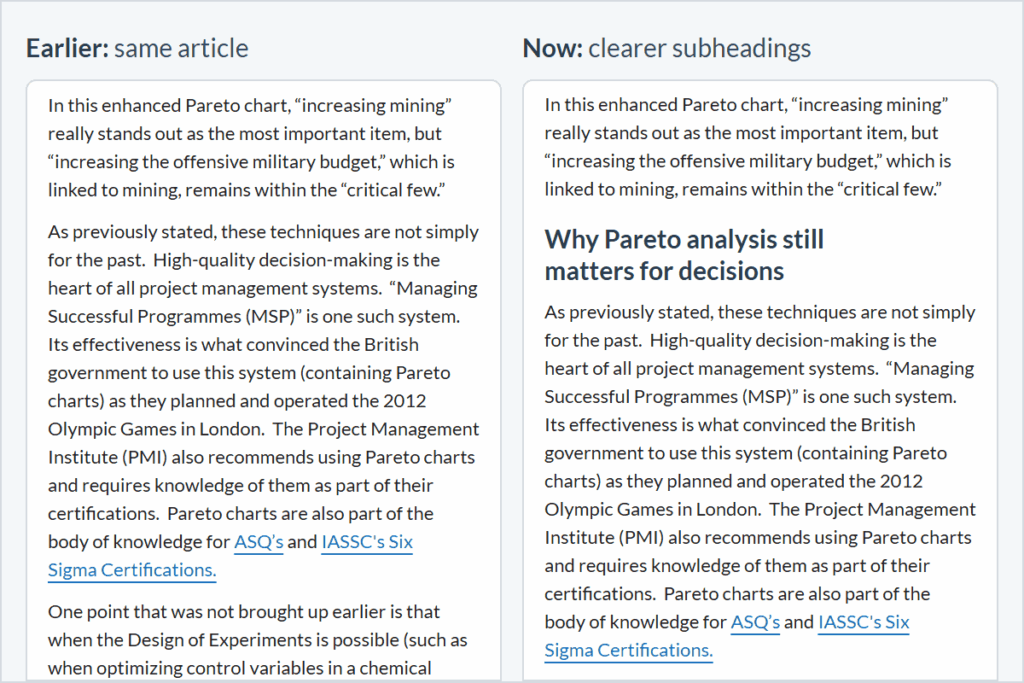
Over two weeks, from late September into October, we worked through 140 articles on the site, a few at a time. No rewrites. Shorter sentences, clearer subheadings, consistent punctuation and phrasing from page to page. The picture above shows one of them, our article on the Pareto principle: the same words, now with subheadings you can scan. Each edit took minutes. Together, they make the site easier to read for anyone studying on a phone at lunch or after a long shift.
For members: clearer answer explanations
We did the same with the practice questions. About 1,400 answer explanations now read more clearly and follow one consistent style, so you spend your study time on the concept, not on decoding the explanation. Here’s one from the Black Belt process capability questions.
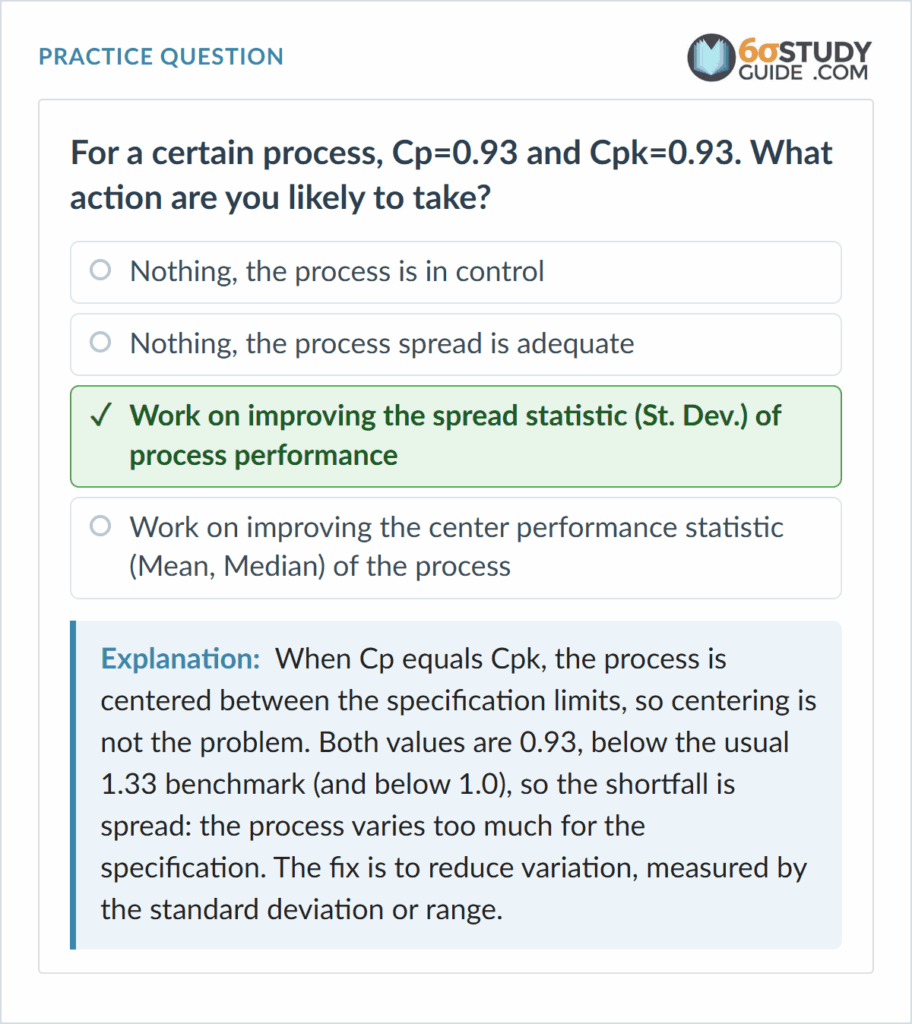
If you’re a member, these are already in your practice quizzes.
None of that was one big project. It was the same small step, repeated.
Try kaizen at work this week
Pick one document your team uses every week: a work instruction, a checklist, a handoff email template, a report everyone reads.
- Read it as if you were new to the job.
- Fix three small things that slow a reader down: a vague step, a term used two different ways, a missing “why”.
- Write down what you changed and tell the people who use it.
- Next week, do it again.
Three small fixes a week is about 150 a year, on the documents your team actually uses. That’s kaizen at work. It also makes a better story in an interview or a performance review than “I took a course.”
Leave a comment and tell me which document you picked. I read these, and the good examples might show up in a future Friday Kaizen (only with your permission).
Best, Ted.
“This really helped me to test myself and practice more based on the area where I lack, studied the concepts again and again till I got confident to go for an exam and cleared the exam successfully.”
Manikandan N., LinkedIn Recommendation
When you’re ready, there are a few ways I can help:
First, join 12,000+ other Six Sigma professionals by subscribing to my email newsletter. A short read every Monday to start your work week off correctly. Always free.
* * *
If you’re looking to pass your Six Sigma Green Belt or Black Belt exams, I’d recommend starting with my affordable study guide:
1)→ 🟢Pass Your Six Sigma Green Belt: a study guide organized by the exam Body of Knowledge, 1,000+ practice questions with detailed answer explanations, and 8 full-length mock exams
2)→ ⚫Pass Your Six Sigma Black Belt: the full Black Belt Body of Knowledge, 2,000+ practice questions with detailed answer explanations, and 8 full-length mock exams
You’ve spent so much effort learning Lean Six Sigma. Why leave passing your certification exam up to chance? This comprehensive study guide offers 1,000+ exam-like questions for Green Belts (2,000+ for Black Belts) with full answer walkthroughs, access to instructors, detailed study material, and more.
Thousands have used this system to prepare. Join them here.