

Most people meet Lean through its tools: 5S, kanban, value stream maps. The tools make more sense once you know the thinking behind them. That thinking fits in five steps. James Womack and Daniel Jones set out the five lean principles in their 1996 book Lean Thinking, drawing on the Toyota Production System. ASQ’s Green Belt BOK names flow and perfection among the Lean concepts you have to apply, and perfection is the one candidates most often can’t explain.
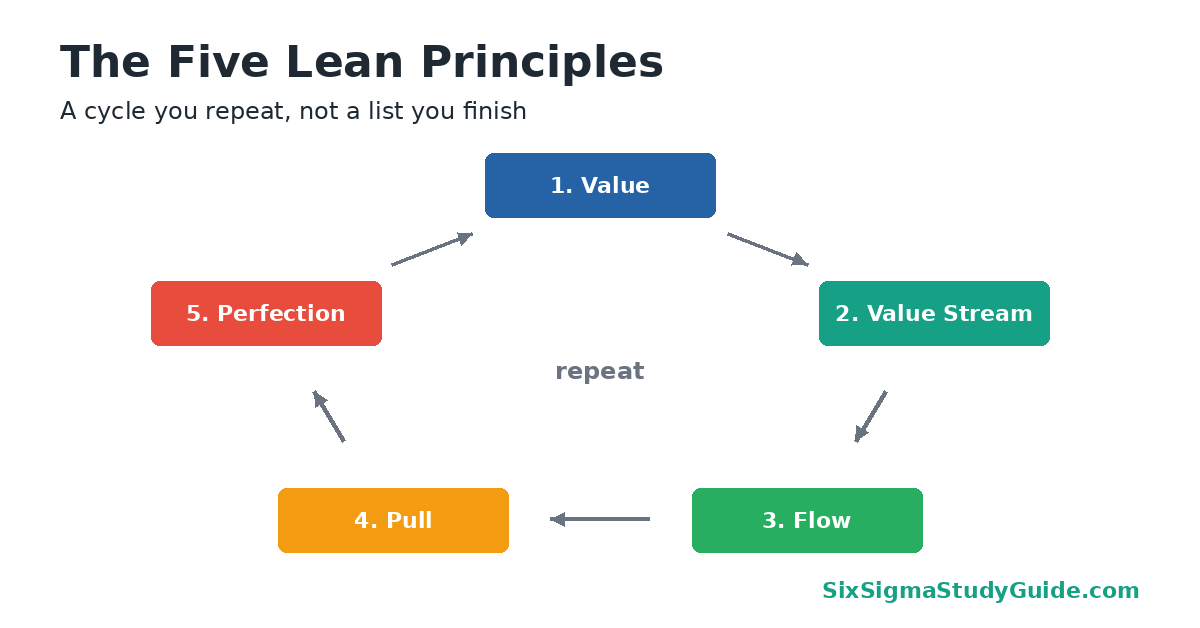
The five lean principles at a glance
- Value. Define value from the customer’s point of view.
- Value stream. Map every step that delivers that value, and find the waste.
- Flow. Make the value-creating steps move without interruption.
- Pull. Let customer demand trigger the work, rather than forecasts.
- Perfection. Repeat the cycle, removing waste continuously.
They’re a sequence. Each one builds on the one before.
1. Value
Value is what the customer is willing to pay for. That can differ a lot from what the organization finds impressive or easy to make.
A useful test for any activity: would the customer pay for this step if they saw it? Machining a part to shape, yes. Moving it to a warehouse and back, no.
This principle sets everything else up. If you misread value, you’ll make a very efficient process that delivers the wrong thing. Our voice of the customer guide covers how to find out what customers value.
2. Value stream
The value stream is every action, value-adding or not, needed to bring a product or service from request to delivery.
Mapping it sorts activities into three groups:
- Value-added: the customer would pay for it.
- Non-value-added but necessary: no direct value, but required for now. Regulatory checks, some inspections.
- Pure waste: no value and not needed. Waiting, rework, extra handling.
The usual finding is humbling. In many processes, value-added time is a small fraction of total lead time. The rest is waiting and movement. See value stream mapping and Lean overview.
3. Flow
Once waste is removed, make the remaining steps flow. Work should move from one value-adding step to the next without stopping in queues, batches or departments.
Flow usually means:
- smaller batches, ideally one piece at a time
- steps placed next to each other
- balanced workloads so no step starves or floods the next
- fewer handoffs between departments
Batch-and-queue thinking feels efficient to each department. It’s slow for the customer. Flow reverses the focus.
4. Pull
In a pull system, nothing is made until the downstream customer signals a need. In a push system, work is made to a forecast and pushed forward whether or not anyone is ready for it.
Pull limits overproduction, which Taiichi Ohno called the worst waste because it hides the others.
A sandwich shop that makes each order when the customer asks for it runs on pull. A shop that makes 50 sandwiches at 11 a.m. and keeps them under a heat lamp runs on push. The first has less waste and fresher food. The second risks throwing food away, or selling it tired.
Kanban is the classic way to run pull. See our kanban article.
5. Perfection
The fifth principle is the least concrete and the most important. After you define value, map the stream, create flow and establish pull, you start again. Each pass exposes waste that the last one hid.
Perfection is a direction to keep moving in. No process reaches zero waste, but every process can get closer.
In practice, pursuing perfection looks like:
- regular kaizen events and daily small improvements
- standard work that gets updated whenever someone finds a better way
- visible measures that show the gap between current and ideal
- people at every level trained and expected to spot and remove waste
Worked example: a hospital discharge process
Say a hospital ward has a problem (an illustrative case). Patients ready to go home often wait most of the day to leave. Beds aren’t free for new admissions, so the emergency department backs up.
Value. For the patient, value is going home safely, with clear instructions and the right medication, as soon as they’re medically ready. For the hospital, an early free bed has value too.
Value stream. The team maps the discharge process from “doctor says ready” to “patient leaves.” They find:
- the discharge decision is often made on the late-morning ward round
- pharmacy receives discharge prescriptions in a batch around midday
- transport is booked only after medication arrives
- the discharge summary waits in a queue for a junior doctor
The value-added work (writing the summary, preparing medication, explaining it to the patient) takes a small slice of the hours the patient waits.
Flow. The team changes the order of work:
- likely discharges are flagged the evening before
- prescriptions go to pharmacy as each decision is made, not in a midday batch
- transport is booked in parallel with medication preparation
- a discharge checklist runs alongside, so nothing is left for the end
Pull. Bed management signals each morning how many beds the emergency department will need. The ward uses that demand signal to prioritize which discharges to prepare first.
Perfection. The ward holds a short weekly review of every discharge that left after a target time. Each review finds one more cause: a missing form, a phone number that changed, a step two people thought the other did. The fixes go into the standard discharge process.
Over the following months, discharges move earlier in the day and stay there. The weekly review keeps finding smaller problems, which is a sign the principle is working.
Bicycle factory
A bicycle factory applies the same steps.
- Value: a correctly built, tested bike delivered on the promised date.
- Value stream: frames wait days between welding, painting and assembly.
- Flow: painting moves next to assembly, and batches shrink from 200 frames to 20.
- Pull: assembly builds to customer orders. Painting refills a small buffer only as assembly takes from it.
- Perfection: monthly kaizen events target the biggest remaining delay, each time a different one.
How the five lean principles connect to Six Sigma
Lean and Six Sigma attack different things. Lean targets waste and speed. Six Sigma targets variation and defects. The five principles fit inside DMAIC easily:
- Value links to Define and the voice of the customer.
- Value stream mapping is a Measure and Analyze tool.
- Flow and pull are common Improve solutions.
- Perfection is the spirit of Control and continuous improvement.
Our Lean Six Sigma page explains how the two methods combine.
On the exam: five lean principles
ASQ lists Lean concepts at Green Belt, with flow and perfection named. Expect:
- Order questions. Value, value stream, flow, pull, perfection.
- Definition questions. Value is defined by the customer.
- Push vs. pull. Pull means downstream demand triggers production.
- Perfection. It means continuous improvement through repeated cycles. It is not a one-time target or a zero-defect specification.
- Matching tools to principles. Value stream map for the value stream, kanban for pull, one-piece flow for flow, kaizen for perfection.
The trap with “perfection” is an answer that treats it as achieving zero defects. In Lean, perfection means the ongoing pursuit.
When you’re ready, there are a few ways I can help:
First, join 12,000+ other Six Sigma professionals by subscribing to my email newsletter. A short read every Monday to start your work week off correctly. Always free.
* * *
If you’re looking to pass your Six Sigma Yellow Belt, Green Belt or Black Belt exam, I’d recommend starting with my affordable study guide:
1)→ 🟡Pass Your Six Sigma Yellow Belt: built for ASQ, IASSC and ILSSI, 1,700+ practice questions with explanations, and six full-length mock exams for your exam
2)→ 🟢Pass Your Six Sigma Green Belt: a study guide organized by the exam Body of Knowledge, 1,300+ practice questions with detailed answer explanations, and 20 full-length mock exams
3)→ ⚫Pass Your Six Sigma Black Belt: the full Black Belt Body of Knowledge, 2,200+ practice questions with detailed answer explanations, and 20 full-length mock exams
You’ve spent so much effort learning Lean Six Sigma. Why leave passing your certification exam up to chance? This comprehensive study guide offers 1,700+ exam-like questions for Yellow Belts, 1,300+ for Green Belts and 2,200+ for Black Belts with full answer walkthroughs, access to instructors, detailed study material, and more.
Thousands have used this system to prepare. Join them here.