
I love helping people pass their Six Sigma certification exams. In February I received a note from Dan, who had recently passed his exam using Pass Your Six Sigma Green Belt.
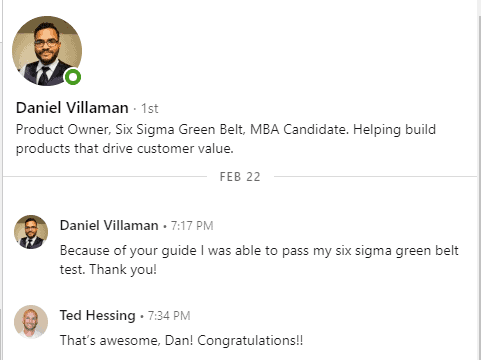
Dan was kind enough to follow over email and share a few of his best practices:
Learning
Of course it’s best to take Six Sigma training, but if you’re short on time, Dan has a specific recommendation:
For the ASQ greenbelt, if the person has limited time to study I would recommend spending more time learning concepts than learning how to work through complicated problems.
Dan Villaman, (via LinkedIn)
Prioritize Your Study Time
After learning basics, Dan focused on the equations;
Instead of going deep into each control chart or test I would learn when it needs to be used, and then simple equations to get UCL and LCL.
Dan V
There are several ways to prioritize your study. My favorite is to take a baseline exam, pick the topics you score the worst in, and bring those areas up to be strengths.
Test Taking Strategy
Everyone has their own test taking strategy. The important thing is to practice enough simulated exams so that you can hone and develop your own.
(The) Only reason I was able to finish on time was by skipping every questions that I didn’t automatically know and then going back and answering them after I had gotten all the easy ones.
Dan V
This “skip and return” approach is one of the most consistently recommended test-taking strategies among students who pass on their first attempt, and there’s a practical reason it works: a question you’re unsure of doesn’t get easier by staring at it longer under time pressure, but a question later in the exam might actually jog your memory on an earlier one you skipped. It also protects you from the worst outcome, running out of time with easy points left unanswered because you got stuck on one hard question early on.
Why Concepts Before Calculations
Dan’s advice to prioritize concepts over complicated problem-solving is worth unpacking, since it can sound counterintuitive for a famously math-heavy exam. The reasoning holds up: a multiple- choice exam rewards recognizing the right tool and the right conceptual relationship far more often than it rewards grinding through a multi-step calculation by hand. If you understand when to use a hypothesis test versus a control chart, and why, you can often eliminate two or three wrong answers before doing any math at all. Deep calculation fluency matters too, but it’s the second priority when study time is genuinely limited, not the first.
One More Thing Worth Adding
Dan’s path also illustrates something easy to overlook: he didn’t try to reinvent his own study method from scratch. He borrowed a baseline-test-then-target-weak-areas approach that’s proven to work for many students before him, applied it to his own situation, and adjusted his test-taking pace based on what he learned about himself along the way. That combination, a known-good method plus honest self-assessment, shows up again and again in the successful student stories on this site, far more reliably than any one specific study trick does on its own.
The Common Thread
What’s notable across Dan’s tips, and most of the other student success stories on this site, is how little they rely on raw intelligence or natural talent. Concepts before complicated problems, a baseline test to find weak spots, a deliberate pacing strategy, these are all learnable habits, not fixed traits. If you’re reading this while studying, the actionable version is simple: take a practice exam now, before you’ve studied everything, specifically to find out which sections need the most work, rather than studying everything equally and hoping it’s enough.
Questions Other Students Ask About Dan’s Approach
Does the skip-and-return strategy work on a computer-based exam, or only paper? Yes. Every major proctoring platform used for ASQ and IASSC exams lets you flag a question and jump back to it later, the digital equivalent of circling a question on paper. Learn the flag function in whatever practice environment you use beforehand, so it’s second nature on exam day instead of something you’re figuring out under time pressure.
Does “concepts before calculations” apply to IASSC and Villanova exams too, not just ASQ? The underlying logic holds for any multiple-choice Six Sigma exam, regardless of certifying body: recognizing which tool applies to a scenario is tested far more often than deep manual calculation. The specific topics and question style vary by body, but the study-time tradeoff Dan describes does not.
How do I find my weak areas if I haven’t studied anything yet? Take a baseline practice exam before you’ve reviewed the material in depth. It will feel uncomfortable, you’re expected to guess on plenty of questions, but the pattern of what you got wrong is the whole point. That pattern becomes your study plan instead of working through every topic in the book equally.
Follow in Dan’s Footsteps
If this resonates with you, perhaps you’d like to also join Pass Your Six Sigma Green Belt.
If you have your own exam story, pass or fail, send it over. These write-ups exist because students like Dan took a few minutes to share what actually worked, and that’s still the best source of material for the next person studying the same material. Congratulations again, Dan, and thank you for taking the time to write back. If you’re still studying, take what fits your situation from his approach and leave the rest, every exam journey looks a little different.
