

The Pugh Analysis Matrix is an analysis tool that results in an optimal concept. You refine a list of ideas by using a matrix-based process to weight and compare the conceptual designs.
- Similar to pro vs cons
- Evaluate multiple options vs a baseline
- Use a matrix to address multiple factors.
The Pugh matrix was developed by Stuart Pugh, head of the design division and a professor at the University of Strathclyde in Glasgow. It goes by many names: the Pugh method, decision matrix method, decision grid, selection matrix, problem selection matrix, criteria rating form, and opportunity analysis, among others.
Used for decision making, this matrix helps you select the most viable option from a list of alternatives. First, you determine the most important criteria for the decision. Then you score each alternative against those criteria and pick the best one. Individuals and teams both use this method, though teams tend to get more value from it.
One useful variation for team decision-making: each person creates their own Pugh matrix first, then the team compares results together. Most often, a Pugh matrix helps you evaluate several alternatives to pick the best one. However, it also works when only one solution exists and you need to optimize it, or when none of the available alternatives are good enough on their own.
The Pugh Matrix can then be used to choose specific aspects of the all the alternatives and then combine them to make the most feasible product. The end product will be better than the product made initially.
How to Create a Pugh Analysis Matrix
Step 1: Create a chart of Criteria (y axis) vs Concepts (x axis)
Step 2: Pick one concept and rate it across all criteria.
Step 3: fill out the rest of the chart with a (Same, +, or -). This is done relative to the one we entered data for.
Step 4: Sum the + and – s. Come up with a net score. Ex. +4 or -1 or 0.
Step 5: Iterate across all concepts
Step 6: Merge the results to find the winner
Pugh Matrix Example
Let’s assume we have four alternatives: A, B, C, and D. We already have a system in place, but we want to know if any of these four alternatives would improve on it. First, we decide on the selection criteria, then pick the four most important ones and label them 1, 2, 3, and 4 (for example, price, hours of work, and so on). Now we draw the Pugh matrix: alternatives go across the top, and criteria go down the left side, as shown below:

The baseline is the system that we have in place at the moment. Since we are going to compare and judge everything with respect to this therefore we rate it 0.
Now let us consider option A. When it comes to criteria 1, do we consider that it is better, the same as, or worse than the baseline? If it’s better we give it a +1, if it’s the same we give it a 0, and if it’s worse we give it a -1. Let’s say it’s +1. We then treat criteria 2, 3, and 4 in the same way. The table now looks like this:
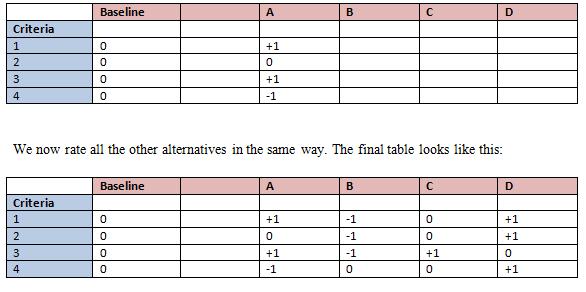
Now that we have all the all the alternative scores, we can select the one which has the highest positive score which in this case happens to be D.
Weighting: Sometimes we can also give alternatives a weight i.e. the importance they have in a specific project and then using this weight we can determine the best option.
Pugh Matrix Videos
Six Sigma Black Belt Certification Pugh Analysis Questions:
Question: Which of the following tools is appropriate to use with multiple criteria requiring a single option to be selected? (Taken from ASQ sample Black Belt exam.)
(A) Pugh matrix
(B) Kano model
(C) Hypothesis testing
(D) PDCA
Answer:
A: Pugh matrix allows you to use multiple criteria to decide on the best option. The Kano model is about customer delight (or lack there of.) Hypothesis testing is a statistical validation (or not). PDCA stands for plan-do-check-act and is more of a framework for achieving great business results rather than a tool.
Comments (2)
For some reason my coworker said Pew Matrix and knowing they had a six sigma background I was able to find this on the internet. There’s a typo in the 4th paragraph where you said “pew matrix”
Hah! Thanks! I’ve updated the text.
Really appreciate the note. Keep them coming!